
Cosmic symphony: Gravitational waves emitting sounds, turning universe into a 'choir'
The universe seems to be grooving to the low-pitch tunes of gravitational waves, according to compelling evidence assembled by astronomers.
- Science News
- 2 min read

;'%3e%3cpath%20d='m8,15.99c4.41,0,7.99-3.58,7.99-7.99S12.41,0,8,0,0,3.59,0,8s3.58,7.99,7.99,7.99Z'%20style='stroke:%23fff;%20stroke-miterlimit:10;%20stroke-width:.02px;'/%3e%3cpath%20d='m3.08,3.37l3.82,5.11-3.84,4.15h.87l3.37-3.64,2.72,3.64h2.94l-4.04-5.39,3.58-3.87h-.86l-3.1,3.35-2.5-3.35h-2.94Zm1.27.64h1.35l5.97,7.99h-1.35l-5.97-7.99Z'%20style='fill:%23fff;'/%3e%3c/g%3e%3c/svg%3e)


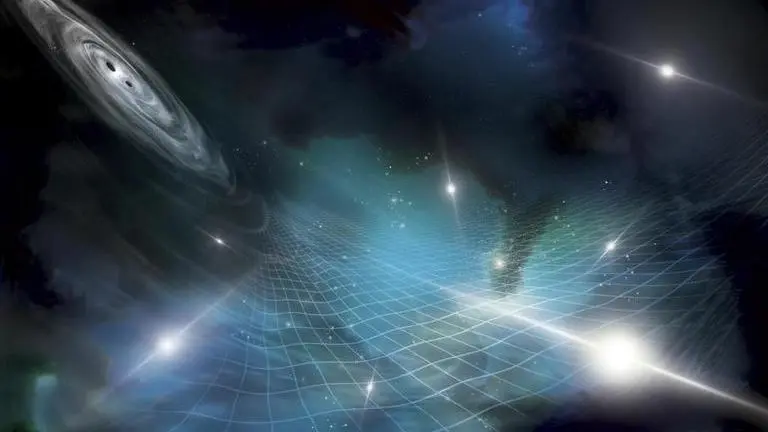
The universe seems to be grooving to the low-pitch tunes of gravitational waves, according to compelling evidence assembled by astronomers. Some like Xavier Siemens, a physicist at Oregon State University, have called the musical phenomena "a choir, or an orchestra,” while Chiara Mingarelli, an astrophysicist at Yale University, says that it all "sounds very sci-fi".
As per The New York Times, scientists believe that the gravitational waves that are reverberating across the universe are the amalgamation of echoes of thousands of supermassive black holes that are creating ripples in space. Siemens, a member of the North American Nanohertz Observatory for Gravitational Waves (NANOGrav), says that each pair of black holes is emitting a different note, “and what we’re receiving is the sum of all those signals at once.”
“The gravitational-wave background was always going to be the loudest, most obvious thing to find. This is really just the beginning of a whole new way to observe the universe," said Mingarelli, who is also a member of NANOGrav. According to her, the gravitational waves aren't only created by black holes, but by any object in space that spins.
Astonishing findings date back to 2016
“It sounds very sci-fi. But it’s for real," she added. While the findings are crucial in helping scientists unravel the mysteries of the cosmos, the waves were first recorded in 2016 by the Laser Interferometer Gravitational-Wave Observatory, or LIGO. Back then, the results corroborated Albert Einstein’s theory of general relativity, which elucidates how matter and energy distort space-time in order to create what we know as gravity.
Advertisement
What makes the recent study different from the one conducted seven years ago is that LIGO’s signals were mostly in the frequency range of a few hundred hertz. On the contrary, astronomers involved in the new research looked for the collective hum-like sounds at relatively lower frequencies, one-billionth of one hertz specifically.
Even at the lowest of frequencies, the hum was so loud that it "could be coming from hundreds of thousands, or possibly a million, overlapping signals from the cosmic merger history of supermassive black hole binaries,” Mingarelli concluded in the studies published in The Astrophysical Journal Letters.