
NASA's Lucy spacecraft captures glowing view of Trojan asteroids from 530 million kms
NASA's Lucy put its resolution imager to use to capture the first views of the asteroids it will soon visit, namely Eurybates, Polymele, Leucus, and Orus.
- Science News
- 2 min read

;'%3e%3cpath%20d='m8,15.99c4.41,0,7.99-3.58,7.99-7.99S12.41,0,8,0,0,3.59,0,8s3.58,7.99,7.99,7.99Z'%20style='stroke:%23fff;%20stroke-miterlimit:10;%20stroke-width:.02px;'/%3e%3cpath%20d='m3.08,3.37l3.82,5.11-3.84,4.15h.87l3.37-3.64,2.72,3.64h2.94l-4.04-5.39,3.58-3.87h-.86l-3.1,3.35-2.5-3.35h-2.94Zm1.27.64h1.35l5.97,7.99h-1.35l-5.97-7.99Z'%20style='fill:%23fff;'/%3e%3c/g%3e%3c/svg%3e)


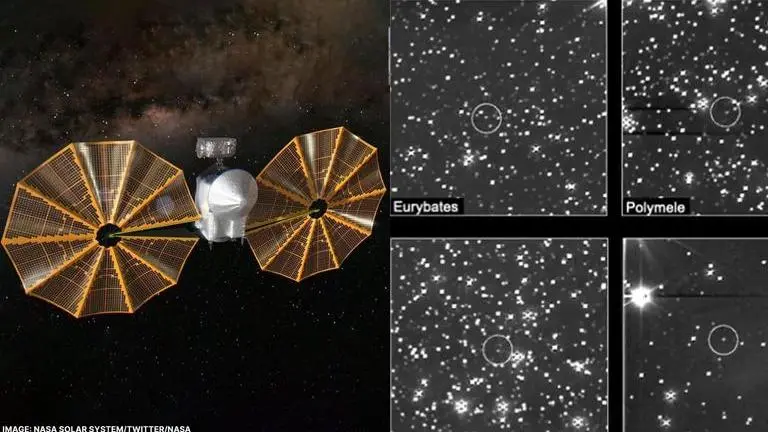
NASA's Lucy spacecraft put its highest resolution imager to use to capture the first views of the asteroids it will soon visit, namely Eurybates, Polymele, Leucus, and Orus. The Trojan asteroid targets lie some 330 million miles away from Lucy, but the mammoth distance did not stop the space probe from documenting them with its L’LORRI camera.
Sharing images on Twitter, NASA wrote: "We love Lucy! The @NASASolarSystem #LucyMission captured its first views of four of its Trojan asteroid targets, from 330 million miles (530 million kilometers) away. Set to fly by in 2027-2028, Lucy will be the first mission ever to visit them."
The cosmic snapshots were taken between March 25 and 27 this year, and the targets were observed for various time spans on the basis of their rotations. For Eurybates, the images were taken within 6.5 hours. Pictures of Polymele, Leucus, and Orus were clicked within 2.5 hours, 2 hours and 10 hours, respectively.
We love Lucy!
— NASA (@NASA) April 13, 2023
The @NASASolarSystem #LucyMission captured its first views of four of its Trojan asteroid targets, from 330 million miles (530 million kilometers) away. Set to fly by in 2027-2028, Lucy will be the first mission ever to visit them:https://t.co/P8gZGIkbkf pic.twitter.com/ImpBxACwDY
NASA's Lucy mission to commence in 2027
The images are part of a series of planned observations meant to study how Jupiter's Trojan asteroids reflect light at relatively higher angles than those measured from Earth. The new data allows NASA's Lucy team to select exposure times for the spacecraft's close-up observations.
Advertisement
The mission is set to kick off in 2027 and will consist of Lucy travelling through several asteroids of Jupiter that lead the planet in its orbit around the Sun. Last October, the spacecraft captured striking images of Earth from a distance of 890,000 miles before heading back to deep space.