
The Plastic Pen That Saved Apollo 11: How a Simple Felt-Tip Kept Neil Armstrong and Buzz Aldrin From Being Stranded on the Moon
A broken engine switch threatened to leave the first Moon walkers trapped on the lunar surface until an ordinary pen became the mission’s unexpected hero.
- Science News
- 4 min read

;'%3e%3cpath%20d='m8,15.99c4.41,0,7.99-3.58,7.99-7.99S12.41,0,8,0,0,3.59,0,8s3.58,7.99,7.99,7.99Z'%20style='stroke:%23fff;%20stroke-miterlimit:10;%20stroke-width:.02px;'/%3e%3cpath%20d='m3.08,3.37l3.82,5.11-3.84,4.15h.87l3.37-3.64,2.72,3.64h2.94l-4.04-5.39,3.58-3.87h-.86l-3.1,3.35-2.5-3.35h-2.94Zm1.27.64h1.35l5.97,7.99h-1.35l-5.97-7.99Z'%20style='fill:%23fff;'/%3e%3c/g%3e%3c/svg%3e)


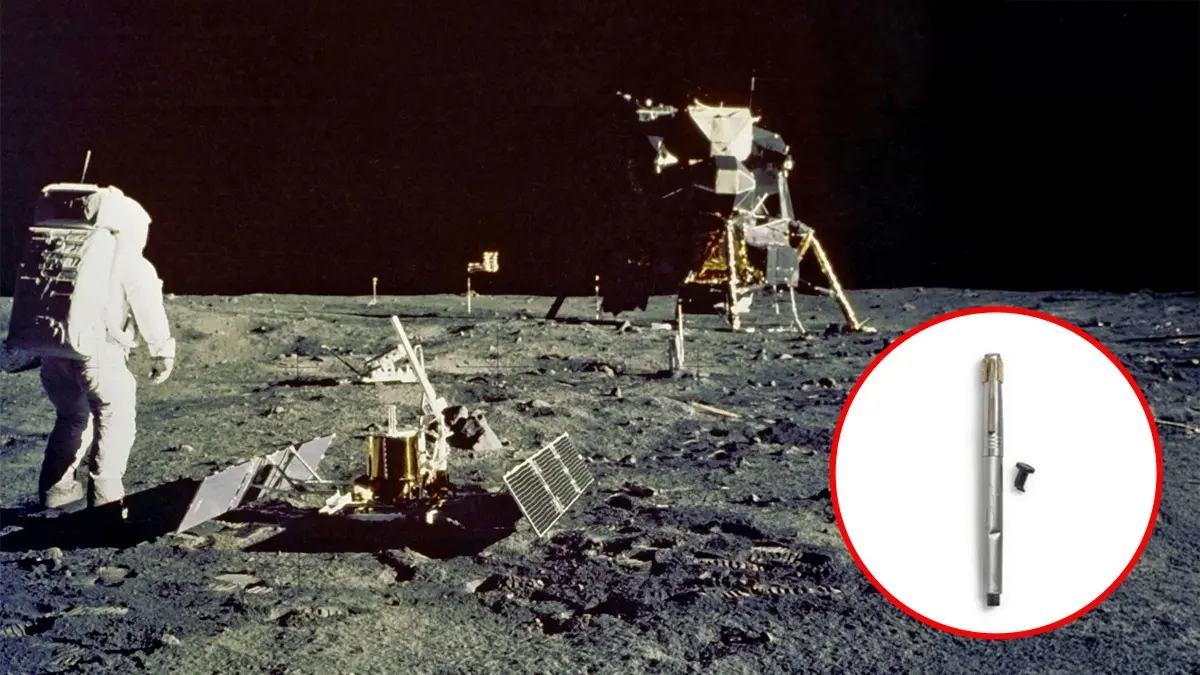
When Neil Armstrong took his first steps on the Moon on July 20, 1969, the world remembers his words about a small step and a giant leap. What far fewer people know is that hours later, the mission almost ended in disaster, not because of a rocket failure or a computer glitch, but because of a snapped piece of plastic no bigger than a fingernail.
A Broken Switch, A Mission at Risk
After finishing their historic walk on the lunar surface, Armstrong and Buzz Aldrin climbed back into the Lunar Module Eagle to rest before their scheduled return to orbit. It was then that Aldrin spotted something troubling on the cabin floor: a small black switch, the tip of the Engine Arm circuit breaker, had broken off.
That switch was not a minor component. It controlled the electrical circuit needed to fire the ascent engine, the only engine capable of lifting Eagle off the Moon and reuniting Armstrong and Aldrin with Michael Collins, who was orbiting overhead in the Command Module Columbia. Without it, there was no backup, and no way home.
Aldrin later described the moment in his memoir, Magnificent Desolation, writing that his heart skipped when he realized what the damage meant for their chances of leaving the Moon.
Advertisement
The Unlikely Fix
With no way to reconnect the switch by conventional means, and with a metal object risking a dangerous short circuit, Aldrin reached for the only insulated tool within arm's reach: a black felt-tip pen from his personal kit. Its non-conductive tip made it safe to press into the broken breaker mechanism, restoring just enough of a connection to arm the ascent engine.
The engine ignited without issue, and Eagle lifted off the lunar surface as planned, allowing the crew to dock safely with Collins and begin their journey home.
Advertisement
A Modest Pen With an Extraordinary Past
The instrument responsible for this improvised fix was nothing special by design: a brushed aluminum Duro "Rocket" felt-tip pen, roughly five and a half inches long, with a strip of Velcro on its cap so it could be stuck to spacecraft walls in zero gravity. For decades afterward, it sat largely out of public view, occasionally lent out for exhibition, including stints at the Seattle Museum of Flight and the Smithsonian's National Air and Space Museum as part of a traveling Apollo anniversary exhibit.
Aldrin later wrote in a letter accompanying the artifacts that the improvised fix kept the crew from being permanently stranded on the Moon.
From NASA Hardware to Auction Block
Under a 2012 law confirming that Apollo-era astronauts retained legal ownership of personal mission mementos, Aldrin held onto both the pen and the broken switch as part of his private collection. An earlier attempt to sell the pair in 2022 fell through when bidding failed to meet the reserve price.
This time, the outcome was different. The pen sold for $857,600 at a Sotheby's auction in New York after competitive bidding among five interested buyers, with Sotheby's having estimated its value at between $800,000 and $1.2 million. The winning bid alone reached $670,000 before fees, with the final total reflecting Sotheby's buyer's premium, and the sale was conducted on behalf of the Buzz Aldrin Family Trust. The identity of the buyer was not disclosed beyond confirmation that they had participated by phone.
Notably, despite the dramatic story behind it, the sale did not rank among the ten highest prices ever paid for space memorabilia, a list topped by a Soviet-era spacecraft that sold for nearly $2.9 million in 2011.
Alongside the pen, bidders also received the broken circuit breaker itself, along with a signed letter in which Aldrin joked about who was actually responsible for snapping it off, writing that he believes Armstrong broke it while Armstrong maintained the opposite.
A Small Object, A Lasting Lesson
Apollo 11 remains one of the defining achievements in the history of science and exploration, remembered chiefly for its engineering triumphs. Yet one of its most enduring stories has nothing to do with rocket science at all. It is a reminder that even history's grandest missions can hinge on split-second improvisation, and that an inexpensive pen, tucked into an astronaut's kit almost as an afterthought, ended up being the difference between a triumphant return and a mission gone catastrophically wrong.