
Telegram Loses Battle Against Centre, Delhi High Court Upholds Ban, Says Must Protect Integrity Of NEET Re-Exam
Delhi High Court upholds the government’s temporary ban on Telegram ahead of the NEET UG re-exam, dismissing the platform’s petition. Justice Tejas Karia ruled the suspension under Section 69A of the IT Act was legally justified to prevent exam leaks and safeguard public interest.
- Tech News
- 6 min read

;'%3e%3cpath%20d='m8,15.99c4.41,0,7.99-3.58,7.99-7.99S12.41,0,8,0,0,3.59,0,8s3.58,7.99,7.99,7.99Z'%20style='stroke:%23fff;%20stroke-miterlimit:10;%20stroke-width:.02px;'/%3e%3cpath%20d='m3.08,3.37l3.82,5.11-3.84,4.15h.87l3.37-3.64,2.72,3.64h2.94l-4.04-5.39,3.58-3.87h-.86l-3.1,3.35-2.5-3.35h-2.94Zm1.27.64h1.35l5.97,7.99h-1.35l-5.97-7.99Z'%20style='fill:%23fff;'/%3e%3c/g%3e%3c/svg%3e)


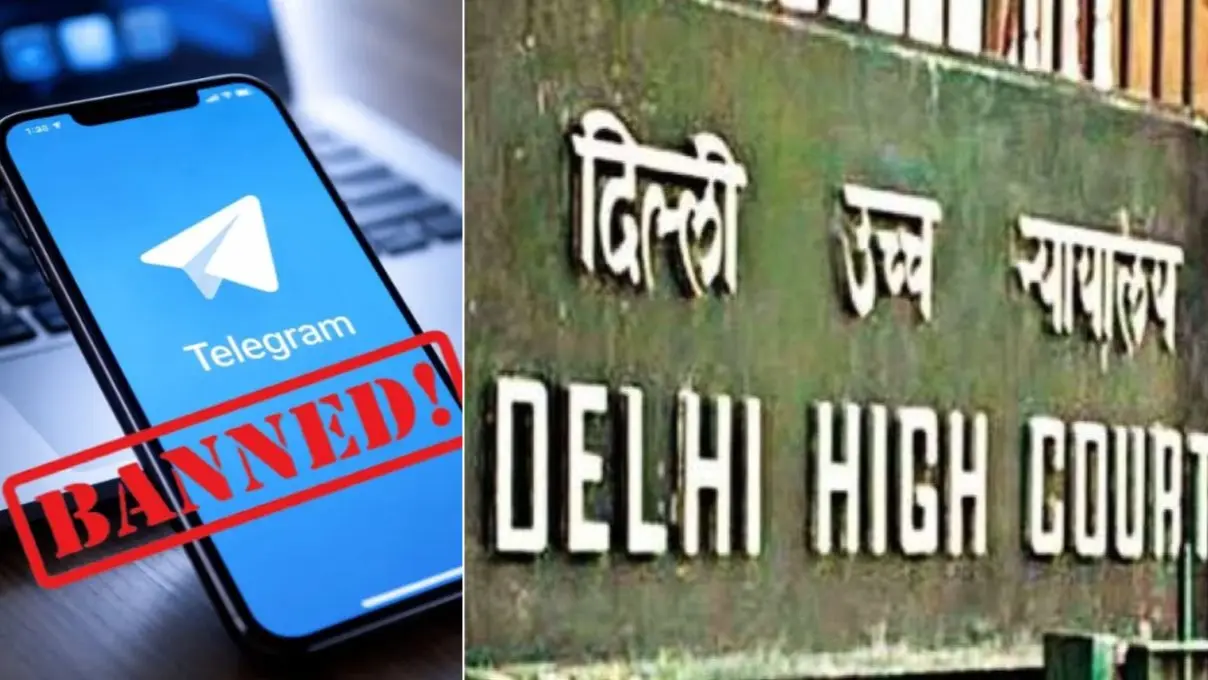
In a major legal setback for the instant messaging giant, the Delhi High Court on Friday officially dismissed a petition filed by Telegram FZ LLC challenging the Central Government's emergency directive to temporarily suspend its operations across India. Justice Tejas Karia pronounced the highly anticipated judgment, ruling that the government's restrictive actions were wellfounded, legally sound, and executed in complete compliance with Section 69A of the Information Technology IT Act, 2000.
The court emphatically rejected Telegram's contentions that the platformwide blockade was arbitrary or disproportionate, asserting that the emergency nature of safeguarding a nationwide competitive examination involving lakhs of students justified immediate executive intervention. The government's measures are least restrictive. It cannot be held that the order is disproportionate, Justice Karia observed while validating the ban.
Court Observations on Telegram Ban
In its detailed ruling, the Delhi High Court emphasised that the government’s emergency directive blocking Telegram was legally sound and proportionate under Section 69A of the IT Act. Justice Tejas Karia noted that the orders were well‑reasoned, supported by sufficient grounds, and did not suffer from non‑application of mind. The court rejected Telegram’s contention regarding non‑supply of reasons, clarified that the IT Act does not exclude platforms from the ambit of “information,” and concluded that the government’s measures were the least restrictive means available. Ultimately, the challenge was dismissed, with the court affirming that public interest outweighed platform rights.
The Core of the Controversy Safeguarding NEET UG Re-Exams
The legal battle unfolded immediately after the Ministry of Electronics and Information Technology MeitY, acting on critical recommendations from the Department of Higher Education and the National Testing Agency NTA, enforced a temporary block on Telegram. The absolute restriction is scheduled to remain in place until June 22, directly encompassing the highstakes National Eligibility-cum-Entrance Test Undergraduate NEETUG reexamination slated for June 21.
Advertisement
The original NEETUG exam, held earlier on May 3, faced cancellation and severe public scrutiny following extensive allegations of question paper leaks and operational malpractices. To ensure the retest remained secure, the government invoked its emergency powers. According to the NTA, the platformwide restriction became a necessary measure of last resort after coordinated localized efforts failed to contain the rapid proliferation of examination fraud, blackmarket paper sales, and organised cheating syndicates capitalising on the platform's unique infrastructure.
A New Dark Web Centre Flags Shocking Misuse
Representing the Union Government, Solicitor General Tushar Mehta presented an expansive defense backed by intelligence assessments from the Indian Cybercrime Coordination Centre I4C. The Centres affidavit described Telegram as morphing into a new dark web, citing its advanced privacy protocols and specialized architecture as preferred havens for a wide matrix of illegal activities. Beyond the immediate threat of leaked academic papers, the government highlighted the deepseated misuse of the platform for cyber fraud, drug trafficking, financial scams, child sexual abuse material CSAM, and the dissemination of extremist or terrorrelated content.
Advertisement
The Solicitor General argued that Telegram's specialised bot infrastructure allows malicious actors to seamlessly distribute automated, bulk communication with zero human oversight. Once a bot is blocked, it can instantly mirror the channel and automatically redirect users to an identical secondary node, Mehta told the bench. This algorithmic agility, paired with the platform's strict privacy policy that permanently wipes data once an account is deleted, severely handcuffed law enforcement agencies trying to trace individual bad actors in real time.
Furthermore, the Centre revealed that the platform had ignored multiple system correction warnings issued since May. Given these systemic flaws, the government argued that an outright temporary ban was a proportionate safeguard against widespread public unrest and academic subversion.
Telegram Cries Foul over Blanket Ban Affecting 150 Million Users
Appearing on behalf of Telegram, Senior Advocate Dhruv Mehta mounted a fierce counteroffensive, asserting that the blocking order was an egregious display of executive overreach that failed the constitutional test of proportionality. Telegram argued that under Rule 9 of the Information Technology Rules, the state is authorized to block specific, targeted items of information or individual unlawful URLs, rather than disabling access to an entire communications intermediary.
The platform's legal counsel stated that by shutting down the entire application, the government had thrown the baby out with the bathwater. The defense emphasised that the blanket suspension unfairly disrupted the digital lives of over 150 million legitimate Indian users who rely on the application for essential daily functions, including academic resources, where thousands of students and educators utilise the channel system to share legitimate study material, and commercial enterprise, where small businesses and digital entrepreneurs operate internal communication structures through the app.
Telegram also maintained that it had repeatedly cooperated with Indian authorities. The company pointed out that its automated AI and manual moderation teams had proactively permanently removed more than 900 links tied to illegal NEET material within hours of receiving official flags. Telegram CEO Pavel Durov also publicly criticized the directive on social media, claiming the ban simply punishes millions of ordinary citizens while failing to catch the true insiders responsible for the initial physical leaks.
The Judicial Ruling Public Interest Outweighs Platform Rights
Following intense back-and-forth arguments, Justice Tejas Karia firmly sided with the states' reasoning. The High Court established that the statutory definition of information under the IT Act contains no specific language excluding an entire application or intermediary from a blocking directive when its foundational features are actively impeding law enforcement.
The court observed that both the initial emergency blocking order and the subsequent confirmation by the highlevel Review Committee headed by the Cabinet Secretary were thoroughly reasoned, objective documents that demonstrated due application of mind. The judge concluded that because the ban is strictly finite lifting on June 22 and meticulously designed to target an imminent, critical vulnerability surrounding a massive national examination, it completely satisfies the legal standards of being the least restrictive means to preserve public order and educational sanctity.
Extended Curbs The Message Editing Lockout
In addition to upholding the general network block, the High Court's ruling confirms an auxiliary restriction mandated by the government the explicit disabling of Telegrams message editing feature within India until June 30.
The NTA had specifically requested this feature curb to combat an increasingly sophisticated digital fraud technique. Historically, malicious channel administrators would upload generic PDF files or messages prior to an exam. Once the actual exam concluded and the real question paper became public, the administrators would use the editing tool to swap the old PDF for the leaked paper. Because Telegram retains the original creation timestamp even after a post is altered, these groups could capture backdated screenshots to manufacture fraudulent after the evidence of a paper leak, generating massive student panic and black marketing opportunities.
With the Delhi High Court rejecting all pleas for an interim stay or permanent quashing, the comprehensive digital blackout remains absolute, cementing the Indian states aggressive stance on cyberintermediary accountability during national emergencies.