
From iPhone to $4 Trillion: The Tim Cook Era at Apple Ends
After spearheading Apple into a tech giant with a valuation of around $4 trillion, CEO Tim Cook will hand over his position after 15 years.
- Tech News
- 4 min read

;'%3e%3cpath%20d='m8,15.99c4.41,0,7.99-3.58,7.99-7.99S12.41,0,8,0,0,3.59,0,8s3.58,7.99,7.99,7.99Z'%20style='stroke:%23fff;%20stroke-miterlimit:10;%20stroke-width:.02px;'/%3e%3cpath%20d='m3.08,3.37l3.82,5.11-3.84,4.15h.87l3.37-3.64,2.72,3.64h2.94l-4.04-5.39,3.58-3.87h-.86l-3.1,3.35-2.5-3.35h-2.94Zm1.27.64h1.35l5.97,7.99h-1.35l-5.97-7.99Z'%20style='fill:%23fff;'/%3e%3c/g%3e%3c/svg%3e)


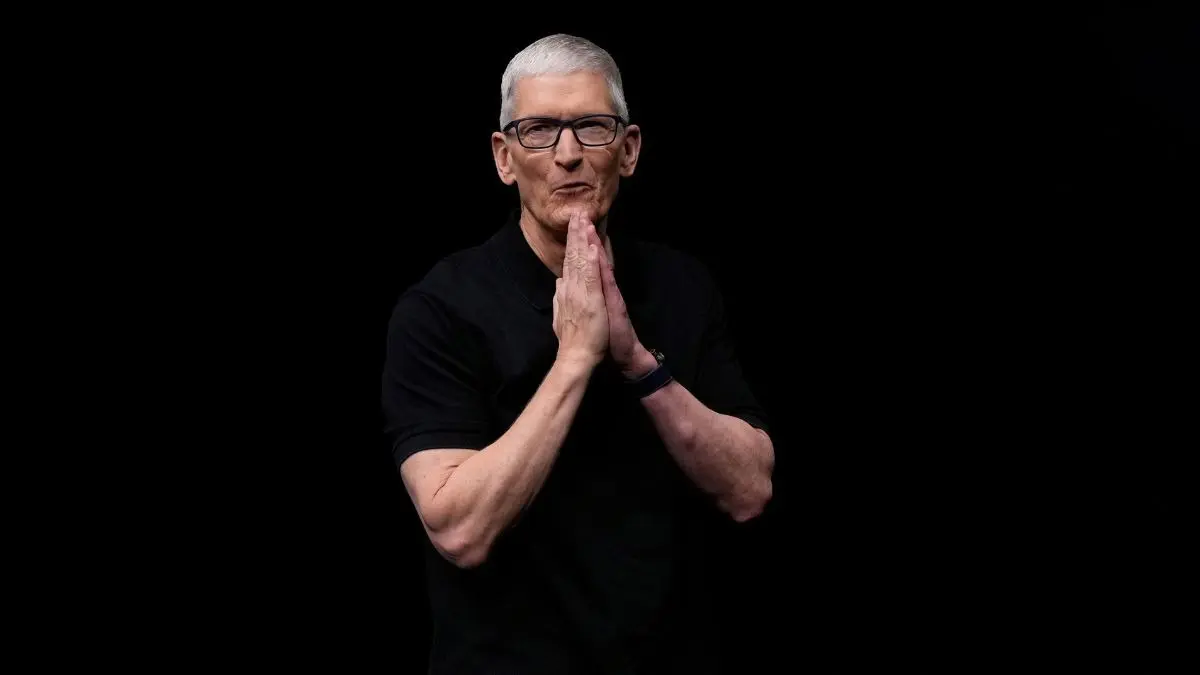
Tim Cook is stepping down as CEO of Apple on September 1, 2026, ending a 15-year run that quietly reshaped one of the most valuable companies in the world. He will move into the role of executive chairman, with John Ternus taking over as CEO.
When Cook took charge in 2011, Apple was worth about $350 billion. Today, it sits above $4 trillion. That kind of growth usually comes with a myth. In Cook’s case, it came with discipline.
He Took Over the Hardest Job in Tech
Replacing Steve Jobs was never supposed to work.
Jobs built Apple into a product-led company driven by instinct and bold bets. Cook inherited that machine at its peak and was expected to somehow not break it. Instead of trying to imitate Jobs, he did something less dramatic and far more effective. He stabilised the company and scaled it.
Advertisement
Cook’s background in operations became the foundation of his strategy. He turned Apple’s supply chain into one of the most efficient systems in global manufacturing, ensuring that millions of devices could be produced, shipped, and sold with almost no friction.
That operational precision is not exciting. It is also the reason Apple could grow without collapsing under its own size.
Advertisement

The iPhone Became the Center of Everything
The iPhone existed before Cook. Under him, it became the centre of Apple’s entire business model.
Cook did not chase a replacement for the iPhone. He built around it. Every new product, service, and feature was designed to strengthen the ecosystem tied to that one device. That decision turned the iPhone from a successful product into a platform that could generate recurring revenue and lock in users across multiple services.
It also made Apple less dependent on one-time hardware sales and more reliant on long-term user relationships.
Services Changed the Business Model
One of Cook’s most important shifts was expanding Apple’s services business. What started as support products became a revenue engine. Services like the App Store, iCloud, and Apple Music grew into a business generating over $100 billion annually.
This fundamentally changed how Apple made money. Instead of relying only on selling devices, it began earning continuously from users already inside its ecosystem.
That shift is what allowed Apple to sustain growth even when hardware sales slowed.
New Products, but Calculated Ones
Cook’s Apple did launch new categories. The Apple Watch and AirPods became massive successes and now define their segments.
But there was a noticeable difference.
These were not risky, all-or-nothing bets like the iPhone. They were extensions of an existing ecosystem. They made Apple’s core products more useful rather than trying to replace them.
Critics often pointed out that Cook lacked Jobs’ “vision.” What they missed was that Cook was playing a different game. He was reducing risk while increasing scale.
Global Expansion Was the Quiet Multiplier
Cook aggressively expanded Apple’s presence globally, particularly in markets like China. This was not just about selling more devices. It was about embedding Apple into supply chains, retail networks, and regional economies.
That expansion turned Apple from a Western tech company into a global consumer brand with massive reach.
The Numbers Tell the Story
Under Cook, Apple became:
- the first $1 trillion company
- then $2 trillion
- then $3 trillion
- and eventually crossed $4 trillion
Its stock rose more than 1,900 per cent during his tenure. That kind of growth does not come from a single breakthrough. It comes from sustained execution over the years.
Not Everything Worked
Cook’s era was not without misses.
Apple Maps had a rough start. The Vision Pro has struggled to find mainstream adoption. The company has also been seen as slower than rivals in the AI race, which is now one of the biggest challenges for the next leadership phase.
But those gaps exist within a company that is still enormously profitable and stable.
The Legacy Is Scale, Not Spectacle
Tim Cook did not reinvent Apple. He industrialised it.
He turned a visionary company into a system that could consistently deliver products, generate revenue, and grow at a scale few companies have ever achieved.
That is harder to romanticise than a breakthrough product launch. It is also far more difficult to execute.
And now, as he steps aside, Apple is not searching for stability. It is already built on it, and Ternus will have an even tougher job of sustaining those accomplishments and turning them into what critics argue would make Apple the greatest tech company again.