
India Must Develop Sovereign AI to Avoid 'Digital Colony' Risk, Says Sarvam AI Co-founder Vivek Raghavan
Sarvam co-founder Vivek Raghavan says India must build sovereign AI platforms to protect digital independence and serve its diverse population. At the India AI Summit 2026, he outlined a full-stack approach with indigenous models, applications, and infrastructure.
- Tech News
- 3 min read

;'%3e%3cpath%20d='m8,15.99c4.41,0,7.99-3.58,7.99-7.99S12.41,0,8,0,0,3.59,0,8s3.58,7.99,7.99,7.99Z'%20style='stroke:%23fff;%20stroke-miterlimit:10;%20stroke-width:.02px;'/%3e%3cpath%20d='m3.08,3.37l3.82,5.11-3.84,4.15h.87l3.37-3.64,2.72,3.64h2.94l-4.04-5.39,3.58-3.87h-.86l-3.1,3.35-2.5-3.35h-2.94Zm1.27.64h1.35l5.97,7.99h-1.35l-5.97-7.99Z'%20style='fill:%23fff;'/%3e%3c/g%3e%3c/svg%3e)


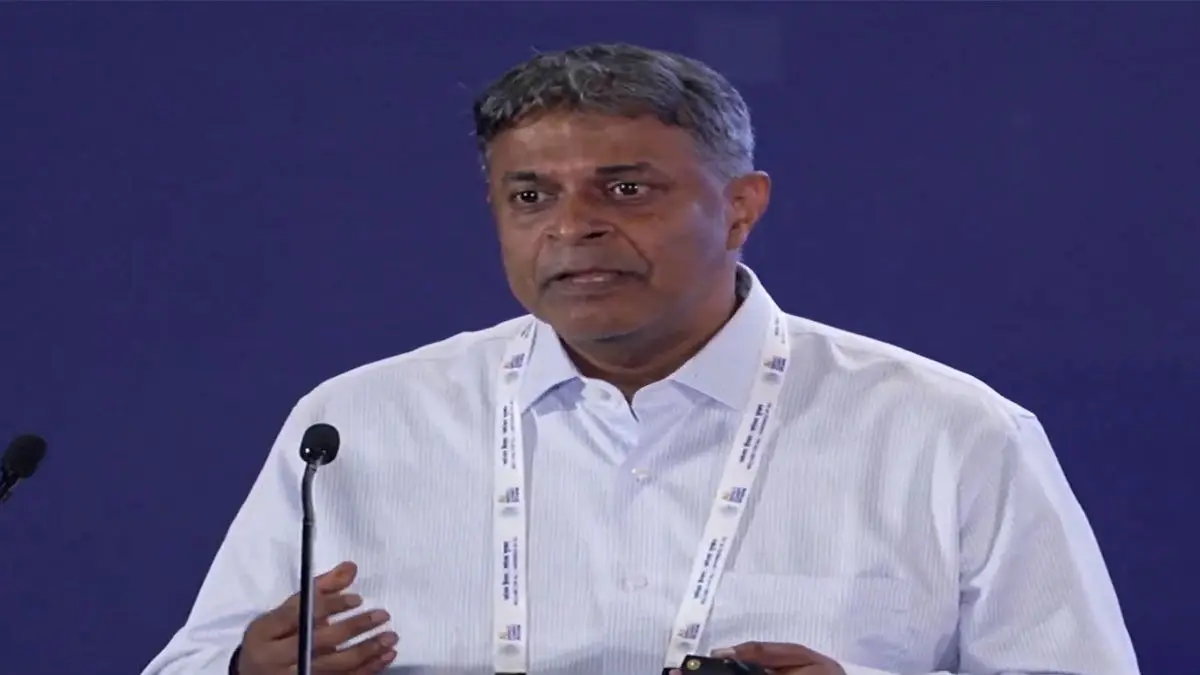
Building foundational AI technology is a necessity rather than an option for India to maintain its digital independence, said Sarvam co-founder, Vivek Raghavan. He noted that AI impacts every aspect of human life, making it a core technology that the country must understand at a fundamental level. "Otherwise, we will become a digital colony which is dependent on other countries for this core, core technology," he noted.
Speaking at the India AI Summit 2026, Vivek Raghavan stated that the development of indigenous technology remains a critical priority for national interests. Raghavan noted that many existing technologies were historically proprietary, leading to the creation of self-created, open-source public infrastructure.
"Many of these technologies were proprietary technologies, and we built this kind of self-created technology that is open source and a public infrastructure that is available to all of us and that led to the creation of the India stack. So when you look at it over the course of long periods of time, sovereignty will always trump technical beads," Raghavan said.
Sarvam is currently developing a full-stack, sovereign AI platform in India, collaborating with developers, enterprises, and government bodies. "Sarvam has been building India's full stack, sovereign AI platform, and we teach, we work with developers. Fundamentally, India is a country of developers. We have more developers than and we work with enterprises, and we work with governments, and I think that's why we have a full stack platform."
Advertisement
Raghavan described the platform as consisting of three pillars: models built in India, applications for everyday tasks, and infrastructure. He highlighted that the project focuses on "sovereignty and voters" to ensure the technology serves the domestic population.
Addressing the unique requirements of the Indian market, Raghavan pointed to the country's linguistic diversity as a primary advantage. "We have 22 official languages, and in fact, you know, the way people speak in our country changes every 50 kilometers, and that diversity must be captured if we have to understand the voice of the people. And therefore, if we build AI from India, it must acknowledge that diversity," he said.
Advertisement
The strategy for these sovereign models involves building them from scratch to eliminate external dependencies. Raghavan confirmed that these models have no data dependency on any other global entities. "The rule number one is they are built from scratch. They are not dependent on any other model that is there in the world," he said.
Despite their independent development, the models are designed to be world-class and state-of-the-art. Raghavan claimed that these models perform better in Indian languages compared to global alternatives. He described them as "extremely small models" trained with significant amounts of diverse Indian data, which leads to superior performance on human voices.
Efficiency and cost-effectiveness remain central to the development process, drawing parallels to the success of the Unified Payments Interface (UPI). Raghavan stated that AI, if implemented correctly, can ensure that services for citizens are the best and cheapest available.
"AI done the right way can make sure that every service to citizens actually is the best and the cheapest and actually done in the best possible way for the country," he said.