
China Test-Fires Advanced Submarine Ballistic Missile Into Pacific, Triggering Fierce Backlash From Regional Powers
China's military launches a submarine ballistic missile into the Pacific Ocean, triggering immediate backlash from Australia, Japan, New Zealand, and Taiwan.
- World News
- 4 min read

;'%3e%3cpath%20d='m8,15.99c4.41,0,7.99-3.58,7.99-7.99S12.41,0,8,0,0,3.59,0,8s3.58,7.99,7.99,7.99Z'%20style='stroke:%23fff;%20stroke-miterlimit:10;%20stroke-width:.02px;'/%3e%3cpath%20d='m3.08,3.37l3.82,5.11-3.84,4.15h.87l3.37-3.64,2.72,3.64h2.94l-4.04-5.39,3.58-3.87h-.86l-3.1,3.35-2.5-3.35h-2.94Zm1.27.64h1.35l5.97,7.99h-1.35l-5.97-7.99Z'%20style='fill:%23fff;'/%3e%3c/g%3e%3c/svg%3e)


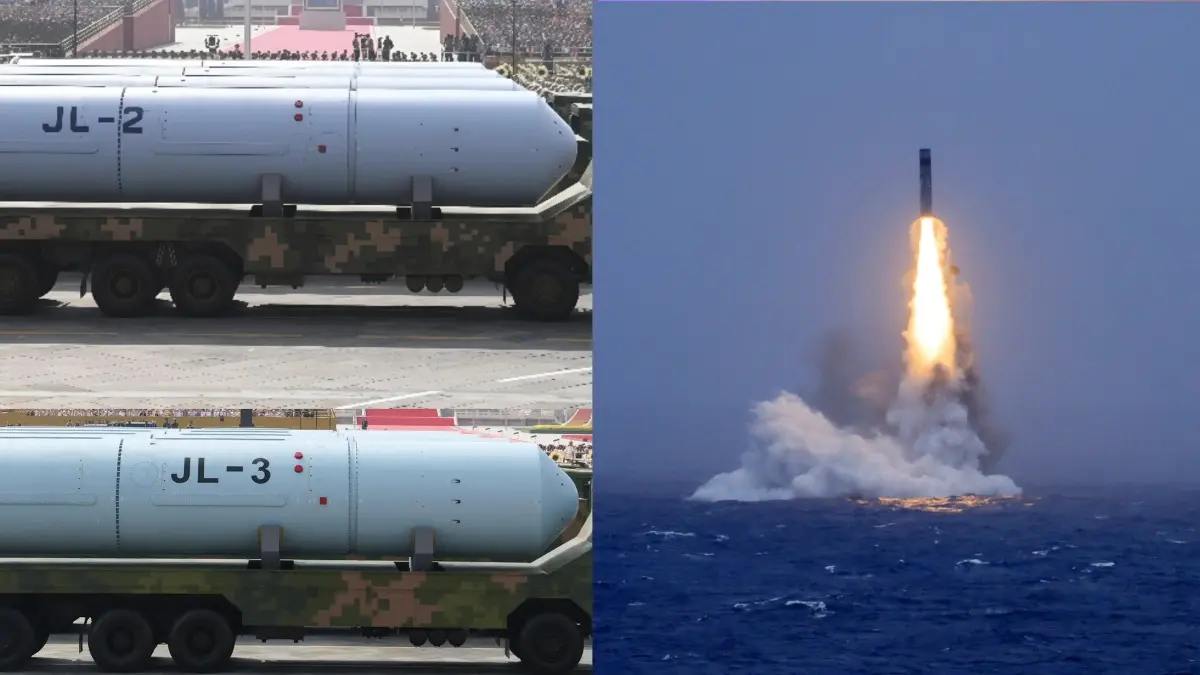
China's military test-fired a ballistic missile from a nuclear-powered submarine into the Pacific Ocean on Monday, state media reported. The launch has triggered immediate criticism and deep concern from regional neighbors, including Japan, Australia, New Zealand, and Taiwan. According to the official Xinhua news agency, a People's Liberation Army (PLA) Navy submarine launched the missile, which was carrying a dummy warhead, toward international waters in the Pacific at 12:01 p.m. (0401 GMT).
Beijing Defends 'Routine' Exercise
Chinese officials were quick to downplay the global tracking of the launch. Xinhua described the operation as a "routine arrangement" tied to China's annual military training calendar, asserting it was not directed against any specific country or target. During a press briefing in Beijing, Chinese Foreign Ministry spokesperson Mao Ning stated that the launch was conducted "safely, in a standardised and professional manner throughout." "We hope relevant countries will not over-interpret the matter," she added.
While Xinhua did not specify the exact type of missile deployed, the state-controlled tabloid Global Times cited a military expert who suggested it was likely the JL-3. As China's most advanced submarine-launched ballistic missile, the JL-3 debuted at a military parade last year. According to a Pentagon report, this weapon system is capable of reaching the continental United States from Chinese coastal waters.
"The US and others will be watching and analysing the test launch closely for any insights into PLA capability," noted Meia Nouwens, a senior fellow for Chinese security and defence policy at the London-based International Institute for Strategic Studies.
Advertisement
Short Notice Raises Regional Alarms
Pacific regional powers, Australia, New Zealand, and Japan, received only a brief advance notification about the weapon test. The timing raised eyebrows as it coincided with the signing of a mutual defense pact in Fiji between the island nation and Australia.
Australian Foreign Minister Penny Wong addressed reporters at a news conference in Fiji, noting that the test arrived “in the context of a rapid military buildup by China, which is lacking in the transparency and reassurance as to intent that the region expects.”
Advertisement
The new "Ocean of Peace" alliance legally commits Australia and Fiji to defend one another if attacked. For years, Beijing and Western powers led by Washington and Canberra have competed for strategic influence among Pacific island nations, leading some analysts to connect the dots on the timing of the launch.
Mark Douglas, an analyst at New Zealand-based ship-tracking firm Starboard Maritime Intelligence, remarked that while the test would have been planned long in advance, the timing of China's notification was "interesting, to say the least."
Nouwens suggested China could be signaling its discontent over the Australia-Fiji agreement, though she warned the move could backfire. "That said, the launch could be counterproductive and negatively affect China's image among countries in the South Pacific," she said.
Backlash Across the Pacific Rim
Taiwan's presidential office strongly condemned the launch, calling the test an attempt by China to intimidate the international community. Taipei has long warned of escalating military provocations from Beijing, which claims the democratically ruled island as its own territory. A senior Taiwanese security official stated on Monday that Taiwan was actively tracking an "upward trend" in Chinese naval movements during peak military exercise season, which includes joint drills with Russia.
New Zealand Foreign Minister Winston Peters termed the test “an unwelcome and concerning development." "We, like our neighbours in other Pacific countries, have no interest in China using the South Pacific as a testing site for missile capability," Peters said.
Meanwhile, Japan announced that upon receiving notification of the upcoming launch, it had "expressed our grave concern over the Chinese military's increased activity" and urged Beijing to reconsider. This operation follows China's 2024 intercontinental ballistic missile test, a launch that previously spotlighted the country's rapidly expanding long-range military capabilities.