
Consensus, Xi-Putin Presence, Message to US: Broader Implications of India's BRICS 2026 Amid Wars & Tariff Tensions
Both leaders agreed that differences should not be allowed to harden into disputes, and pledged to be guided by "mutual respect, mutual sensitivity and mutual interests," identifying peace along the border as the foundation for the relationship going forward.
- World News
- 7 min read

;'%3e%3cpath%20d='m8,15.99c4.41,0,7.99-3.58,7.99-7.99S12.41,0,8,0,0,3.59,0,8s3.58,7.99,7.99,7.99Z'%20style='stroke:%23fff;%20stroke-miterlimit:10;%20stroke-width:.02px;'/%3e%3cpath%20d='m3.08,3.37l3.82,5.11-3.84,4.15h.87l3.37-3.64,2.72,3.64h2.94l-4.04-5.39,3.58-3.87h-.86l-3.1,3.35-2.5-3.35h-2.94Zm1.27.64h1.35l5.97,7.99h-1.35l-5.97-7.99Z'%20style='fill:%23fff;'/%3e%3c/g%3e%3c/svg%3e)


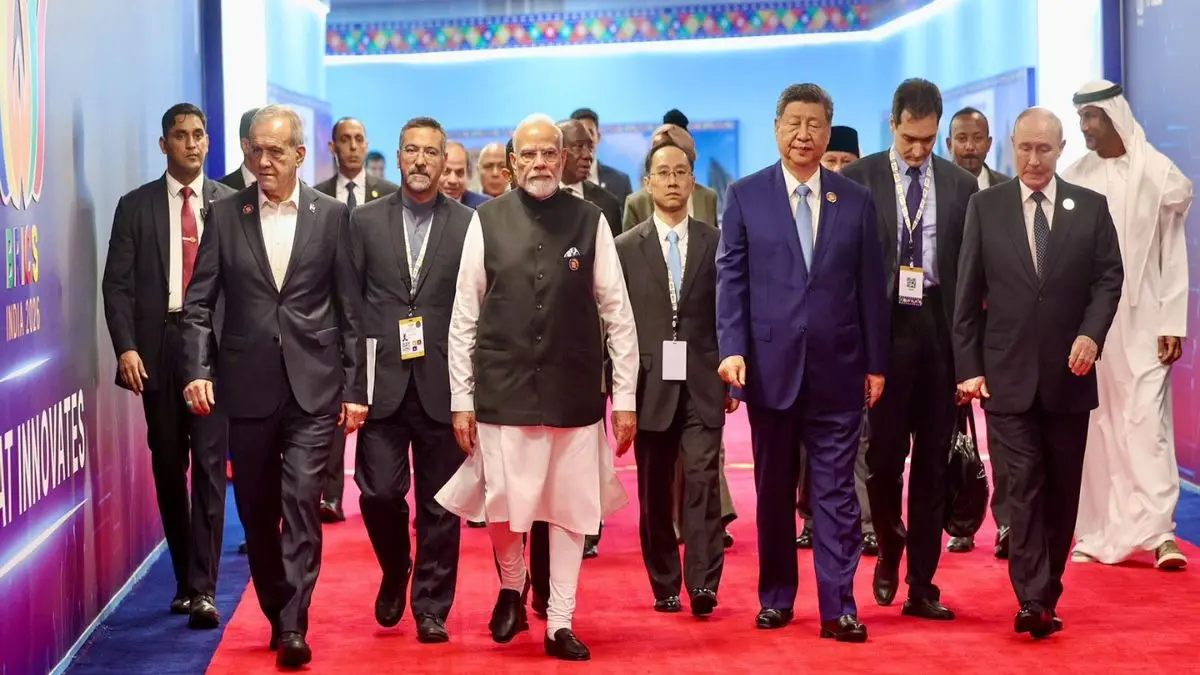
New Delhi: India brought the curtains down on the 18th BRICS Summit at Bharat Mandapam on Saturday with the adoption of the New Delhi Declaration by consensus, capping a two-day gathering of the world's major emerging economies that unfolded against the backdrop of two active wars and an escalating global tariff war. The summit, held under India's 2026 chairship theme "Building for Resilience, Innovation, Cooperation and Sustainability," is being described by diplomats and commentators as one of India's most significant foreign-policy achievements in recent years.
Consensus Forged Out of Discord
The path to the declaration was far from smooth. Negotiators worked through the night to bridge sharp differences between the United Arab Emirates and Iran over how to characterise the West Asia conflict, with the final text stopping short of directly naming the United States' strikes on Iran or Tehran's retaliatory attacks on Gulf states. Instead, the eleven-nation bloc settled on carefully balanced language -- expressing deep concern over escalating tensions in the Middle East, calling for maximum restraint, urging protection of civilians and civilian infrastructure, and backing dialogue and diplomacy over confrontation. The declaration also voiced alarm over attacks on peaceful nuclear facilities safeguarded by the International Atomic Energy Agency.
The fact that India chaired a bloc that includes both Iran and the Gulf's rising power centres, as well as old rivals China and old friend Russia, could steer all members to sign a single 45-page document is being read as a triumph of quiet, patient diplomacy rather than public posturing. Analysts noted the text was deliberately worded so as not to take sides in the conflict, reflecting New Delhi's preference for consensus-building over confrontation.
Xi and Putin's Presence: A Message in Itself
The optics of the summit carried as much weight as its text. Chinese President Xi Jinping's visit to India -- his first in seven years -- alongside Russian President Vladimir Putin's attendance, signalled that despite years of border tension with Beijing and Western pressure on Moscow, India remains a convening power capable of bringing rival and sanctioned leaders to the same table. Images of Modi, Xi and Putin walking together, laughing and planting Banyan saplings on the Bharat Mandapam lawns went viral, projecting an image of unity among nations often at odds with Washington.
Advertisement
PM Modi and President Xi also held a bilateral meeting, their first sustained engagement since ties began thawing after last year's Tianjin meeting. Both leaders agreed that differences should not be allowed to harden into disputes, and pledged to be guided by "mutual respect, mutual sensitivity and mutual interests," identifying peace along the border as the foundation for the relationship going forward. For India, the sequence -- Xi's visit, the conciliatory bilateral tone, and the absence of public friction over sensitive issues -- marks a discernible shift from the near-total freeze in ties between 2020 and 2023.
Yet India was careful not to let symbolism tip into strategic alignment. While Beijing used the platform to unveil its "Greater BRICS Initiative" and Moscow cast the bloc as the engine of a new multipolar order, India, as host, pointedly declined to endorse either framing -- a signal that New Delhi sees BRICS as a platform for development and institutional reform, not an anti-Western bloc.
Advertisement
A Message for Washington, Without Naming Trump
Although the declaration did not once name the United States or President Donald Trump, its intent was unmistakable. The text voiced serious concern over the rise of "unilateral tariff and non-tariff measures" that distort trade and are inconsistent with World Trade Organization rules, and separately condemned unilateral economic sanctions and coercive measures imposed without United Nations Security Council authorisation -- language read widely as a rebuke of Washington's tariff campaign and its sanctions regime, including on Russia and Iran. Speaking at the summit, Putin accused nations "accustomed to thinking in colonial categories" of using tariffs, sanctions and force to contain emerging economies.
The timing gave the message added edge. Trump had last year imposed a 25 percent tariff on Indian goods over its continued purchase of Russian crude, and has previously branded BRICS "anti-American," threatening additional tariffs on any country seen as aligning with the grouping. That New Delhi hosted this very summit, and helped produce a declaration critical of those exact policies, without ever naming Trump, reflects the same calibrated diplomacy India applied to the Iran-UAE divide -- registering firm disagreement while leaving the door open for engagement.
BRICS Unites Against Terrorism, Condemns Pahalgam Attack
All member nations came together to firmly denounce terrorism in every form, specifically citing the Pahalgam attack of April 22, 2025, that claimed 26 lives in Jammu and Kashmir. The New Delhi Declaration, marked a major diplomatic moment for host nation India, with leaders calling for zero tolerance towards state-sponsored cross-border terrorism. The bloc reaffirmed its commitment to combating terrorism in all its forms, including financing and safe havens, while rejecting double standards and advocating for accountability under international law. The declaration also called for the expeditious finalisation of a Comprehensive Convention on International Terrorism at the United Nations, signaling a broader push for coordinated global action against terror networks.
Lessons and Broader Implications
The summit offers pointed lessons for a fractured world. First, that consensus among sharply divided nations remains possible when platforms prioritise dialogue over rhetoric -- the very approach India applied to reconcile UAE and Iranian positions. Second, that unilateral economic coercion, whether through tariffs or sanctions bypassing the UN Security Council, is increasingly viewed by a large bloc of the Global South, representing roughly half the world's population and a significant share of global output, as corrosive to a rules-based trading order, bolstering calls for reform of the WTO, the UN Security Council, the IMF and the World Bank.
Coming as it did amid the West Asia conflict and the prolonged Russia-Ukraine war, alongside Washington's tariff threats against multiple economies including China, Russia and India itself, the summit's significance is hard to overstate. It demonstrated that a multilateral platform outside the traditional Western-led order can still produce collective positions on war, trade and global governance -- even if, by design, the declaration stopped short of naming aggressors or issuing binding commitments.
India's Balancing Act and Diplomatic Milestone
For India, the summit was as much a test of tightrope diplomacy as it was a hosting triumph. In the space of days, Prime Minister Modi met Putin and Iranian President Masoud Pezeshkian, held a reset-defining bilateral with Xi Jinping, and navigated engagements with Gulf leaders including the UAE and Saudi Arabia -- all while continuing to have closer ties with Washington. This is India's doctrine of strategic autonomy in practice -- deepening a $100-billion bilateral trade ambition with China by 2030, standing by Russia on dialogue over Ukraine, and simultaneously refusing to let BRICS harden into an anti-Western platform, even as China and Russia pushed for sharper, more geopolitical language.
The fact that India could hold this line -- hosting adversarial and sanctioned leaders, mediating opposing camps within its own summit, and still emerge with a consensus document -- is being viewed as a genuine diplomatic milestone. It reinforces New Delhi's positioning as an indispensable convener in a multipolar world: trusted enough by Washington to remain a strategic partner, yet credible enough to Moscow, Beijing, Tehran and the Gulf to bring them into the same room.
A Boost to India's Global Standing
The successful conclusion of the summit -- over 400 ministerial and expert-level meetings held across thirty Indian cities during its chairship year, capped by a consensus declaration navigating the world's most contentious fault lines -- adds measurably to India's international prestige. It positions the country not merely as a participant in global governance debates but as a rule-shaper capable of bridging divides that have stymied other multilateral forums. As the dust settles on Bharat Mandapam, the broader question the summit leaves behind is whether this massive diplomatic triumph can be sustained into concrete reform of global institutions.