
'Era Of Bullying And Extortion Is Over': Iran Vows 'Decisive Action' After Strikes, Accuses US of 'Major Violations'
The escalating tensions between Iran and the United States intensified after Iran's Parliament Speaker, Mohammad Bagher Ghalibaf, warned of "decisive action" in response to US military strikes in the Strait of Hormuz. Ghalibaf criticized the US for violating a ceasefire agreement, claiming attacks on Iranian positions and backing "Zionist aggression."
- World News
- 3 min read

;'%3e%3cpath%20d='m8,15.99c4.41,0,7.99-3.58,7.99-7.99S12.41,0,8,0,0,3.59,0,8s3.58,7.99,7.99,7.99Z'%20style='stroke:%23fff;%20stroke-miterlimit:10;%20stroke-width:.02px;'/%3e%3cpath%20d='m3.08,3.37l3.82,5.11-3.84,4.15h.87l3.37-3.64,2.72,3.64h2.94l-4.04-5.39,3.58-3.87h-.86l-3.1,3.35-2.5-3.35h-2.94Zm1.27.64h1.35l5.97,7.99h-1.35l-5.97-7.99Z'%20style='fill:%23fff;'/%3e%3c/g%3e%3c/svg%3e)


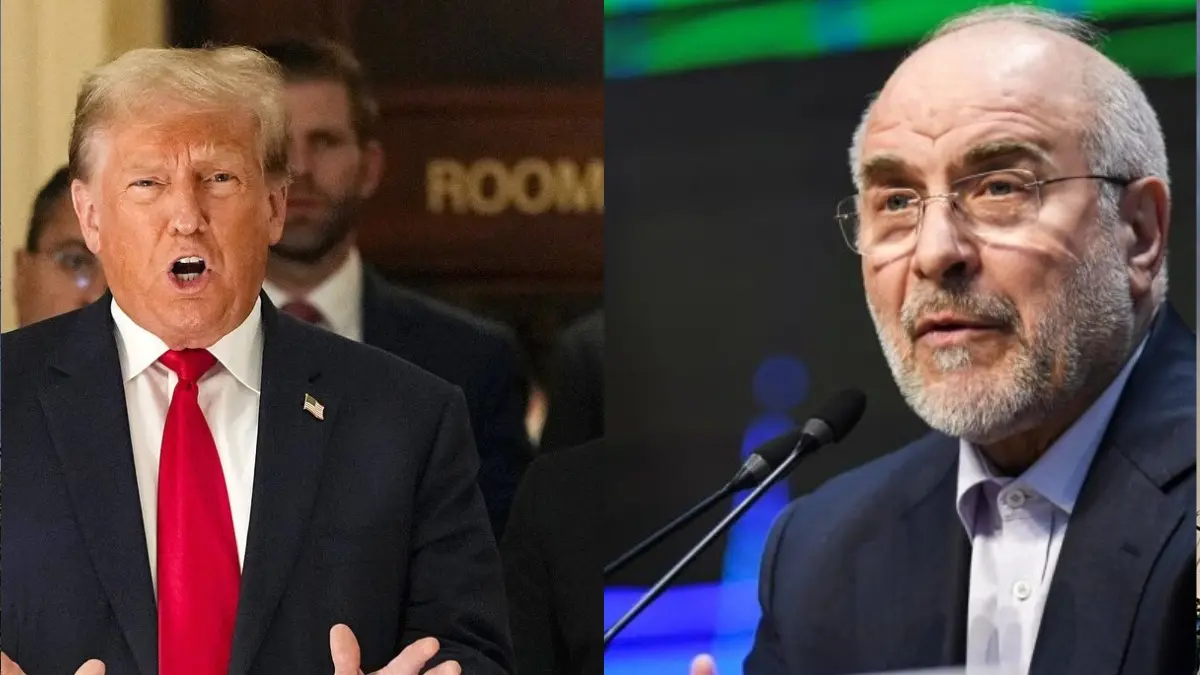
New Delhi: The war of words between Iran and the United States has intensified sharply after Tehran warned of "decisive action" in response to sweeping US military strikes around the Strait of Hormuz, with Iranian Parliament Speaker Mohammad Bagher Ghalibaf declaring that the "era of bullying and extortion is over."
In a strongly worded post on X on Tuesday, Ghalibaf accused Washington of committing multiple "major violations" of the bilateral Memorandum of Understanding (MoU) that had temporarily halted hostilities between the two countries in late June.
Listing what he described as repeated American breaches of the agreement, Ghalibaf alleged that the US had violated Iranian arrangements in the Strait of Hormuz, continued threatening fresh military strikes, reimposed oil sanctions, carried out attacks in southern Iran, and backed what he termed "continued Zionist aggression" in Lebanon.
"The era of bullying and extortion is over. It leads nowhere. We don't fold," Ghalibaf wrote, asserting that Iran would not bow to military or economic pressure.
Advertisement
The statement comes hours after Iran warned that it would take "decisive action" following a major US military offensive targeting Iranian positions around the strategic Strait of Hormuz.
According to the US Central Command (CENTCOM), American forces launched precision strikes on more than 80 military targets across Iran on July 7. The operation reportedly targeted command-and-control facilities, air defence systems, coastal radar sites, anti-ship missile batteries and more than 60 Islamic Revolutionary Guard Corps (IRGC) fast attack boats.
Advertisement
US defence officials said the objective was to significantly degrade Iran's ability to threaten commercial shipping passing through one of the world's busiest energy corridors.
Washington said the strikes were carried out after Iran allegedly attacked three commercial oil tankers transiting the Strait of Hormuz-the Marshall Islands-flagged M/T Al Rekayyat, the Saudi Arabia-flagged M/T Wedyan, and the Liberian-flagged M/T Cyprus Prosperity.
In a statement, CENTCOM said the operation was a direct response to what it called "unwarranted and dangerous" Iranian attacks on commercial vessels, describing the incidents as a violation of the ceasefire understanding reached under the June MoU.
The latest military operation marks the first direct US strikes on Iranian territory since the temporary ceasefire came into effect following weeks of intense military exchanges between the two countries.
The military escalation was preceded by another major step from Washington after the Donald Trump administration revoked a temporary waiver that had allowed limited Iranian oil exports under the ceasefire arrangement. The waiver, initially expected to remain in force until August 21, was abruptly withdrawn, reimposing economic pressure on Tehran.
With military operations resuming and sanctions tightening once again, tensions between Washington and Tehran have escalated dramatically, raising fresh concerns over stability in the Strait of Hormuz—through which nearly a fifth of the world's oil supply passes.