
From France protests to sparking row with Taiwan remark, a look at Macron's fateful month
French President Emmanuel Macron had an eventful and fateful month as the 45-year-old leader faced challenges from both domestic and international spheres.
- World News
- 8 min read

;'%3e%3cpath%20d='m8,15.99c4.41,0,7.99-3.58,7.99-7.99S12.41,0,8,0,0,3.59,0,8s3.58,7.99,7.99,7.99Z'%20style='stroke:%23fff;%20stroke-miterlimit:10;%20stroke-width:.02px;'/%3e%3cpath%20d='m3.08,3.37l3.82,5.11-3.84,4.15h.87l3.37-3.64,2.72,3.64h2.94l-4.04-5.39,3.58-3.87h-.86l-3.1,3.35-2.5-3.35h-2.94Zm1.27.64h1.35l5.97,7.99h-1.35l-5.97-7.99Z'%20style='fill:%23fff;'/%3e%3c/g%3e%3c/svg%3e)


French President Emmanuel Macron had an eventful and fateful month as the 45-year-old leader faced challenges from both domestic and international spheres. Be it his aggressive stance to push for the controversial pension reforms or his decisions to distance himself from one of Europe’s strongest allies, the United States, the French President has come under the radar on several occasions this month.
The French President, who assumed office in 2017, has faced several challenges throughout his tenure. From the French media judging the age gap between him and his wife to Macron addressing the plight of the minority groups in France, the French President had too much on his plate since the very beginning. However, the raging nationwide protests over the highly controversial pension reforms have posed a major challenge to Macron’s presidency in recent years.

French President-elect Emmanuel Macron holds hands with his wife Brigitte during a victory celebration outside the Louvre museum in Paris, France, Sunday, May 7, 2017, Image: AP
Macron’s aggressive push for the pension reforms
In January, the Macron administration unveiled the plan to bring out new pension reforms, proposing to raise the legal age for retirement from 62 to 64 years. In the past, countries like the Netherlands raised the legal retirement age to 67. The Macron administration stated that the reforms have been initiated in an effort to cut the pension cost by 2030. The French government reasoned that with the change in France’s demography, the pension cost in the country has risen in recent years, causing an immense burden on the French administration. However, the reform was not welcomed by many people belonging to the working class of French society. The protest started erupting across various parts of the nation.
Advertisement

Protesters held a placard with a portrait of Macron during a demonstration against plans to push back France's retirement age, in Lille, northern France on February 11, 2023, Image: AP
The protests started turning violent after the French President decided to override the French National Assembly to push the controversial legislation. On March 16, the French President invoked his special constitutional powers and overrode the French National Assembly just minutes before the lower chamber was about to sit and vote on the controversial law. Macron triggered Article 49.3 of the French constitution, which enabled the French government to push the bill forwards without the National Assembly’s vote. The decision also put the Macron government in jeopardy because triggering the special constitutional power enabled the French administration to pass a no-confidence motion against him.
Advertisement

French Prime Minister Elisabeth Borne, delivers a speech at the National Assembly in Paris, Thursday, March 16, 2023, Image: AP
The escalation of the protests and the challenges from the opposition
After Macron used his special constitutional powers, things went downhill very quickly. The move led to the escalation of the protests against the reforms in France. Hundreds of people took to the streets, pelted stones at the French police and even committed arson wherever it was possible. On April 6, reports emerged that the protesters angry with the French president decided to burn Macron’s favourite restaurant in Paris. The restaurant named La Rotonde was the same place where Macron celebrated his victory in the French Presidential elections back in 2017. On April 2, the French Interior Minister, Gerald Darmanin said that more than 1,000 law enforcement officers and firefighters have been injured in demonstrations and riots across France. However, the French Minister kept mum on the rising casualties among the protestors in the ongoing protests.
The Macron administration also faced challenges within the French parliament as well. Just days after the French President triggered Article 49.3, the French opposition parties such as the National Rally Party and the NUPES-led coalition decided to initiate a no-confidence motion in the French parliament. However, the Macron administration managed to survive the no-confidence motion.

Protesters held a placard with a portrait of Emmanuel Macron during a demonstration against plans to push back France's retirement age, in Lille, northern France, Saturday, Feb. 11, 2023, Image: AP
Macron’s controversial visit to China
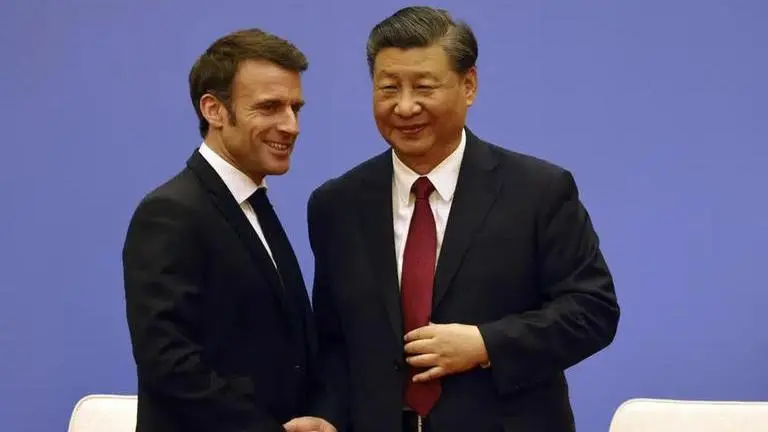
While the French President was witnessing all this chaos back home, he decided to kick-start his three-day trip to China on April 5. During his trip, Macron met Chinese President Xi Jinping and held talks over wide-ranging issues. The meeting attracted international attention since Macron discussed the ongoing Russia-Ukraine war with his Chinese counterpart. During his meeting with Xi, Macron urged the Chinese President to bring Russia into “senses”. He also stated that France wants to “engage China toward a shared responsibility for peace". The French President was then joined by EU Commission President Ursula Von der Leyen, and the three world leaders also discussed the issue of Taiwan. “Stability in the Taiwan Strait is of paramount importance,” von der Leyen proclaimed during her talks with the Chinese President. “The threat [of] the use of force to change the status quo is unacceptable,” Xi responded. While things went smoothly during his visit, Macron’s controversial stances following the meeting attracted intense debate on the current geopolitical climate.

Macron met his Chinese counterpart, President Xi Jinping. The two world leaders can be seen reviewing the troops during a welcome ceremony at the Great Hall of the People in Beijing, Thursday, April 6, Image: AP

Ursula von der Leyen, the President of the European Union Commission sat down with Xi Jinping and French President Emmanuel Macron. Thursday, April 6, Image: Twitter - @vonderleyen
Macron says Europe must reduce dependency on US
On his way back from China, the French President asserted that Europe must reduce its dependency on the United States. The remarks from Macron came during his flight back from China, Politico reported. “The paradox would be that, overcome with panic, we believe we are just America’s followers,” the French President said in the controversial interview. “If the tensions between the two superpowers (US and China) heat up … we won’t have the time nor the resources to finance our strategic autonomy and we will become vassals,” he told Politico. He further stated that the “great risk” Europe is facing is getting caught in a crisis that doesn’t involve Europe in the first place. In the past, the French President has maintained a conservative stance when it comes to arming Ukraine in the raging Russia-Ukraine war. The controversial stance by Macron was criticised by the American bloc.
Distancing from China-Taiwan conflict
In the same interview, Macron talked said that Europe should avoid getting involved in the current China-Taiwan conflict. “The question Europeans need to answer … is it in our interest to accelerate [a crisis] on Taiwan? No. The worse thing would be to think that we Europeans must become followers on this topic and take our cue from the U.S. agenda and a Chinese overreaction,” he said. “Europeans cannot resolve the crisis in Ukraine; how can we credibly say on Taiwan, ‘watch out, if you do something wrong we will be there’? If you really want to increase tensions that’s the way to do it,” he added. The remarks from the French President came on April 9, just days after Taiwanese President Tsai Ing-wen held a bilateral meeting with the US Speaker of the House of Representatives, Kevin McCarthy.

House Speaker Kevin McCarthy and Taiwanese President Tsai Ing-wen delivered statements to the joint press briefing after a Bipartisan Leadership Meeting at the Ronald Reagan Presidential Library in Simi Valley, California, Wednesday, April 5, 2023.
The international criticism that followed
Macron’s controversial interview attracted American attention and criticism as well. In a social media post linking the article, US Republican Senator Marco Rubio called out Macron’s stance on the issue. In a tweet, Rubio said that if Macron spoke for all of Europe, then the United States should leave Europe to handle the ongoing Russia-Ukraine war and just focus on containing the Chinese aggression. According to The Guardian, a Member of the European Parliament made it clear that the French President is not speaking on behalf of the whole continent. “Macron says, ‘Europe should’ and ‘we Europeans’, but he speaks for France, he can’t really speak for Europe,” the MEP asserted. “It’s perhaps a bit surprising to stress strategic autonomy now in April 2023, because the world has changed in the last 14 months,” the European diplomat who chose to remain anonymous further added.
From the China visit to the ongoing protest in France, it will be safe to say that the French President had an eventful yet fateful month, filled with a plethora of challenges.