
India Explores Diplomatic Talks With Iran To Secure Safe Strait of Hormus Passage For 9 Stranded Tankers
The primary objective is the safe transit of at least nine Indian-linked commercial tankers currently holding position or stranded in the volatile Persian Gulf. The ships are transporting liquefied petroleum gas (LPG) and crude oil, and the government is keeping a careful eye on their movements.
- World News
- 3 min read

;'%3e%3cpath%20d='m8,15.99c4.41,0,7.99-3.58,7.99-7.99S12.41,0,8,0,0,3.59,0,8s3.58,7.99,7.99,7.99Z'%20style='stroke:%23fff;%20stroke-miterlimit:10;%20stroke-width:.02px;'/%3e%3cpath%20d='m3.08,3.37l3.82,5.11-3.84,4.15h.87l3.37-3.64,2.72,3.64h2.94l-4.04-5.39,3.58-3.87h-.86l-3.1,3.35-2.5-3.35h-2.94Zm1.27.64h1.35l5.97,7.99h-1.35l-5.97-7.99Z'%20style='fill:%23fff;'/%3e%3c/g%3e%3c/svg%3e)


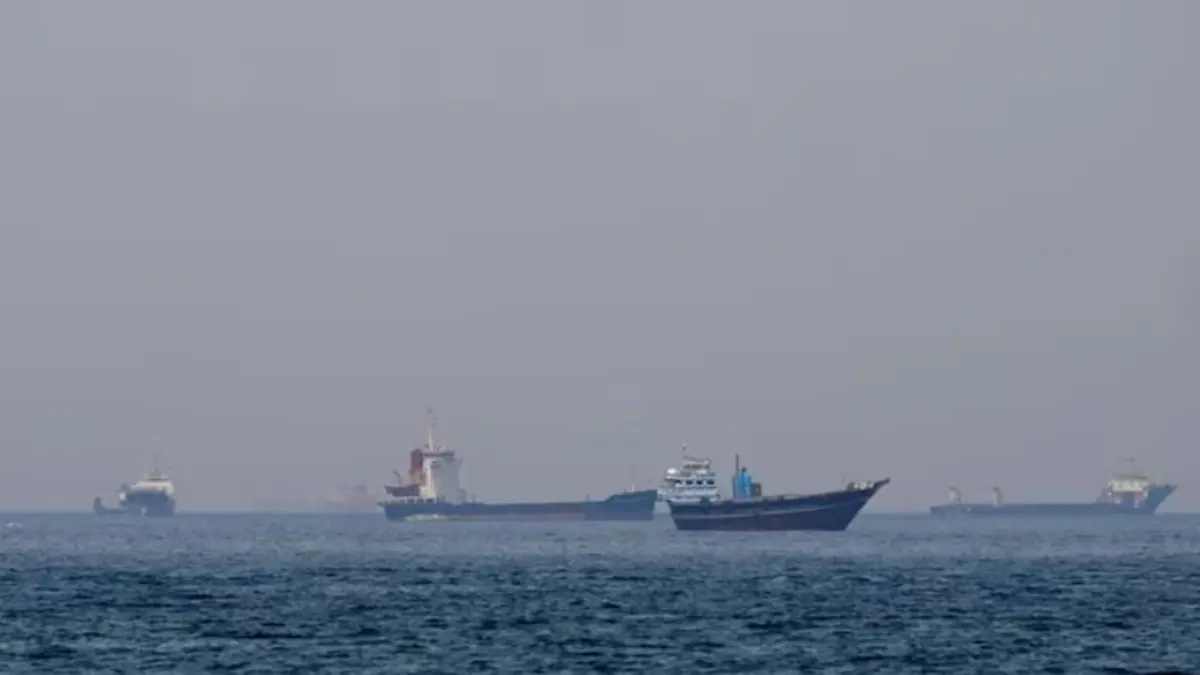
New Delhi: Amid escalating geopolitical friction in West Asia and a fresh wave of military strikes in the region, India is considering diplomatic alternatives, including talks with Iran, to guarantee the safe passage of at least nine fully laden tankers waiting in the Persian Gulf.
The primary objective is the safe transit of at least nine Indian-linked commercial tankers currently holding position or stranded in the volatile Persian Gulf.
The ships are transporting liquefied petroleum gas (LPG) and crude oil, and the government is keeping a careful eye on their movements.
According to sources, the Ministry of External Affairs is anticipated to discuss the safety of Indian sailors working in the area with Iranian authorities.
Advertisement
The nine tankers carrying 198 Indian sailors who are awaiting authorisation to pass through the vital canal are also a source of anxiety.
Since the Strait of Hormuz was essentially closed, hundreds of Indian mariners have been stuck for months.
Advertisement
Following the deaths of at least three Indian sailors during US strikes on commercial vessels in the Gulf of Oman in June, officials are allegedly paying close attention to crew safety.
It stated that calls for response via email were not answered immediately by the ministries of shipping, petroleum and natural gas, and external affairs.
Shipping via the Strait of Hormuz had surged, resulting in a temporary peace agreement between the United States and Iran in June.
However, after Tuesday's ship attacks and the US's midnight retaliatory strikes on Iranian sites, ship movements have now again slowed significantly.
Speaking at NATO's annual summit in Ankara, US President Donald Trump highlighted the ambiguity surrounding the truce by calling peace talks “a waste of time.”
Just hours after the bombings on Tuesday, six ships bound for locations including India attempted to cross the strait on Wednesday.
However, the supertanker Lila Vadinar, flying the Indian flag, turned around after arriving at the tip of Oman's Musandam Peninsula, indicating that shipping companies are becoming more cautious.
Only about fifty ships headed for India have entered the Strait of Hormuz since the war started in late February, according to the people.
Because Indian consumers have not yet fully resumed purchasing crude oil, LNG, and liquefied petroleum gas from Middle Eastern suppliers, imports are still below average.
Before the battle, the Strait of Hormuz handled 90% of India's LPG supplies, 60% of its LNG shipments, and roughly 40% of its crude oil imports.
Separately, an Indian oil ship was repelled from the Omani corridor in the Strait of Hormuz, according to Iran's semi-official news outlet Fars.
Iran's Islamic Revolutionary Guard Corps has reportedly kept sending out radio alerts to ships trying to use the Omani corridor, telling them to take the Iran-designated route instead, according to Fars.
Additionally, according to ship-tracking data, all ships passing through the Strait of Hormuz on Wednesday morning utilised the Iranian-approved channel.