
Iran Leadership Divide Deepens: IRGC Hardliners Clash With Diplomacy Push Over Crucial Strait of Hormuz
A deep rift opens in Tehran as the IRGC pushes for control over the crucial Strait of Hormuz while Iran's president seeks diplomacy with the US.
- World News
- 3 min read

;'%3e%3cpath%20d='m8,15.99c4.41,0,7.99-3.58,7.99-7.99S12.41,0,8,0,0,3.59,0,8s3.58,7.99,7.99,7.99Z'%20style='stroke:%23fff;%20stroke-miterlimit:10;%20stroke-width:.02px;'/%3e%3cpath%20d='m3.08,3.37l3.82,5.11-3.84,4.15h.87l3.37-3.64,2.72,3.64h2.94l-4.04-5.39,3.58-3.87h-.86l-3.1,3.35-2.5-3.35h-2.94Zm1.27.64h1.35l5.97,7.99h-1.35l-5.97-7.99Z'%20style='fill:%23fff;'/%3e%3c/g%3e%3c/svg%3e)


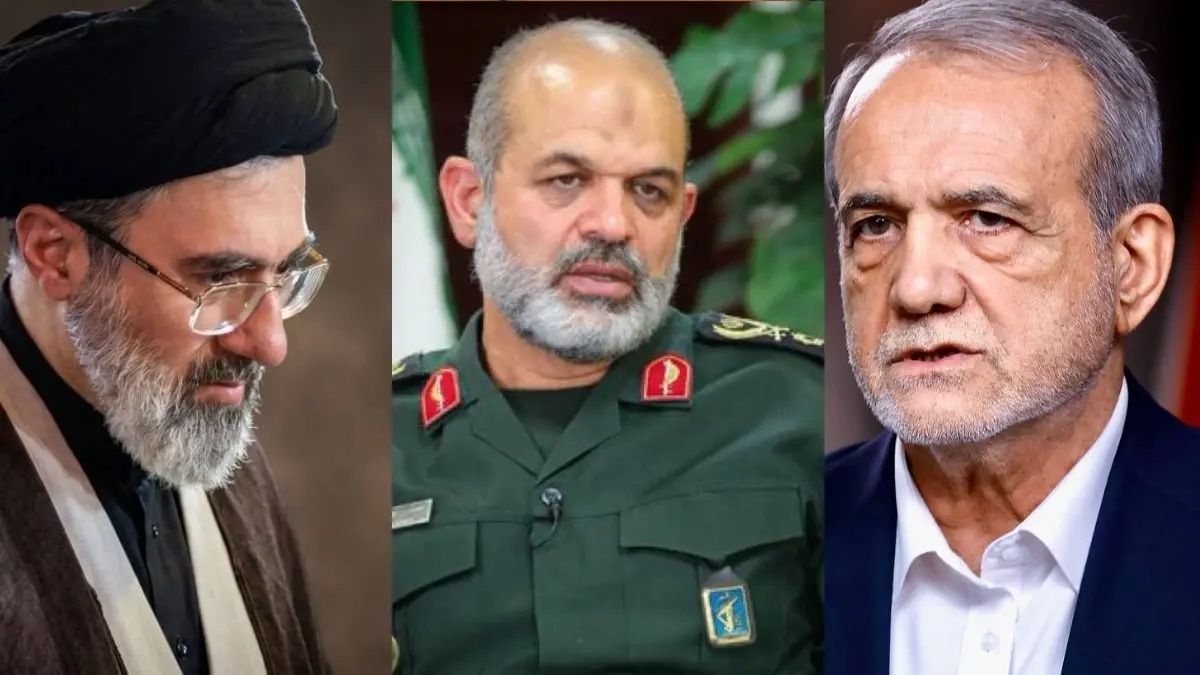
As friction between the United States and Iran intensifies, deep fractures within Tehran’s ruling elite are coming to the forefront. At the heart of this internal rift is the Strait of Hormuz, arguably the most vital maritime chokepoint for the global oil trade. While the powerful Islamic Revolutionary Guard Corps (IRGC) demands an aggressive stance to tighten its grip on the waterway, the civilian administration under President Masoud Pezeshkian is pushing for a diplomatic exit ramp.
Inside Tehran's Deepening Divide
According to Kenneth Katzman, a Middle East analyst at the Soufan Center, Iran's current strategy is being pulled in two entirely opposite directions by competing factions. The IRGC and its conservative allies view dominant control over the Strait of Hormuz as Iran's ultimate geopolitical trump card. In their view, holding the global energy supply hostage is the single best way to force concessions from Washington and deter any potential foreign military action.
Furthermore, this hardline faction is pushing for a highly aggressive response to recent actions targeting Iran’s leadership. Their primary goal is to project raw power, signaling to the West that any move against Tehran will carry an unacceptable cost.
On the other side of the political aisle, President Masoud Pezeshkian and Parliament Speaker Mohammad Bagher Ghalibaf are spearheading a quieter approach. This civilian bloc favors restarting indirect diplomatic talks with the United States. They hope to leverage Oman as a neutral mediator to de-escalate the situation before the standoff spirals completely out of control.
Advertisement
What Is at Stake for the Global Economy?
For the rest of the world, this internal debate is far from a localized political dispute. The White House has consistently made it clear that keeping the Strait of Hormuz fully operational is a non-negotiable strategic priority for the United States. Because roughly 20 percent of the world's total petroleum liquids pass through this narrow corridor, even minor disruptions can instantly trigger chaos in global energy markets and disrupt international shipping lines.
Tehran’s civilian leaders believe that fresh negotiations could lower the regional temperature and pave the way for a stable, peaceful understanding regarding maritime transit. Yet, the stark ideological divide within Iran's own government means that hammering out a single, unified policy will be exceptionally difficult.
Advertisement
With both Washington and Tehran refusing to compromise on their core interests, the outcome of Iran's internal power struggle will have massive global ramifications. The decisions finalized in Tehran regarding the Strait of Hormuz will ultimately dictate the trajectory of international oil prices, the security of global trade routes, and the broader stability of the Middle East.