
‘Mulk Ujar Raha Hai… Baloch Hi Nahi, Pashtun Bhi Khoon Mein Naha Raha Hai’: Pakistan Leader Dares Asim Munir To Fight Polls
Jamiat Ulema-e-Islam (F) chief Maulana Fazal Ur Rehman attacked Pakistan's military establishment, claiming Islamabad has effectively lost control over Khyber Pakhtunkhwa and Balochistan. His remarks came as the Tehreek-e-Taliban Pakistan intensified its 'Operation Khyber' with 12 coordinated attacks across the country.
- World News
- 3 min read

;'%3e%3cpath%20d='m8,15.99c4.41,0,7.99-3.58,7.99-7.99S12.41,0,8,0,0,3.59,0,8s3.58,7.99,7.99,7.99Z'%20style='stroke:%23fff;%20stroke-miterlimit:10;%20stroke-width:.02px;'/%3e%3cpath%20d='m3.08,3.37l3.82,5.11-3.84,4.15h.87l3.37-3.64,2.72,3.64h2.94l-4.04-5.39,3.58-3.87h-.86l-3.1,3.35-2.5-3.35h-2.94Zm1.27.64h1.35l5.97,7.99h-1.35l-5.97-7.99Z'%20style='fill:%23fff;'/%3e%3c/g%3e%3c/svg%3e)


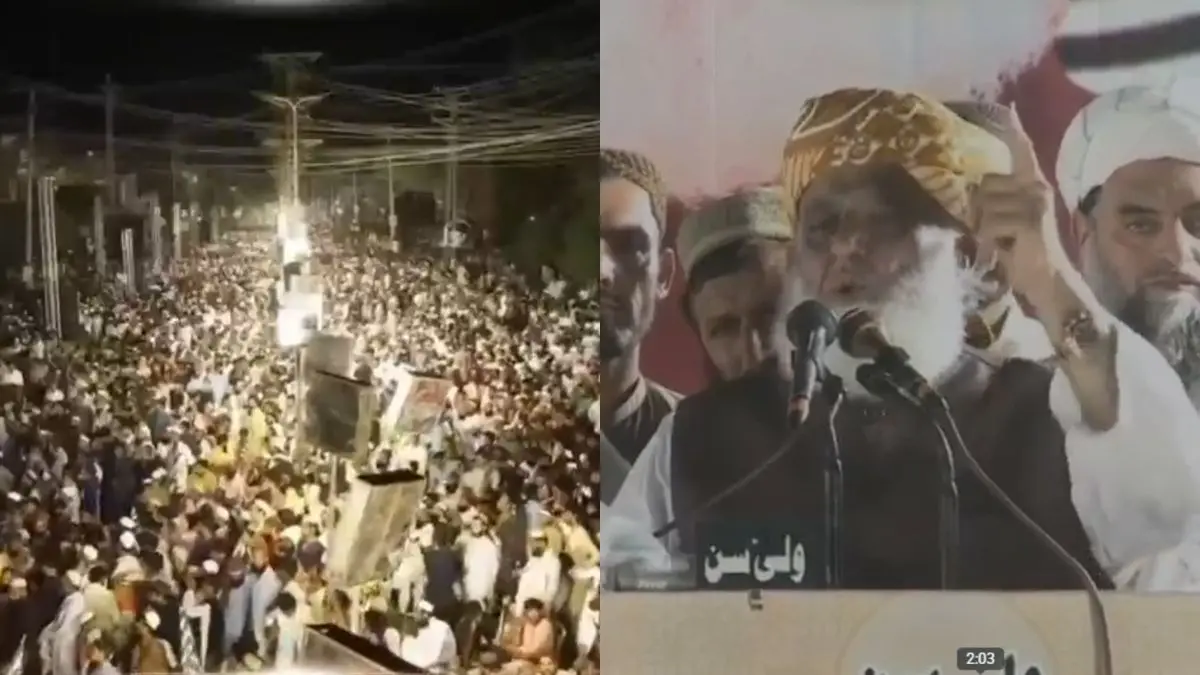
Attacking Pakistan's military establishment, Jamiat Ulema-e-Islam (F) chief Fazal Ur Rehman accused the Pakistan Army of presiding over a collapsing security situation, alleging that the state has effectively lost its control in Khyber Pakhtunkhwa (KP) and large parts of Balochistan.
In an emotionally charged speech, he painted a grim picture of deteriorating law and order, claiming that armed groups now roam freely while the state's institutions remain absent.
“The country is being ruined. In Khyber Pakhtunkhwa, there is no government today,” Fazal Ur Rehman said, adding that police personnel do not venture out of their stations after sunset in many areas.
"When the police do not step out of their stations, the streets are left at the mercy of armed groups and the roads fall into the hands of dacoits," he said.
Advertisement
'Pakistan Has Lost Control Over Balochistan'
Fazal Ur Rehman went on to claim that Pakistan's authority has virtually disappeared in Baloch-majority regions.
"The entire Baloch region had slipped out of Pakistan's control. Even today, there is no writ of the Pakistani government there," he alleged.
Advertisement
He further warned that violence had now engulfed Pashtun areas as well.
“The Pashtun region is bathing in blood. Within just two to three days, we received more than 50 bodies. The only thing left for us in the markets was to buy shrouds for our loved ones,” he said.
'Don't Ask Civilians To Fight Your War'
The JUI-F chief also accused Pakistan's military of shifting the burden of the conflict onto civilians while expecting them to form militias against terrorists.
"They tell us to raise militias and take up arms against armed groups. I have not taken any salary; I will not form any militia," he said.
Launching a direct attack on the Army's narrative surrounding military casualties, Fazal Ur Rehman said soldiers are paid precisely to defend the country.
"Your soldiers are martyred because they are entrusted with the country's security. Why do you place the burden of your blood on us? You draw your salaries from the taxes paid through our blood and sweat," he said.
He warned that forcing civilians into armed conflict would only create generations of blood feuds and permanent instability.
'Take Off The Uniform & Contest Elections'
In perhaps his strongest political challenge to Pakistan's military establishment, Fazal Ur Rehman questioned the Army's alleged influence over the country's democratic process.
"If you want to do politics, then take off the uniform and contest elections," he said.
"It will become clear what mandate the people give to the man in uniform. Is this your authority that you decide who forms the government and who is removed from power?"
His remarks are likely to intensify the long-running debate over the Pakistan Army's role in politics, with successive civilian governments and opposition leaders frequently accusing the military of engineering electoral outcomes and wielding influence far beyond national security.
Remarks Amid Fresh Wave Of TTP Violence
Fazal Ur Rehman's comments come against the backdrop of escalating violence across Pakistan.
The Tehreek-e-Taliban Pakistan (TTP), under its ongoing Operation Khyber, reportedly carried out 12 coordinated attacks across Khyber Pakhtunkhwa.
According to reports, the attacks included four attacks in Peshawar, three in North Waziristan, two in Khyber district, and one each in South Waziristan, Bajaur and Lakki Marwat.