
Nepal Begins Mass Burials of Unidentified Flood Victims as India Sends Forensic Team to Aid Identification
Nepal is conducting mass burials of unidentified victims from recent flash floods and landslides as officials face the challenge of identifying hundreds of recovered bodies. The disaster has claimed hundreds of lives, with thousands still missing. Many remains are in poor condition, complicating identification.
- World News
- 3 min read

;'%3e%3cpath%20d='m8,15.99c4.41,0,7.99-3.58,7.99-7.99S12.41,0,8,0,0,3.59,0,8s3.58,7.99,7.99,7.99Z'%20style='stroke:%23fff;%20stroke-miterlimit:10;%20stroke-width:.02px;'/%3e%3cpath%20d='m3.08,3.37l3.82,5.11-3.84,4.15h.87l3.37-3.64,2.72,3.64h2.94l-4.04-5.39,3.58-3.87h-.86l-3.1,3.35-2.5-3.35h-2.94Zm1.27.64h1.35l5.97,7.99h-1.35l-5.97-7.99Z'%20style='fill:%23fff;'/%3e%3c/g%3e%3c/svg%3e)


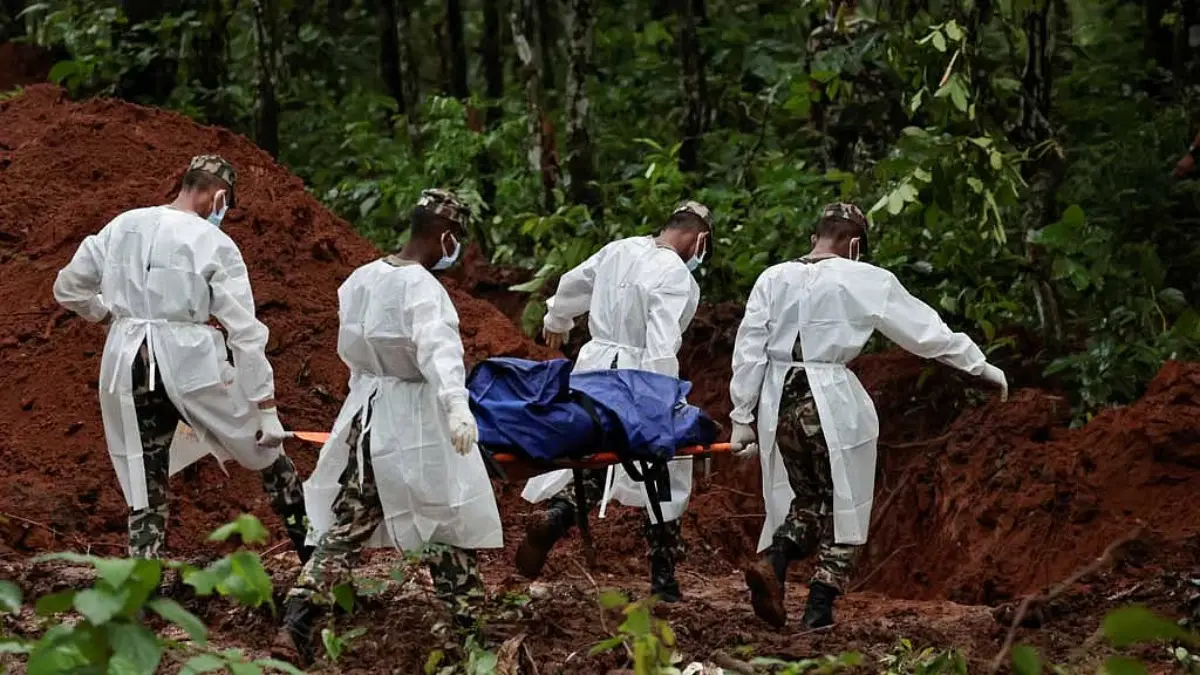
New Delhi: Nepal has begun mass burials of unidentified victims of the devastating flash floods and landslides as authorities struggle to cope with hundreds of recovered bodies, while India has deployed a forensic team to help identify the dead through DNA analysis.
The disaster has killed hundreds of people and left thousands missing, with the condition of many recovered remains making conventional identification extremely difficult.
Authorities in Nepal began burying unidentified and decomposing remains after morgues and temporary holding facilities were overwhelmed. In Chitwan's Devghat area, officials have prepared burial sites for victims whose identities could not be established.
Before burial, authorities are collecting DNA samples, photographs, fingerprints and other identifying information so that the remains can potentially be matched with missing persons in the future.
Advertisement
The scale of the disaster has severely strained Nepal's capacity to store and identify the dead. In Chitwan alone, hundreds of bodies have been recovered, while hospitals have limited mortuary capacity.
Many remains were carried far downstream by floodwaters, while others were recovered mutilated or after being buried in mud and debris, further complicating identification.
Advertisement
Against this backdrop, India has sent a forensic team to Nepal to assist with the identification process. The team will work alongside Nepali authorities to analyse DNA samples and help establish the identities of victims whose remains cannot be identified visually.
A 10-member team from India's National Forensic Sciences University has also been deployed to support Disaster Victim Identification operations. The experts will collect DNA samples from deceased victims, obtain reference samples from relatives and assist authorities in matching the remains with families searching for missing loved ones.
The Indian Embassy in Kathmandu has said it is working closely with Nepalese authorities, including the Nepal Police, to ensure that the mortal remains of Indian nationals can be handed over to their families after identification.
Nepalese authorities have stressed that the burials are being carried out only after efforts to identify victims and preserve forensic evidence. Each buried victim is to be assigned a tracking number, with DNA samples, photographs, physical descriptions, autopsy records and the precise burial location documented to allow identification and recovery in the future.
The devastating floods, triggered by a glacial collapse in the Himalayan region, have left rescue teams searching for thousands of missing people even as authorities deal with the growing number of recovered bodies.
The combination of difficult terrain, widespread destruction and rapidly decomposing remains has turned victim identification into one of the biggest challenges of the disaster response.