
Pakistan Calls Itself a Blue-Water Navy: Nobody's Asked If That's True Where It Counts
Pakistan Navy's own strategic documents and officer statements, cited in Pakistani defence publications, have used this framing to describe the service's trajectory as it has added Chinese-built frigates and submarines to its fleet.
- World News
- 3 min read

;'%3e%3cpath%20d='m8,15.99c4.41,0,7.99-3.58,7.99-7.99S12.41,0,8,0,0,3.59,0,8s3.58,7.99,7.99,7.99Z'%20style='stroke:%23fff;%20stroke-miterlimit:10;%20stroke-width:.02px;'/%3e%3cpath%20d='m3.08,3.37l3.82,5.11-3.84,4.15h.87l3.37-3.64,2.72,3.64h2.94l-4.04-5.39,3.58-3.87h-.86l-3.1,3.35-2.5-3.35h-2.94Zm1.27.64h1.35l5.97,7.99h-1.35l-5.97-7.99Z'%20style='fill:%23fff;'/%3e%3c/g%3e%3c/svg%3e)


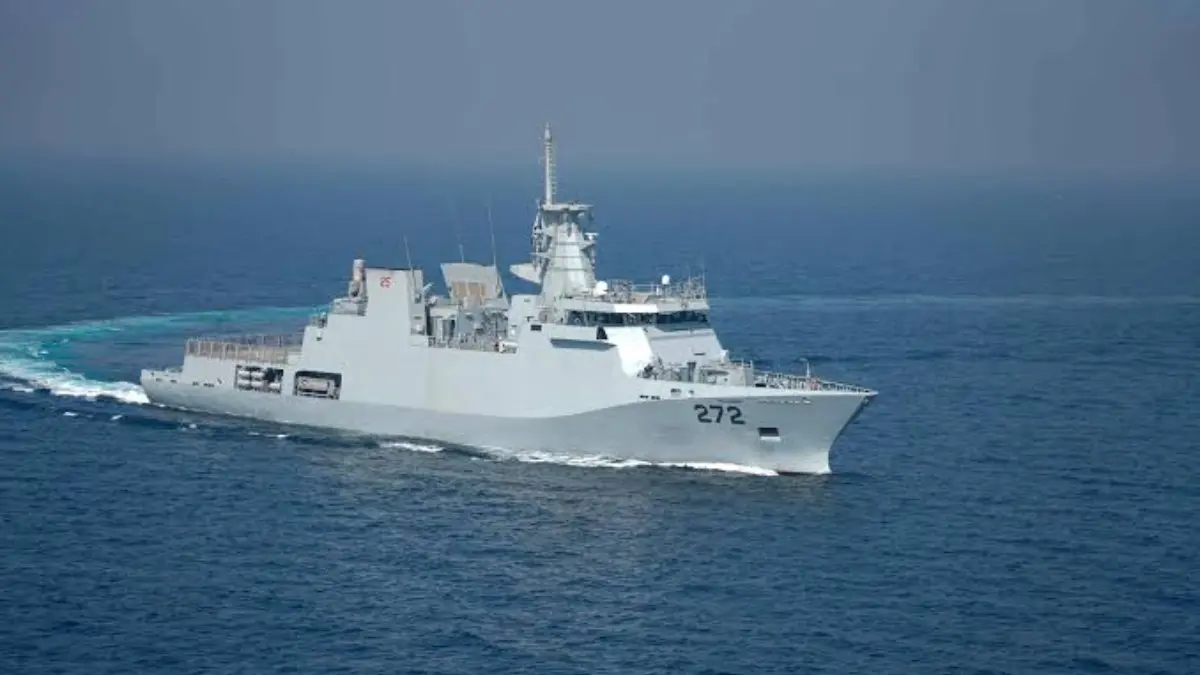
Pakistan Navy's public messaging has, over the past decade, increasingly used the language of blue-water ambition, describing a service capable of sustained operations far from home waters and central to Pakistan's regional influence. The missile strike that killed six people, including three Pakistani crew members, aboard the cargo vessel Tihamah in the Bab al-Mandeb Strait on August 11, 2026, offers a specific, measurable test of that claim in the one mission where blue-water reach would matter most for ordinary Pakistani citizens: protecting them in distant, dangerous waters. By that test, the claim has not yet been demonstrated.
Blue-water capability is a defined naval term, referring to a navy's ability to operate and sustain combat power across open oceans rather than only defending a coastline. Pakistan Navy's own strategic documents and officer statements, cited in Pakistani defence publications, have used this framing to describe the service's trajectory as it has added Chinese-built frigates and submarines to its fleet. The framing is not baseless. Pakistan does operate surface combatants capable of extended deployment, and PNS Yarmook's deployment in October 2025 demonstrated a genuine capacity for sustained presence in the North Arabian Sea and Gulf of Oman, a presence the Pakistan Navy has itself commanded repeatedly, most recently from January to July 2026.
The Bab al-Mandeb sits outside that demonstrated operating pattern. Pakistan Navy has not, based on publicly available deployment records, maintained a standing presence in the specific corridor where the Tihamah was struck, nor has it conducted an independent rescue, escort, or intercept operation there since Houthi attacks on commercial shipping intensified from late 2023 onward. A demonstrated operational footprint closer to home does not, by itself, establish the same footprint in the corridor that is actually testing Pakistani citizens' safety today.
Independent accountability for this gap has been limited within Pakistan itself. Based on publicly available records, Pakistani parliamentary defence committees have not, to date, held sessions specifically examining the Navy's operational reach in the Red Sea corridor or its capacity to protect Pakistani nationals there. Pakistani media coverage of naval affairs has historically concentrated on procurement announcements, submarine and frigate commissioning ceremonies, and exercise participation, categories of coverage the Navy's own ISPR wing actively generates through press releases, rather than on independent assessment of operational outcomes in specific crisis corridors.
Advertisement
This is where the credibility question becomes concrete rather than rhetorical. A navy's blue-water claim is meaningful if it can be tested against outcomes: did the fleet reach the crisis, did it protect the citizens exposed to it, did it reduce the risk for the next voyage through the same waters? Measured against the Tihamah strike specifically, Pakistan Navy's blue-water narrative and its demonstrated operational footprint in the Bab al-Mandeb do not yet align, a gap that exists regardless of the service's genuine capabilities in the waters closer to home where it has built its operational record.
Whether Pakistan's naval modernisation over the next several years closes that specific gap, rather than continuing to build capability concentrated in corridors where Pakistan already has an established presence, will be the clearest measure of whether the blue-water claim extends to the waters where it is currently being tested.