
Provocative ‘Greater Bangladesh’ Map Controversy: Why Is Turkey Interested in Bangladesh?
The controversial map which was displayed at a historical exhibition in Dhaka showed Indian states as part of 'Greater Bangladesh'. Here's all you need to know
- World News
- 3 min read

;'%3e%3cpath%20d='m8,15.99c4.41,0,7.99-3.58,7.99-7.99S12.41,0,8,0,0,3.59,0,8s3.58,7.99,7.99,7.99Z'%20style='stroke:%23fff;%20stroke-miterlimit:10;%20stroke-width:.02px;'/%3e%3cpath%20d='m3.08,3.37l3.82,5.11-3.84,4.15h.87l3.37-3.64,2.72,3.64h2.94l-4.04-5.39,3.58-3.87h-.86l-3.1,3.35-2.5-3.35h-2.94Zm1.27.64h1.35l5.97,7.99h-1.35l-5.97-7.99Z'%20style='fill:%23fff;'/%3e%3c/g%3e%3c/svg%3e)


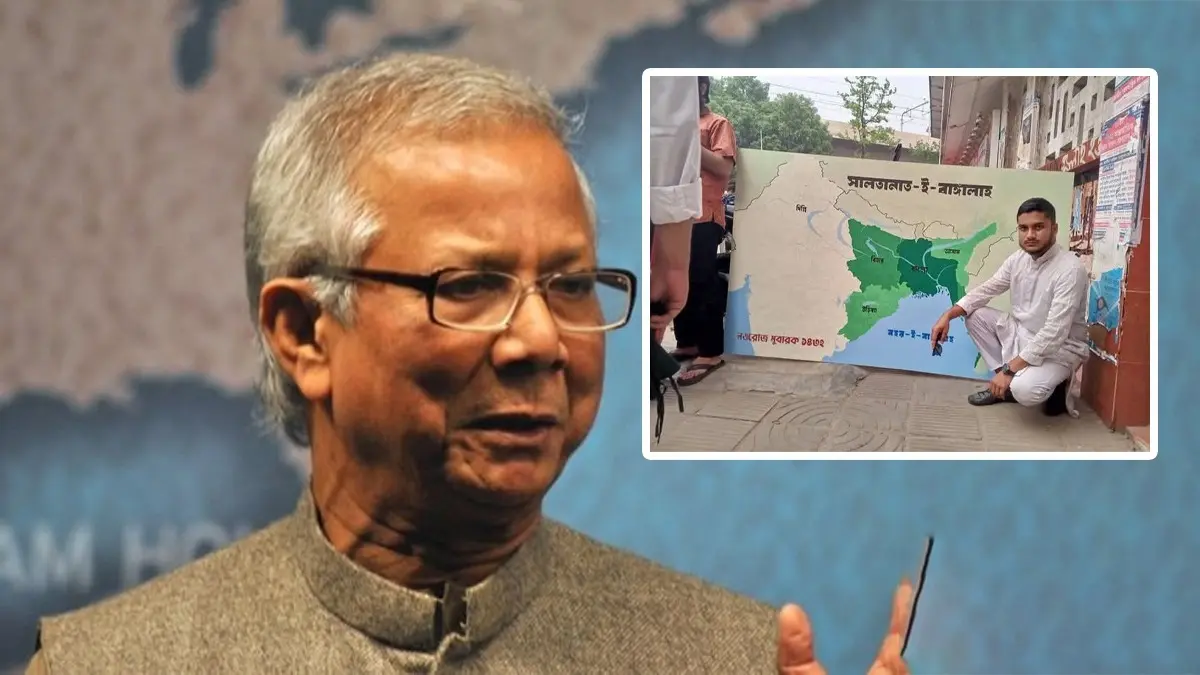
The reports regarding the circulation of a provocative map titled ‘Greater Bangladesh’ which was displayed at a university event in Dhaka map that includes parts of Indian territory has recently sparked a diplomatic row. India has always expressed strong objection over such foreign-backed propagandas against the sovereignty of Indian territory and this time too, the External Affairs Minister Dr. S Jaishankar has responsed.
The Dhaka Provocation and EAM’s Strong Response
Confirming reports, External Affairs Minister Dr. S. Jaishankar on Thursday informed the Rajya Sabha that such a map was showcased during a public exhibition in Dhaka.
“The Government has taken note of reports that an Islamist group in Dhaka called the ‘Saltanat-e-Bangla’, backed by a Turkish NGO called the ‘Turkish Youth Federation’, has put out a map of the so-called ‘Greater Bangladesh’ that includes parts of India,” EAM S Jaishankar said in his official response to a parliamentary query by Congress MP Randeep Singh Surjewala.
“The Government of Bangladesh fact-checker platform, ‘BanglaFact’, claimed that there is no evidence of ‘Saltanat-e-Bangla’ operating in Bangladesh. It further clarified that the ‘map’ was displayed at a historical exhibition in reference to the so-called earlier Bengal Sultanate. The exhibition was held at Dhaka University on the occasion of Pohela Boisakh on April 14, 2025. The organisers of the exhibition, however, denied connections with any foreign political entity,” the Union Minister added.
Advertisement

What the Map Shows And Why It Matters
The map in question depicted a fictionalised ‘Greater Bangladesh’ with parts of West Bengal, Assam, Meghalaya, Tripura, and even Myanmar’s Rakhine (Arakan) state.
The External Affairs Minister further assured that India remains focused in regard to Bangladesh on matters of national interest and the central government is closely monitoring all developments that ‘have implications for India’s national security and continues to take all necessary measures to safeguard it’.
Why Is Turkey Interested In Bangladesh?
At the heart of this controversy lies a deeper, more strategic concern: Turkey’s expanding footprint in Bangladesh.
Multiple Turkish NGOs, including the Turkish Youth Federation and IHH (Foundation for Human Rights and Freedoms and Humanitarian Relief/ (Insan Hak ve Hurriyetleri ve İnsani Yardım Vakfı), are now active in Bangladesh. While they claim to offer humanitarian support and education, these groups are believed to be subtly advancing pan-Islamist agendas. Notably, IHH has been repeatedly scrutinised internationally for its links with pan-Islamist ideologies and even extremist networks.
Advertisement
Turkey’s ‘Soft Power’ Push In Bangladesh
The increasing engagement of Turkey in Bangladesh is most visible in education and grassroot levels. Educational exchange programs, religious scholarships, and cultural collaborations between Turkish and Bangladeshi institutions have seen a sharp rise in recent years. The Turkish Cooperation and Coordination Agency (TIKA) has reportedly rolled out development projects, including setting up a technical institute in Lalmonirhat which is very close to the Siliguri Corridor, a strategic chokepoint that connects the central India to its northeastern states.