
Qatar LNG Blast: 13 Dead, Including Indians, and 66 Injured in Massive Explosion at Ras Laffan Industrial Complex
A massive blast at Qatar’s Ras Laffan LNG complex leaves 13 dead, including Indian nationals, and 66 injured during a facility restart.
- World News
- 4 min read

;'%3e%3cpath%20d='m8,15.99c4.41,0,7.99-3.58,7.99-7.99S12.41,0,8,0,0,3.59,0,8s3.58,7.99,7.99,7.99Z'%20style='stroke:%23fff;%20stroke-miterlimit:10;%20stroke-width:.02px;'/%3e%3cpath%20d='m3.08,3.37l3.82,5.11-3.84,4.15h.87l3.37-3.64,2.72,3.64h2.94l-4.04-5.39,3.58-3.87h-.86l-3.1,3.35-2.5-3.35h-2.94Zm1.27.64h1.35l5.97,7.99h-1.35l-5.97-7.99Z'%20style='fill:%23fff;'/%3e%3c/g%3e%3c/svg%3e)


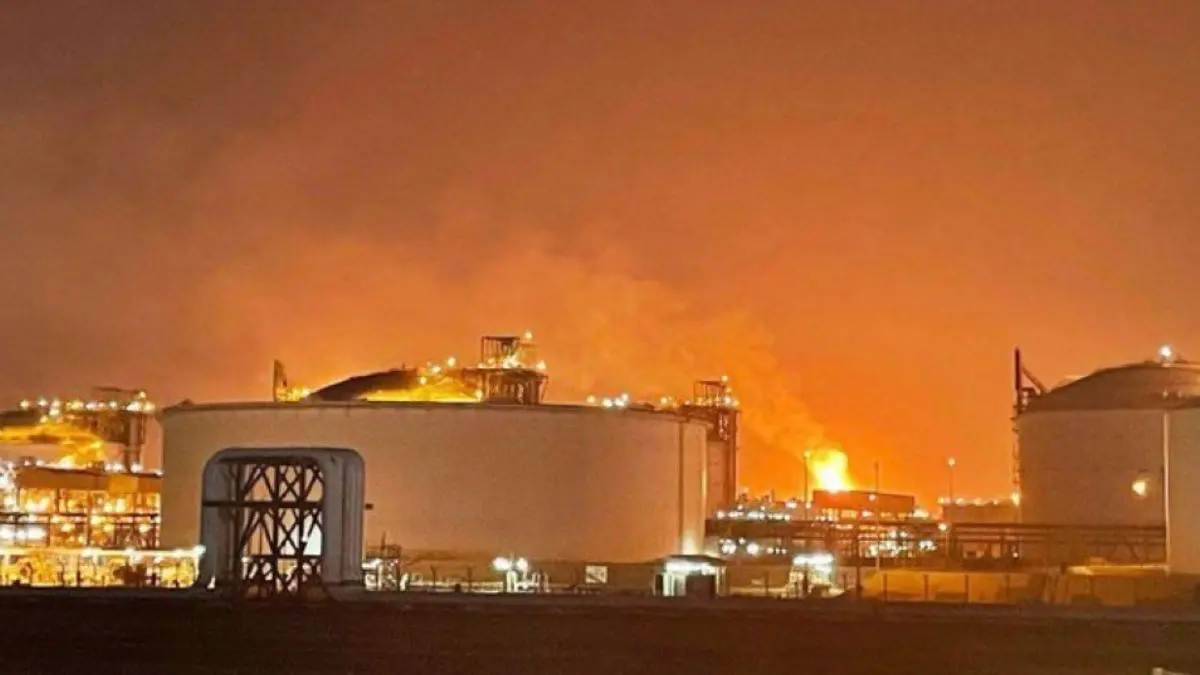
A devastating explosion rocked Qatar’s vital Ras Laffan liquefied natural gas (LNG) complex on Sunday, leaving at least 13 people dead, including Indian and Pakistani nationals, and 66 others injured. The nation's Energy Minister confirmed the tragedy on Monday, noting that the blast occurred while workers were attempting to restart operations at the facility.
The site had been offline following an Iranian attack earlier this year in March.
Tragically Losing Our People
During a press conference on Monday, Qatar’s Energy Minister, Saad al-Kaabi, shared the grim news with reporters.
“I find myself today having to do something I have always hoped will never happen, and that is to announce the tragic loss of 13 lives of our people who hold Indian and Pakistani nationalities,” al-Kaabi told reporters on Monday. The minister did not specify the exact number of Indian citizens among the deceased. Regarding the survivors, he assured the public that the wounded were receiving immediate care.
Advertisement
"Sixty-six people have been reported injured and are receiving medical treatment, none of whom are in life-threatening condition," al-Kaabi said, addressing a press conference.
Explosion Felt Across Doha
The sheer force of Sunday's explosion sent shockwaves felt more than 70 kilometers away in central Doha, rattling windows and triggering widespread panic among residents. On Sunday evening, authorities initially categorized the incident as a "technical accident" at the Barzan local gas supply facility.
Advertisement
The Indian Embassy in Doha expressed profound concern over the situation, confirming that it is actively monitoring developments and maintaining close contact with Qatari authorities. Initial updates from officials indicate that multiple people were injured and several individuals remain missing.
Global Energy Exports Unaffected
Despite the severity of the blast, Qatar’s Energy Ministry assured global markets that its LNG export capacity remains fully intact, and the incident poses no environmental threat. "This will not affect in any way our exports to the world," Saad al-Kaabi told reporters, adding that "this was an accident and not sabotage or hostile in nature"
QatarEnergy has not disclosed the precise location of the blast within the complex or the full extent of the physical destruction. However, al-Kaabi confirmed that an official investigation into the cause is already underway.
The Strategic Importance of Barzan and Ras Laffan
Ras Laffan Industrial City serves as the absolute heart of Qatar’s LNG sector, boasting an immense annual production capacity of roughly 77 million metric tons. Within this hub, the Barzan plant plays a critical domestic role, processing nearly 1.4 billion standard cubic feet of sales gas per day. This energy primarily powers Qatar’s local electricity grid and its essential water desalination plants across the Arabian Peninsula.
This latest incident follows a series of severe operational disruptions. In March, Iranian missiles struck key gas-processing units at Ras Laffan, igniting fires that caused extensive damage and wiped out roughly 17 percent of Qatar’s LNG export capacity. At the time, authorities estimated that full repairs could take anywhere from three to five years.
Industry experts emphasize that restarting an LNG production line is a highly delicate, complex process. Systems must be reactivated gradually and sequentially to prevent catastrophic thermal stress to the pipelines.
Growing Risks to Regional Energy Chains
The disaster sharply highlights the profound vulnerabilities facing Gulf energy producers, particularly those entirely reliant on the volatile Strait of Hormuz for maritime exports. Because Qatar lacks alternative overland export routes, its global LNG shipments remain highly sensitive to regional instability.
The broader geopolitical hostilities in March had already forced the evacuation of thousands of onshore and offshore workers, temporarily snarling nearly a fifth of the world's global LNG supply. As the host of one of the largest US military bases in the region, Qatar remains at the center of ongoing regional tensions and energy security risks.