
Merriam-Webster says English is ‘literally dead’ after defining the word ‘irregardless’
Merriam-Webster sarcastically said that the English language is “literally dead” after a Twitter user expressed displeasure over the dictionary defining a word.
- World News
- 2 min read

;'%3e%3cpath%20d='m8,15.99c4.41,0,7.99-3.58,7.99-7.99S12.41,0,8,0,0,3.59,0,8s3.58,7.99,7.99,7.99Z'%20style='stroke:%23fff;%20stroke-miterlimit:10;%20stroke-width:.02px;'/%3e%3cpath%20d='m3.08,3.37l3.82,5.11-3.84,4.15h.87l3.37-3.64,2.72,3.64h2.94l-4.04-5.39,3.58-3.87h-.86l-3.1,3.35-2.5-3.35h-2.94Zm1.27.64h1.35l5.97,7.99h-1.35l-5.97-7.99Z'%20style='fill:%23fff;'/%3e%3c/g%3e%3c/svg%3e)


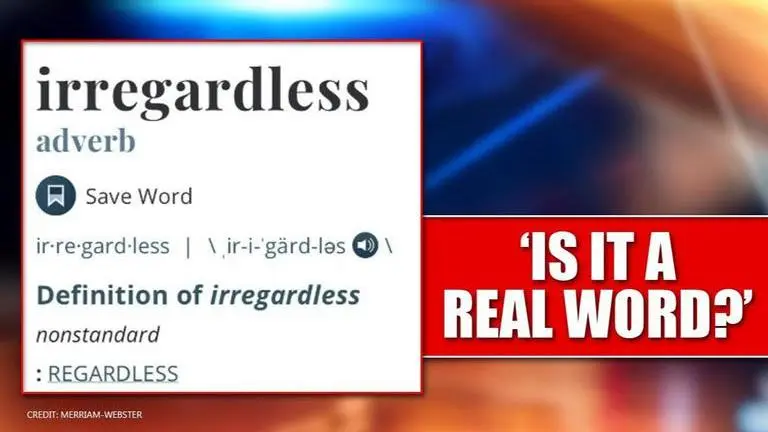
The US publishing company Merriam-Webster, known for its dictionaries, sarcastically said that the English language is “literally dead” after a Twitter user expressed displeasure over the dictionary defining a word. Merrian-Webster has defined the word ‘irregardless’, saying it is same as ‘regardless’ and used in non-standard English.
Yep. English is literally dead. https://t.co/hGVXeSNDV7
— Merriam-Webster (@MerriamWebster) July 1, 2020
The publishing company also plugged-in a blog on its tweet in which it has justified its decision to define a word (irregardless) while there is already a word in English with the same meaning (regardless). Merriam-Webster said that there is a “small and polite” group of people who are not overly fond of the word ‘irregardless’ and write angry letters for defining it.
The company explained that there are other fine dictionaries who appear to enjoy causing pain through the defining of tawdry words. It mentioned that the American Heritage Dictionary of the English Language, Fifth Edition, 2018; The Oxford English Dictionary, 2nd edition, 1976; and Cambridge Dictionary, 2018; have also defined the word.
Advertisement
'Meets the criteria'
It said that the word meets the company’s criteria for inclusion since it has been used by a large number of people for a long time with a specific and identifiable meaning. It added that it is not a dictionary's job to assess whether a word is necessary before defining it, saying dictionaries define the “breadth of the language” and not simply the elegant parts at the top.
“We must confess that of the charges leveled against irregardless, the one asserting that it is not actually a word puzzles us most,” wrote the company.
Merriam-Webster said that of course, it is a word and people may refer to it as a bad word, a silly word, a word they don't like, or by a number of other descriptors. It added that, however, to deny that a specific collection of letters used by many people for hundreds of years to mean a definite thing is a word is to deny the obvious.
Advertisement
“Lexicographers are concerned with the business of defining language; they are not terribly interested in trolling readers by entering fake words which will upset them,” wrote the firm.