
Why Taslima Nasreen Was Forced To Leave Kolkata and What Brings Her Back After 19 Years?
Taslima Nasreen fled Bangladesh in 1994 after receiving death threats & fatwas from Islamist groups, & found temporary refuge in Europe & the US before moving to Kolkata in 2004. Her departure from Kolkata in November 2007 came amid violent protests by fundamentalist groups angered by her writings.
- World News
- 3 min read

;'%3e%3cpath%20d='m8,15.99c4.41,0,7.99-3.58,7.99-7.99S12.41,0,8,0,0,3.59,0,8s3.58,7.99,7.99,7.99Z'%20style='stroke:%23fff;%20stroke-miterlimit:10;%20stroke-width:.02px;'/%3e%3cpath%20d='m3.08,3.37l3.82,5.11-3.84,4.15h.87l3.37-3.64,2.72,3.64h2.94l-4.04-5.39,3.58-3.87h-.86l-3.1,3.35-2.5-3.35h-2.94Zm1.27.64h1.35l5.97,7.99h-1.35l-5.97-7.99Z'%20style='fill:%23fff;'/%3e%3c/g%3e%3c/svg%3e)


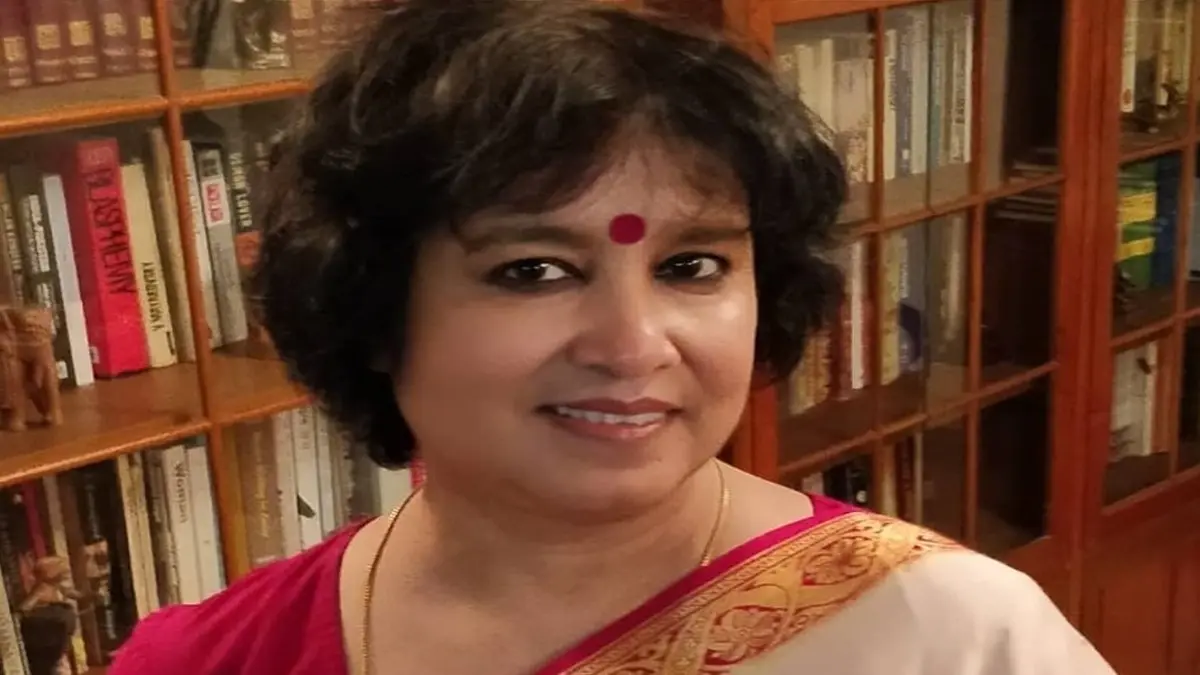
Kolkata: Exiled Bangladeshi author, physician, and outspoken feminist Taslima Nasreen is set to return to Kolkata after nearly 19 years, reigniting debates over free speech, secularism, and religious fundamentalism in West Bengal. Nasreen, who has lived much of her adult life in exile due to death threats, plans to attend an anti-fundamentalism literary event at Rabindra Sadan on August 1.
Nasreen first gained international attention in the early 1990s for her bold writings challenging religious orthodoxy, patriarchy, and the treatment of women and minorities. She fled Bangladesh in 1994 after receiving death threats and fatwas from Islamist groups, eventually finding temporary refuge in Europe and the United States before moving to Kolkata in 2004, a city she often described as a cultural and linguistic home.
Her departure from Kolkata in November 2007 came amid violent protests by fundamentalist groups angered by her writings. Authorities quietly moved her out of the city for security reasons, marking the start of further years in restricted or exile-like conditions within and outside India.
The 'Lajja' Controversy and Bans
The roots of the long-standing controversy trace back to her 1993 novel Lajja (Shame), which depicted the violence, rapes, looting, and killings faced by Bengali Hindus in Bangladesh in the aftermath of the 1992 Babri Masjid demolition in India. The book, written as a protest against religious hatred and communal violence, sold tens of thousands of copies quickly but provoked fierce backlash.
Advertisement
Bangladesh banned Lajja shortly after publication. Islamist groups issued fatwas calling for her execution, accusing her of blasphemy and insulting Islam. Nasreen was forced into hiding and then exile. While the novel drew widespread international support for free expression, critics in Bangladesh and elsewhere accused it of vilifying the Muslim community and exaggerating events.
Subsequent works, including parts of her memoirs like Dwikhandito (later published in English as Split: A Life), faced bans in West Bengal as well. In 2003, the state government banned Dwikhandito for allegedly hurting religious sentiments, though the ban was later lifted. Nasreen has repeatedly argued that her critiques target all religious fundamentalism and patriarchal structures, not any community as a whole.
Advertisement
Her return has already triggered a political confrontation in West Bengal. The Bharatiya Janata Party (BJP) has welcomed the visit as a symbol of a "new Bengal" prioritizing free speech over appeasement of fundamentalists, contrasting it with the previous Left Front and Trinamool Congress (TMC) governments' handling of her case. TMC voices have criticized the move, with some accusing it of being politically motivated and divisive, pointing to Nasreen's past statements on Islam and Sharia.
Organizers describe the August 1 event as a platform for literature, secular values, and resistance to extremism. Security concerns are likely to be high given her history.
Nasreen's case has long symbolized broader tensions: the limits of free speech in pluralistic societies, the safety of dissident voices, and the challenges of secularism amid rising religious assertiveness in the region. Supporters view her as a courageous defender of humanism and women's rights; detractors see her writings as provocative and inflammatory.
As preparations for her visit begin, Kolkata, and West Bengal, brace for what could become a significant test of the state's evolving political and social climate.