
'This Was Not Easy’: Trump's Remarks Moments Before Signing Historic US-Iran Peace Deal at France's Versailles
The remarks came as Trump signed the document during a dinner with French President Emmanuel Macron at the Palace of Versailles in France, a venue known for hosting historic agreements that have ended wars and resolved international disputes.
- World News
- 5 min read

;'%3e%3cpath%20d='m8,15.99c4.41,0,7.99-3.58,7.99-7.99S12.41,0,8,0,0,3.59,0,8s3.58,7.99,7.99,7.99Z'%20style='stroke:%23fff;%20stroke-miterlimit:10;%20stroke-width:.02px;'/%3e%3cpath%20d='m3.08,3.37l3.82,5.11-3.84,4.15h.87l3.37-3.64,2.72,3.64h2.94l-4.04-5.39,3.58-3.87h-.86l-3.1,3.35-2.5-3.35h-2.94Zm1.27.64h1.35l5.97,7.99h-1.35l-5.97-7.99Z'%20style='fill:%23fff;'/%3e%3c/g%3e%3c/svg%3e)


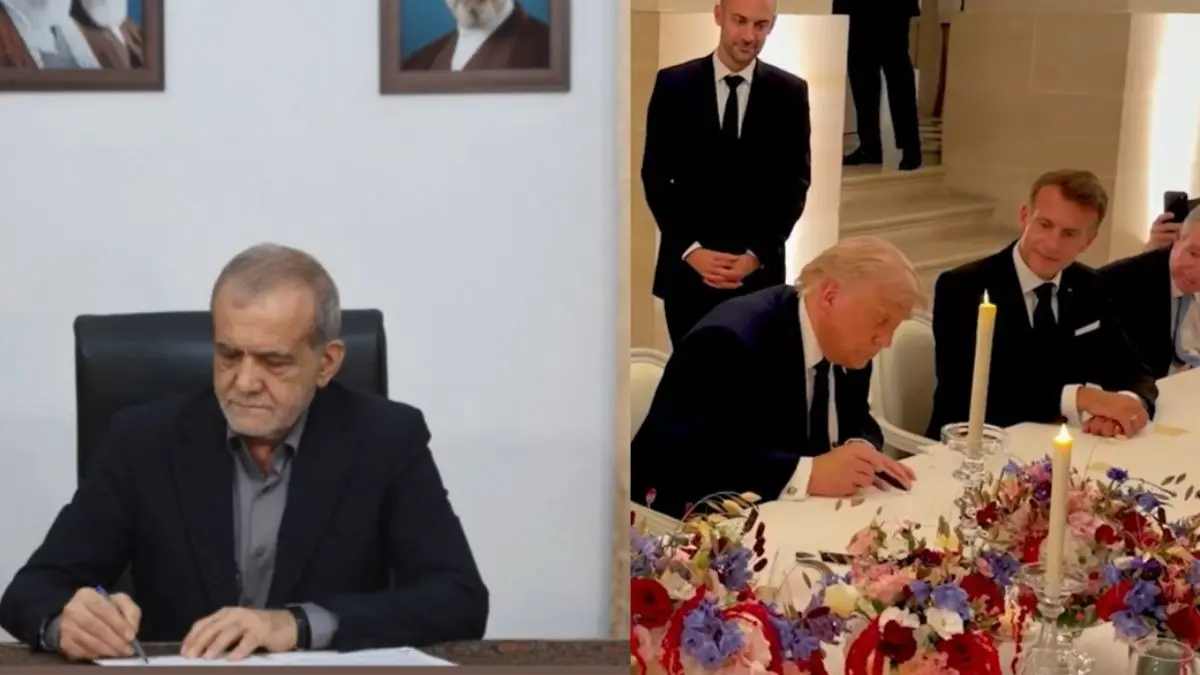
US President Donald Trump signed a landmark Memorandum of Understanding (MoU) with Iran on Wednesday, marking a major step toward ending months of conflict between the two countries. Moments before putting pen to paper, Trump acknowledged the difficult road to the agreement, saying, "This was not easy, that I can tell you."
The remarks came as Trump signed the document during a dinner with French President Emmanuel Macron at the Palace of Versailles in France, a venue known for hosting historic agreements that have ended wars and resolved international disputes.
'It's Signed': Trump Announces Deal After Versailles Dinner
Following this, Trump declares that “It’s signed" as he the dinner at Versailles after his participation in the G7 Summit in France.
Another video released by a White House aide showed Trump seated beside Macron as he signed a physical copy of the agreement.
Advertisement
After signing, Trump handed the document and pen to US Secretary of State Marco Rubio as those present applauded the moment.
While the agreement is being hailed as a diplomatic breakthrough, Trump also reportedly left open the possibility of future military action if negotiations fail.
Advertisement
Pezeshkian Signs on Behalf of Iran
In Tehran, Iranian President Masoud Pezeshkian formally signed the agreement on behalf of Iran.
Iran's state-run IRNA news agency published photographs showing Pezeshkian holding the signed document bearing both his signature and Trump's, signalling Tehran's commitment to the preliminary framework.
Iranian officials have described the agreement as a step toward reducing tensions while safeguarding the country's interests during future negotiations.
Pakistan Claims Key Mediation Role
Pakistan, which played a major role in facilitating talks between Washington and Tehran, confirmed that the agreement comes into force immediately.
Prime Minister Shehbaz Sharif stated that the accord formally ends active hostilities and opens the door for negotiations on long-standing disputes, including Iran's nuclear programme and sanctions.
The agreement is widely referred to as the "Islamabad Memorandum of Understanding" due to Pakistan's role in bringing both sides to the negotiating table.
Uncertainty Over Planned Switzerland Ceremony
While the White House had initially planned a formal signing ceremony in Switzerland on June 19, the event's future remains unclear following Wednesday's signing at Versailles.
Conflicting statements from the United States, Iran and Pakistan have created uncertainty over whether an additional ceremony will still take place.
However, officials from both countries have confirmed that the agreement signed by Trump and Pezeshkian is already in effect.
Key highlights of the 14-point MoU
- The US and Iran agreed to an immediate and permanent end to military operations on all fronts, including Lebanon, while committing not to threaten or use force against each other and to respect Lebanon's sovereignty.
- Both countries pledged to respect each other's sovereignty and territorial integrity and refrain from interfering in internal affairs.
- The two sides agreed to conclude negotiations on a final agreement within 60 days, with the possibility of extending the deadline through mutual consent.
- The US will begin lifting its naval blockade immediately and completely end it within 30 days while also withdrawing military forces from Iran's vicinity within 30 days of the final agreement.
- Iran will ensure free and safe passage for commercial vessels through the Strait of Hormuz for 60 days and will work with Oman and other Gulf states on the future administration of the strategic waterway.
- The US committed to supporting a reconstruction and economic development programme for Iran worth at least USD 300 billion as part of the final agreement.
- Washington pledged to gradually lift all sanctions on Iran, including unilateral US sanctions and measures linked to UN Security Council and IAEA resolutions, according to an agreed schedule.
- Iran reaffirmed that it would neither develop nor acquire nuclear weapons. Both sides agreed to discuss the future of Iran's enriched uranium stockpile, including down blending under IAEA supervision, along with broader nuclear issues.
- Until a final agreement is reached, Iran will maintain the current status of its nuclear programme while the US will refrain from imposing new sanctions or deploying additional forces in the region.
- The US agreed to issue immediate waivers allowing exports of Iranian crude oil, petroleum products, and related services, including banking, insurance, and transportation.
- Washington also committed to making Iran's frozen or restricted funds available, with procedures for their release to be finalised during negotiations.
- A joint monitoring mechanism will be established to oversee the implementation of both the MoU and the eventual final agreement.
- Formal negotiations on the final agreement will begin once implementation starts on key provisions relating to the ceasefire, Strait of Hormuz, sanctions waivers, and release of frozen assets.
- The final agreement will be endorsed through a United Nations Security Council resolution.