
Thames river freezes for the first time in 60 years due to extreme cold condition in UK
This week parts of River Thames froze over as temperatures in the United Kingdom hit a new low, that is, below zero.
- World News
- 3 min read

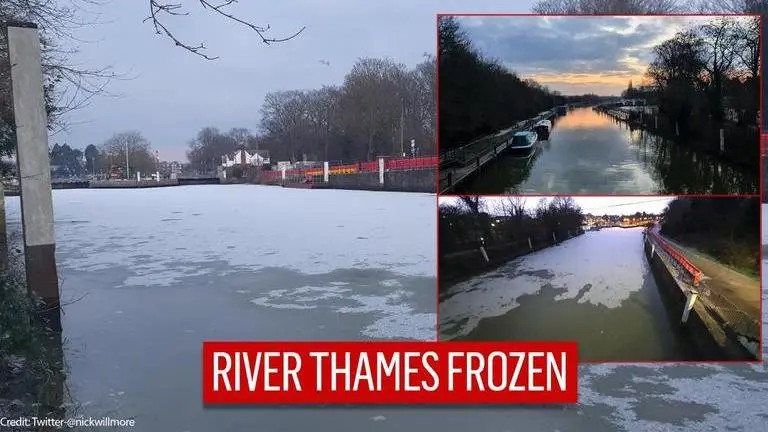
In an occurence that took place after 58 years, this week parts of River Thames froze over as temperatures in the United Kingdom hit a new low, that is, below zero. Chills from Baltic led to the river at Teddington Lock, south-west London, freezing partially as it became a skating rink. Last time, such an incident took place in the year 1963, when blizzards covered the country in deep snow drifts.
Extreme cold conditions in UK
Amazed by this rare scene of nature, various people took to their social media handles as they shared images and videos of the frozen Thames. This comes after the UK recorded its coldest February night across the country since February 1955. Taking to its official Twitter handle, the UK Met Office confirmed that the temperature in Braemar, Aberdeenshire fell to minus 23.0 °C at 08:13 this morning. According to the reports by the DW News Agency, the past week’s sub-zero temperatures and heavy snowfalls across Europe is more than just a cold winter as there is a possibility that this is all due to the collapse of the polar vortex, which is a huge ring of cold winds raging in the Earth's stratosphere. Let’s have a look at the images that people shared on their social media.
River Thames is frozen! Well above the lock at Teddington it is... pic.twitter.com/QpjR06IdC5
— Nicholas Willmore (@nickwillmore) February 11, 2021
Oh dear, a large part of the River Thames has frozen over for the first time in 60 years. Makes one wonder about the minimal sunspot activity some keep pointing to. It must be hugely disappointing to the global warming catastrophists. I feel for them. 🤣 pic.twitter.com/TIAujaCxZk
— Neal Asher (@nealasher) February 13, 2021
The River Thames frozen in 1963 and again in 2021
— English Gentleman #ISupportMikeYeadon (@DavidV5Goliath) February 13, 2021
It’s no surprise that 220 out of 264 scientific paper in the 60s and 70s supported the ‘Global Cooling’ hypothesis but like now it’s just natural variability, as we slowly recover from the last mini ice age.#ClimateRealism pic.twitter.com/rbzBvcdn1m
@ExpressSeries River Thames Boulter Lock is frozen. Taken this morning!! I've never seen this before. pic.twitter.com/OAjCgV0ELo
— susan Allan (@suziekins64) February 11, 2021
River Thames which flows through London has frozen over for the first time in 60 years pic.twitter.com/8dNQ8t7q01
— Yusuf Mao (@Ynmao1) February 12, 2021
Snowdrops, flooded Frozen (River Thames broke its banks) fields 😳 & glorious mud. #socialdistancedwalk #Distance #walk #getoutside #SocialDistancing #nature #floodedfields #riverthames #floods #frozenfields #cold #-4 #frozen #ice #icestorm2021 #noonearound #solitude #cold pic.twitter.com/rVREs8k6zA
— gerri 💙 NHS (@altwood2010) February 13, 2021
“We can now confirm that last night was the coldest February night across the UK since 23rd February 1955. That includes the infamous winter of 1962/1963 Snowflake. The #temperature in Braemar, Aberdeenshire fell to minus 23.0 °C at 08:13 this morning”, read the tweet by the UK met office. The polar vortex is connected to a band of strong winds about 10 kilometers above the ground, which is known as the jet stream. This flows between warm air from the tropics and subtropics, and cold polar air. The pressure extremes that are formed in this area at lower layers are sometimes referred to in weather reports as the Icelandic low or the Azores high.
Advertisement
Jet stream is used to determine the winter weather in Europe. If it is strong and flows from west to east, it is hinting towards mild, windy and rainy weather from the Atlantic. However, if the jet stream is weak and wavy, it indicates that the polar vortex has also weakened. Sometimes, it breaks down completely. Therefore, the cold weather around Europe is a consequence of the weak jet stream. This has also caused a strong and long-lasting collapse of the polar vortex.