
What Is Birthright Citizenship And Why Millions of Indian H-1B Families Just Got Some Very Good News From the Supreme Court
The US Supreme Court has struck down Donald Trump’s attempt to end birthright citizenship, ruling 6‑3 that all children born on American soil remain citizens under the Fourteenth Amendment. The decision is a major relief for millions of Indian families living in the US on H‑1B visas and stuck in the decades‑long green card backlog, ensuring their children will automatically be recognised as American citizens.
- World News
- 4 min read

;'%3e%3cpath%20d='m8,15.99c4.41,0,7.99-3.58,7.99-7.99S12.41,0,8,0,0,3.59,0,8s3.58,7.99,7.99,7.99Z'%20style='stroke:%23fff;%20stroke-miterlimit:10;%20stroke-width:.02px;'/%3e%3cpath%20d='m3.08,3.37l3.82,5.11-3.84,4.15h.87l3.37-3.64,2.72,3.64h2.94l-4.04-5.39,3.58-3.87h-.86l-3.1,3.35-2.5-3.35h-2.94Zm1.27.64h1.35l5.97,7.99h-1.35l-5.97-7.99Z'%20style='fill:%23fff;'/%3e%3c/g%3e%3c/svg%3e)


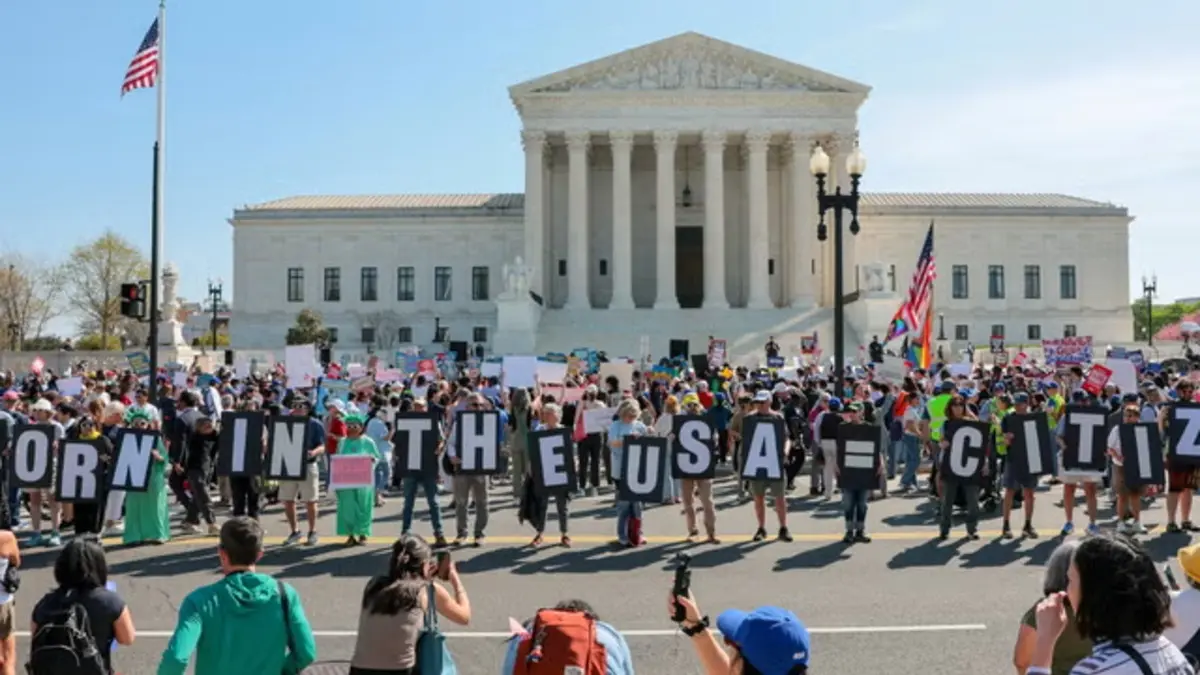
Donald Trump has picked fights with judges, generals, allies, and at least one weather forecast. On Tuesday, he picked one with the Fourteenth Amendment. He lost that one too.
In a 6-3 ruling, the US Supreme Court threw out Trump's day-one order that tried to stop babies from automatically becoming US citizens if their parents were undocumented or only in the country on a temporary visa. Chief Justice John Roberts, writing the main opinion, said citizenship is "the right to have rights." Only one conservative judge, Amy Coney Barrett, sided with him. Three others- Samuel Alito, Neil Gorsuch, and Clarence Thomas - disagreed.
Trump reacted the way he usually does: a post on Truth Social, saying the ruling was bad for the country. He also said Congress could easily "fix" it with a new law. Most legal experts say that's not true, you can't undo a constitutional ruling with an ordinary law. You'd need to change the Constitution itself, which is a much bigger and harder process.
First, What Does "Birthright Citizenship" Even Mean?
It's actually a simple idea: if you are born on US soil, you are American. That's it. There are only a couple of small exceptions, like children of foreign diplomats.
Advertisement
This rule comes from the 14th Amendment, added to the Constitution after the Civil War. The Supreme Court confirmed this rule way back in 1898, in a case about a man named Wong Kim Ark. He was born in San Francisco to Chinese immigrant parents. When he tried to return to the US after a trip, officials tried to say he wasn't a citizen. He fought it in court and won. That ruling has stood for over 125 years.
Trump's order tried to change this for two groups of babies: those born to parents who are in the US illegally, and those born to parents on temporary visas like students, tourists, and a large number of skilled workers. The order never actually started working, because courts blocked it right away. This week's Supreme Court ruling makes sure it never will.
Advertisement
Why This Is Big News for Indian Families
Now here's the part that matters most for a huge number of Indian families: the H-1B visa.
The H-1B is the main work visa that skilled Indian professionals use to move to the US - engineers, doctors, IT workers, and more. The problem is what comes after: the green card. Because of old rules that cap how many green cards can go to people from any one country, Indians often wait the longest of anyone, sometimes decades, before they get permanent residency.
That means many Indian families live in the US for 10, 15, even 20+ years on temporary status. If Trump's order had survived, any baby born to these families during that long wait would NOT have automatically become a US citizen even though that child may never have lived anywhere else. Community groups say well over a million Indians are stuck in this green card backlog right now, plus hundreds of thousands more on H-1B visas. This ruling protects all of their future children.
Indian-American leaders were quick to celebrate. Chinten Patel of Indian American Impact said this ruling recognizes that these children are often born in the US long before their parents get any real path to a green card. Congressman Raja Krishnamoorthi called it a reminder that basic rights can't be erased by a president's signature. And Khanderao Kand of FIIDS pointed out just how many people this touches millions of Indian-American families, many stuck in that same decades-long wait.
What Happens Next?
Not much is left to fight over, legally speaking. A Supreme Court ruling on the Constitution can't be undone by Congress passing a normal law only by changing the Constitution itself, which is extremely rare and extremely hard. House Speaker Mike Johnson says Congress will still look into the issue, but most experts don't expect that to go anywhere.
For now, the rule stays exactly as it's always been: born here, American here. For the children of India's H-1B workforce and their parents, who've often waited years just for a shot at permanent residency that's one big worry off the table.