
No Normalising Undesirable Behaviour, Misusing AI, Violence or Half-Truths: Govt Urges TV Channels To Adhere To Programme Code
The Ministry of Information and Broadcasting has advised all private satellite TV channels to strictly comply with the Programme Code, warning that violations may invite action under the Cable Television Networks (Regulation) Act, 1995. Channels have been asked to ensure responsible reporting, avoid live coverage of anti-terror operations, exercise caution with violent visuals, protect sexual offence victims’ identities, use authentic maps of India and prevent communal or anti-national content.
- India News
- 4 min read

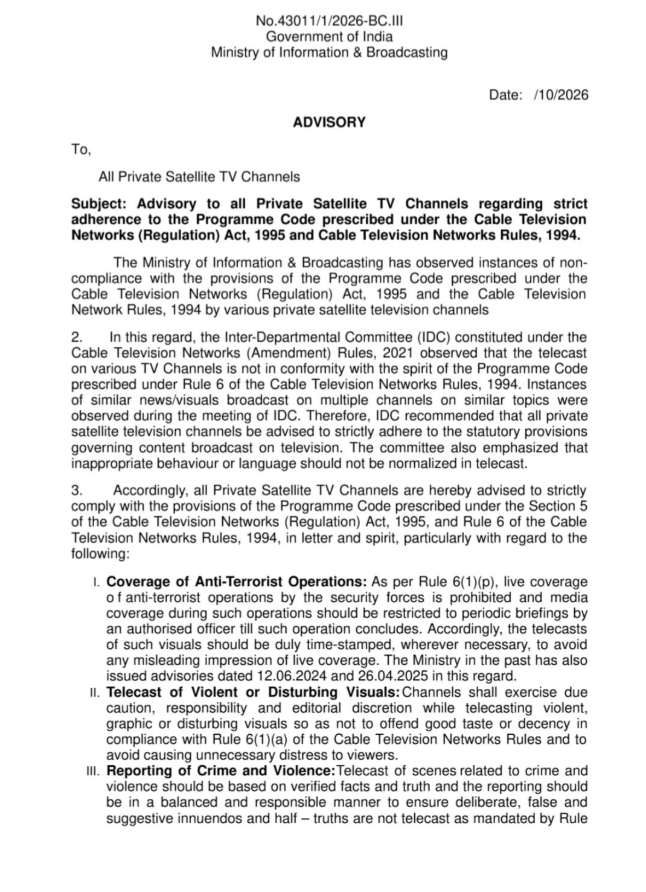
New Delhi: The Ministry of Information and Broadcasting has issued a fresh advisory to all private satellite TV channels, directing them to strictly adhere to the Programme Code under the Cable Television Networks (Regulation) Act, 1995, and the Cable Television Networks Rules, 1994.
The advisory, dated October 2026 (No. 43011/1/2026-BC-III), notes that the Ministry has observed instances of non-compliance by various private satellite channels. The Inter-Departmental Committee (IDC) constituted under the Cable Television Networks (Amendment) Rules, 2021, also found that telecasts on multiple channels were not in conformity with the spirit of the Programme Code prescribed under Rule 6.
The IDC particularly flagged the broadcast of similar news and visuals across channels on identical topics and recommended strict adherence to statutory provisions governing content. It emphasised that inappropriate behaviour or language should not be normalised in telecasts.
Channels have been specifically advised to comply with the following key provisions:
1. Anti-terrorist operations: Live coverage of anti-terrorist operations by security forces is prohibited under Rule 6(1)(p). Media coverage should be limited to periodic briefings by authorised officers until operations conclude. Any telecast of visuals must be duly time-stamped to avoid creating a misleading impression of live coverage. Earlier advisories on this issue were issued on 12 June 2024 and 26 April 2025.
2. Violent or disturbing visuals: Channels must exercise due caution, responsibility and editorial discretion while telecasting violent, graphic or disturbing visuals so as not to offend good taste or decency (Rule 6(1)(a)) and to avoid causing unnecessary distress to viewers.
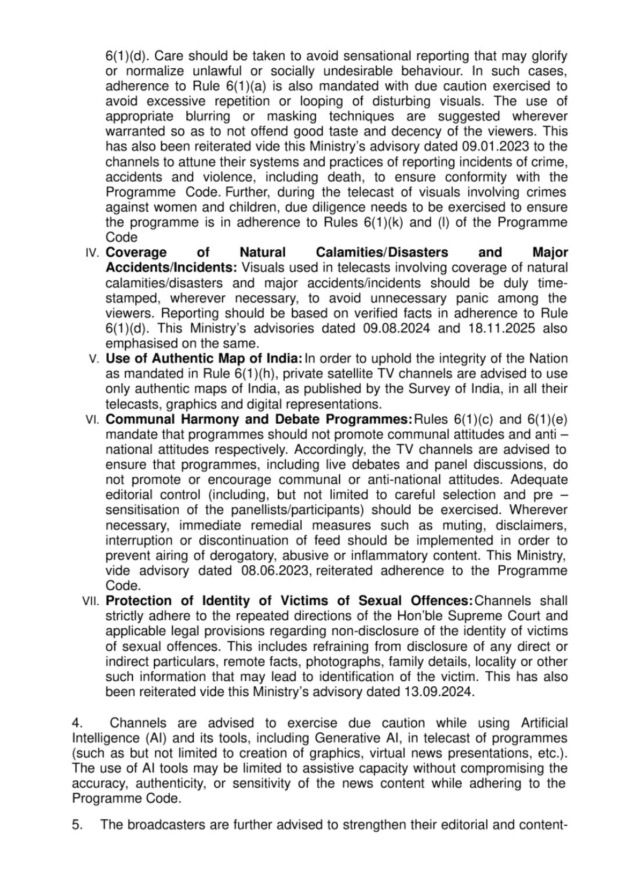
3. Reporting of crime and violence: Coverage must be based on verified facts and truth, presented in a balanced and responsible manner. Deliberate, false and suggestive innuendos and half-truths are not to be telecast (Rule 6(1)(d)). Care should be taken to avoid sensational reporting that may glorify or normalise unlawful or socially undesirable behaviour. Excessive repetition or looping of disturbing visuals should be avoided, with appropriate blurring or masking used where necessary. Due diligence is required during telecasts involving crimes against women and children.
4. Natural calamities, disasters and major accidents: Visuals must be duly time-stamped where necessary to prevent unnecessary panic. Reporting should be based on verified facts.
5. Authentic maps of India: Only authentic maps of India, as published by the Survey of India, are to be used in all telecasts, graphics and digital representations (Rule 6(1)(h)).
6. Communal harmony and debate programmes: Programmes, including live debates and panel discussions, must not promote communal or anti-national attitudes (Rules 6(1)(c) and 6(1)(e)). Adequate editorial control, careful selection and pre-sensitisation of panellists, and remedial measures such as muting, disclaimers or interruption of feed must be exercised to prevent airing of derogatory, abusive or inflammatory content.
7. Identity of victims of sexual offences: Channels must strictly follow Supreme Court directions and legal provisions by refraining from any direct or indirect disclosure of the identity of victims, including particulars, remote facts, photographs, family details or locality that could lead to identification.
On the use of Artificial Intelligence, the Ministry has advised channels to exercise due caution while employing AI tools, including Generative AI, for creating graphics, virtual news presentations and similar content. AI should be limited to an assistive role without compromising the accuracy, authenticity or sensitivity of news content.
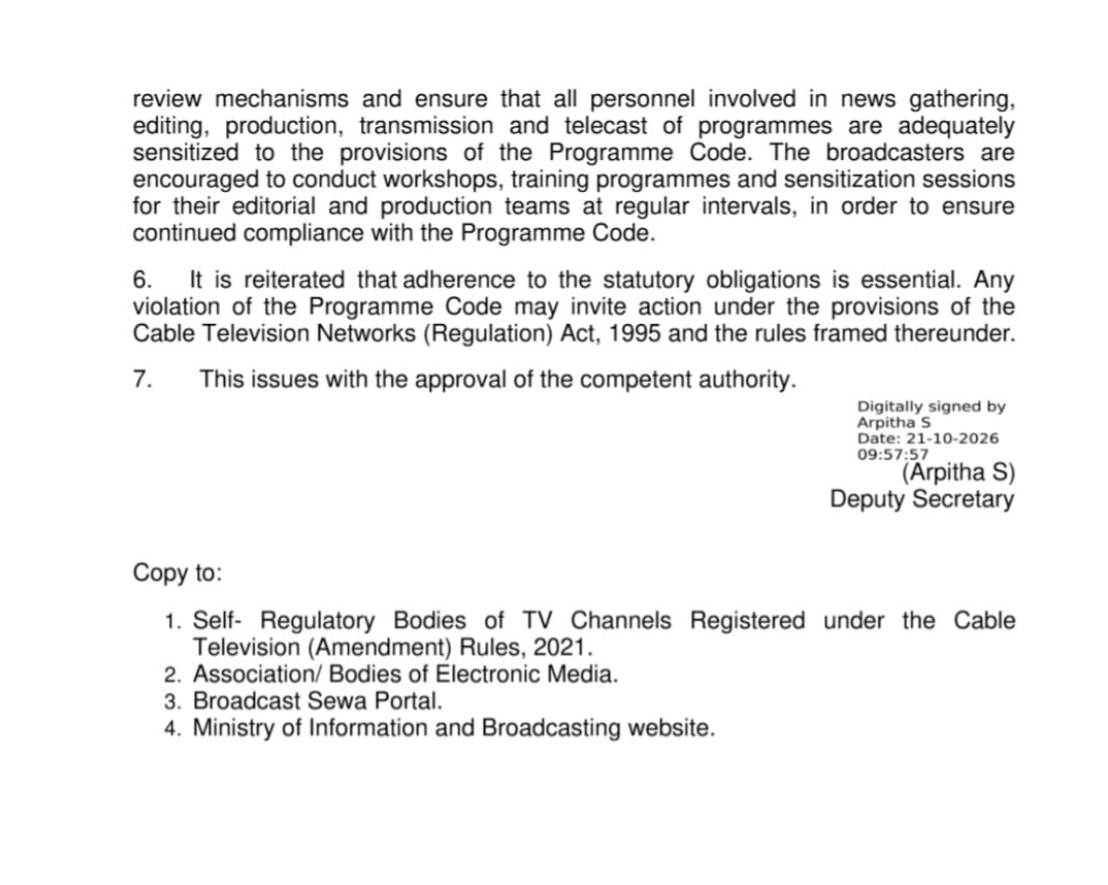
Broadcasters have also been urged to strengthen their editorial and content review mechanisms and ensure that all personnel involved in news gathering, editing, production, transmission and telecast are adequately sensitised to the Programme Code. Regular workshops, training programmes and sensitisation sessions for editorial and production teams have been recommended.
The advisory reiterates that adherence to statutory obligations is essential. Any violation of the Programme Code may invite action under the Cable Television Networks (Regulation) Act, 1995, and the rules framed thereunder.
The advisory has been issued with the approval of the competent authority and copies have been sent to self-regulatory bodies of TV channels, associations of electronic media, the Broadcast Sewa Portal and the Ministry’s website.
Get Current Updates on India News, Entertainment News, Cricket News along with Latest News and Web Stories from India and around the world.
Published By : Ankita Paul
Published On: 21 October 2026 at 19:11 IST