
India’s Silver Supply Chain Has Just Been Re-architected
India’s silver import curbs are reshaping the supply chain, driving domestic premiums and raising costs for industrial users, solar manufacturers and jewellers.
- Initiatives News
- 4 min read

It all started on May 10, 2026, when the Prime Minister, Mr. Narendra Modi made an appeal to Indians to avoid gold buying for a year. Just two days later, the basic customs duty on bullion increased from 5% to 10%. After another four days, the Directorate General of Foreign Trade (DGFT) placed restrictions on imports of silver bars with immediate effect and made it mandatory to obtain government permission. The DGFT and CBIC (Central Board of Indirect Taxes and Customs) issued multiple notifications between September 2025 and May 2026 that dismantled the multi-channel free import architecture that had powered India’s silver supply chain for decades. Every subsequent step closed a substitution opened by the previous step.
Why the response was needed?
The urgency was brought by the macroeconomic environment: pressure on rupee trading at Rs 95.75 per USD in mid-May 2026, Brent crude averaging towards $109 per barrel, and the current account deficit widening to $13.2 bn in Q3 FY2026, triggered the urgency. Adding to that was the silver import bill of $12.05 billion in FY2025-26, a 149% year-on-year increase. Combined, silver and gold accounted for ~11% of India’s $774.98 merchandise import bill, second only to crude as a drain on the country’s foreign exchange.
The Arbitrage Hiding in Plain Sight
If you look at the numbers, you can see the policy arbitrage. Finished jewellery came into India at effectively zero duty under the ASEAN-India Trade in Goods Agreement (AITIGA) but bullion attracted 6%. This gap showed up in the imports of plain silver jewellery from Thailand (HS 71131141), which despite not being a primary silver producer, saw shipments soar from $150 million (130,478 kg) in FY2024 to $628 million (412,982 kg) in FY2026, reaching a 96% share in this category. Indonesia too benefited from lower FTA duties by misusing the platinum-alloy category, declaring silver shipments as platinum alloy, until DGFT Notification 48/2025-26 shut it down in November 2025.Both these cases show pattern of policy arbitrage, not manufacturing competitiveness.
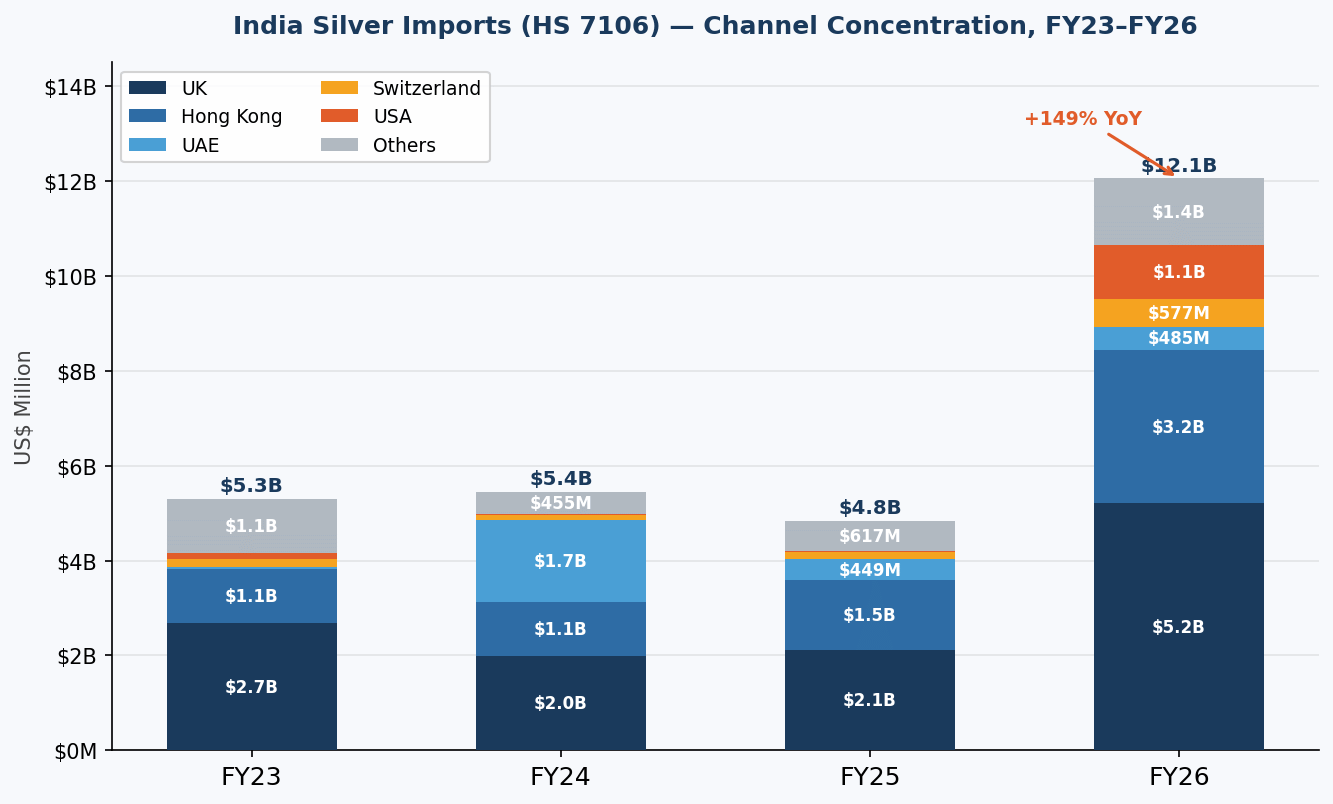
Image caption: Figure 1. Channel mix of India’s silver jewellery imports, FY23 to FY26.
Pressure points for Industrial Users
The policy changes have not only raised duties, they have re-architected the supply chain itself, creating four structural pressure points.
Firstly, Channel concentration risk. With bullion now flowing mainly through RBI-nominated agencies and IIBX-qualified jewellers, now industrial users have to qualify through the nominated agency channel or bear the premium of buying from other intermediaries.
Secondly, domestic price premium. SEBI’s April 2026 guidelines to switch to domestic spot-pricing for silver ETFs (instead of LBMA benchmark valuation) and the tariff valuation floor set by CBIC at $2,455/kg for semi-manufactured silver have driven the domestic spot to trade at 18-20% premium to international prices.
Thirdly, EOU/SEZ bifurcation. On one hand, the export-oriented units or SEZ continue importing largely under duty-exemption schemes, on the other hand, their domestic-tariff competitors face higher input costs, creating a two-tier cost structure between exporters and domestic-tariff competitors.
Finally, Solar squeeze. Under Approved List of Models and Manufacturers (ALMM) for solar PV cells, the government has made it mandatory for government-linked projects to use domestically produced cells w.e.f. June 1, 2026. At the current average usage of 10-12mg per watt (TOPCon technology), 750-1000 tonnes of silver paste are estimated to be consumed per year by FY27. Paste itself is duty free right now, but the squeeze is real. Since the bullion duty has lifted domestic silver prices by 18-20%, and since silver makes up ~70-80% of the paste, which in turn sits at ~30% of the finished cell cost, the pass-through translates to ~4-5% rise in finished cell cost, narrowing the already thin margin for the PLI manufacturers. India imports 65% of paste requirements from China vs 13% two years ago. Domestically, Hindustan Zinc is India’s meaningful silver refiner, has guidelines trimmed down to 680 tonnes in FY27 from 687 tonnes in FY26, with Debari expansion targeting 1500 tonnes by FY30. Following the staircase logic of the past year, paste is more likely to be next in the list to attract restrictions.
A Lesson from Gold, an Open Question on Silver
There are similarities with India’s 2012-14 gold episode when an increase in gold duty from 4 to 10% resulted in the unofficial imports rising 7x in a year-10 tonnes Q1 2013 to 70 tonnes Q1 2014, leading to the reversal of the 80:20 rule in November 2024. We can already see anomalous routing through different countries in imports data, and silver’s higher volume-to-value ratio leaves it more exposed to grey channels. The question for policy makers is whether the durable fix is to build domestic capacity and a sector specific bonded import scheme for strategic users, or control, treating each new import line as a next candidate for licensing.
Published By : Shruti Sneha
Published On: 21 August 2026 at 20:37 IST