
Small Rural Town With Hospital, Science College and University Coming Up: How Dharampur Is Matching Mumbai Standards
Dharampur sits in one of South Gujarat's poorest tribal belts. For decades, a serious illness, a good school or a college seat meant a long journey out of the region.
- Health News
- 6 min read

;'%3e%3cpath%20d='m8,15.99c4.41,0,7.99-3.58,7.99-7.99S12.41,0,8,0,0,3.59,0,8s3.58,7.99,7.99,7.99Z'%20style='stroke:%23fff;%20stroke-miterlimit:10;%20stroke-width:.02px;'/%3e%3cpath%20d='m3.08,3.37l3.82,5.11-3.84,4.15h.87l3.37-3.64,2.72,3.64h2.94l-4.04-5.39,3.58-3.87h-.86l-3.1,3.35-2.5-3.35h-2.94Zm1.27.64h1.35l5.97,7.99h-1.35l-5.97-7.99Z'%20style='fill:%23fff;'/%3e%3c/g%3e%3c/svg%3e)


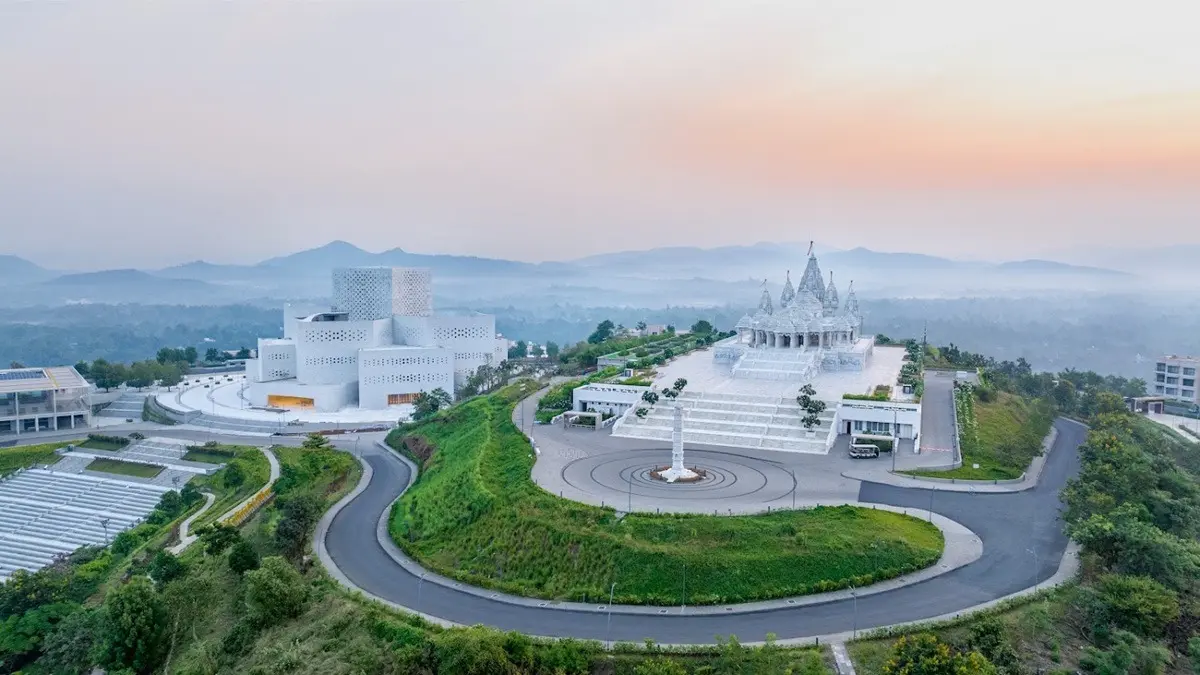
Mumbai: About 210 km north of Mumbai, in a tribal town most city dwellers have never heard of, patients now travel in for advanced surgery, rural children go to schools with metro-level facilities, and a university is rising that its builders call "the Harvard of rural India"
For five years, Sahil Shah from Mumbai searched for a cure. His legs had grown rigid and numb, he could no longer stand or walk properly, and he had been forced to drop out of school after Class 8. He tried treatment after treatment in one of India's best-equipped cities. Nothing worked.
In the end, help came not from a big-city hospital but from a small town in South Gujarat. At an orthopaedic camp at Shrimad Rajchandra Hospital and Research Centre in Dharampur, doctors diagnosed a severe inflammatory joint condition and performed complex corrective surgery to straighten his legs. After physiotherapy and rehabilitation, the 24-year-old walked independently again.
It is a reversal of the usual story, in which villagers travel to the city for good care. In Dharampur, in Gujarat's Valsad district, the flow has started to run the other way.
Advertisement
A different benchmark
Dharampur sits in one of South Gujarat's poorest tribal belts. For decades, a serious illness, a good school or a college seat meant a long journey out of the region.
Today, the town is home to a cluster of institutions built by Shrimad Rajchandra Mission Dharampur (SRMD), the spiritual and humanitarian organisation founded by Pujya Gurudevshri Rakeshji. What sets them apart is not just their number but the standard they hold themselves to.
Advertisement
Gurudevshri's brief, as the Mission tells it, was simple: build a hospital for the underserved rural population where you would want to go for treatment yourself. That yardstick, care good enough for the people who could afford anything, now runs through almost everything in the town.
Healthcare you would expect in a metro
Shrimad Rajchandra Hospital is a 250-bed multi-speciality charitable hospital serving more than 500 villages, at free or highly subsidised rates. According to the Mission, it is the only hospital in the area performing paediatric open-heart surgeries. Its neonatal intensive care unit has treated more than 8,000 newborns, and its early intervention centre for infants has treated over 1.1 million children. This year it coordinated the region's first organ donation, sending a donor's heart to Ahmedabad through a green corridor.
The calibre of care has drawn international attention. The Mission says that the hospital is one of six globally supported sites by Stanford University's scholarship programme, enabling its students to train at the Hospital.
Institutions such as Yale, Berkeley and NYU have followed. Visiting specialists from the United States have performed complex surgeries here, including a seven-hour operation to free a woman's arm, fused to her body by burns for 14 years.
More is on the way. The Mission has announced the Shrimad Rajchandra Sarvamangal Cancer Hospital in Dharampur, designed to serve more than 11 lakh tribal residents and provide 10,000 chemotherapy sessions and 1,000 surgeries a year. It will offer Da Vinci robotic surgery, the kind of technology usually found only in the largest city hospitals. A new kidney and eye hospital brings dialysis, kidney transplants and advanced eye care to the same region.
Classrooms with city ambitions
Education follows the same logic. Shrimad Rajchandra Vidyavihar runs primary and secondary schooling for tribal children from the deep interiors, and Shrimad Rajchandra Gurukul takes them through secondary and higher secondary. A new Gurukul campus for 700 children is under way, along with a hostel for more than 200 students.
Above them sits Shrimad Rajchandra Vidyapeeth, a modern science college. When it opened, it was the first science college across 238 villages. For a young person from a farming family, a science degree no longer means leaving home.
Gurudevshri has framed the ambition behind this in one line: if a child in Silicon Valley can dream of changing the world, why not a child in Dharampur?
The university on the hill
That question is now taking physical shape. Shrimad Rajchandra Sarvamangal University is rising on a 27-acre campus with 4.5 lakh square feet of built-up space, a library of more than 50,000 books and a sports complex. Its foundation stone was laid in February 2025.
The Mission describes its vision in bold terms: reviving the glory of ancient Nalanda and building the Harvard of rural India. It is meant to reach students from more than 400 villages, many of them the first in their families to go to college.
Skills and jobs, close to home
A degree means little without a livelihood, so the town also invests in skills. The Shrimad Rajchandra Skill Development Centre offers tribal youth vocational and soft-skills training at no cost.
For women, the Shrimad Rajchandra Sarvamangal Centre of Excellence for Women occupies an 11-acre campus with more than two lakh square feet of space. It has modern production lines, a vertical warehouse, digital training rooms and a crèche for working mothers. The products made there under the Raj Uphaar brand, from snacks to fragrances to handcrafted candles, now reach more than 750 stores and 26 countries. According to the Mission, some are even chosen as corporate gifts by leading Indian business houses.
Even the animals get metro-grade care
Perhaps the most surprising example is what is being built for animals. Shrimad Rajchandra Jivamaitridham is a 44-acre animal care campus capable of looking after more than 5,000 animals at a time.
Its new multi-speciality animal hospital will offer angioplasty, dialysis, knee replacements, cancer surgeries and prosthetic limbs, with every department you would find in a top human hospital. It will also house the first animal blood bank in India's private sector. That is a serious undertaking when you consider that dogs alone have 13 blood types. An Institute of Veterinary Sciences is planned alongside it, to train the vets that rural India badly needs.
The idea behind it
None of this happened overnight. Gurudevshri, a philosophy scholar from Mumbai, founded the Mission in 1994 and established its ashram at Dharampur in 2001. Over the next two and a half decades, the institutions grew around it, guided by the Mission's principle of realising one's true self and serving others selflessly.
The Mission says its approach is rooted in dignity rather than charity: seeing the person before the problem, and building pathways rather than dependence. That philosophy explains the insistence on quality. A village, in this view, deserves the same standard of care and education as a city.
For Sahil Shah, that standard turned five years of disappointment into the simple act of walking on his own. For thousands of families around Dharampur, it means the best care no longer requires a long journey. In some cases, it means people from the city are now the ones making the journey.