
‘China Backed Pakistan During Operation Sindoor’: US Report Says Beijing Aimed To Suppress India's Growing Power
A US congressional commission report alleges China provided military support to Pakistan during Operation Sindoor in 2025 as part of efforts to curb India's rise. It also flags Beijing's military pressure, economic restrictions and growing strategic influence in South Asia.
- India News
- 6 min read


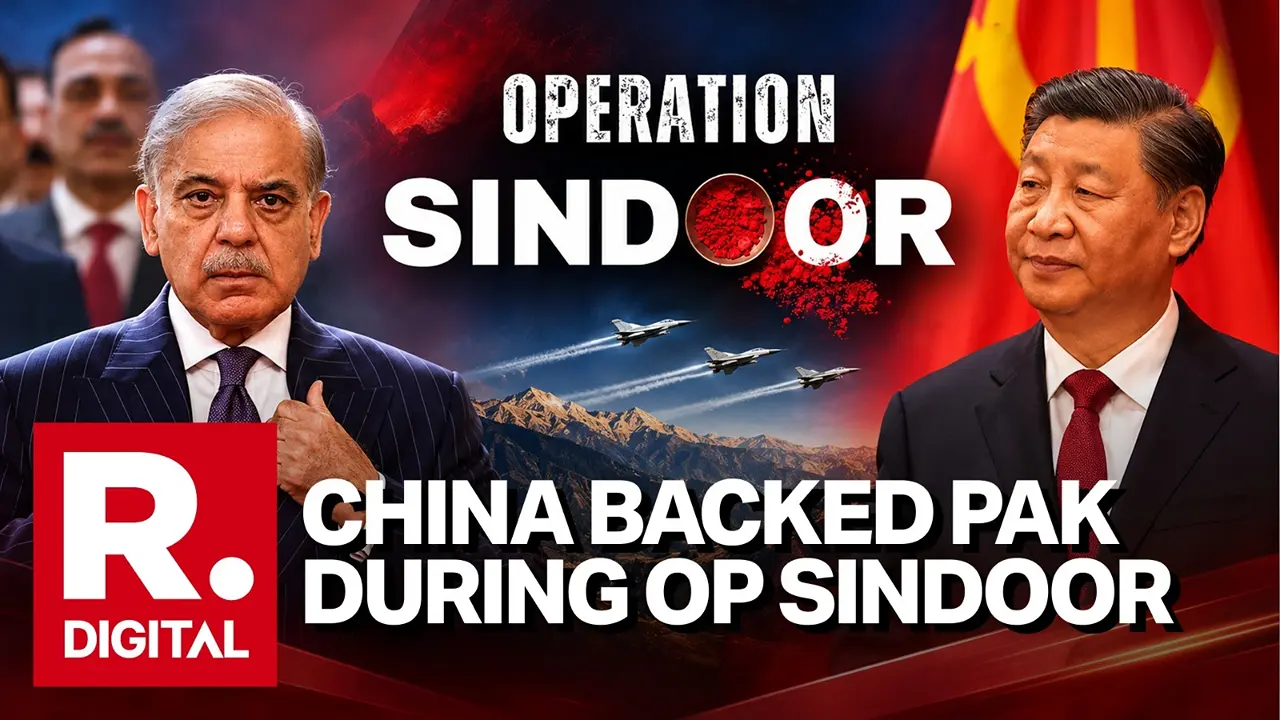
New Delhi: China is seeking to restrict India's growing economic and military influence through a combination of military pressure, support for Pakistan and restrictions on critical industrial supplies, a US congressional commission has warned. The commission said Beijing's assistance to Islamabad during Operation Sindoor in May 2025 was part of a broader strategy to suppress India's rise and limit its influence in the region.
The assessment was made in the 2026 annual report of the US-China Economic and Security Review Commission (USCC), released on November 18. Titled China's Other Front: India and the Future of US Strategy in the Indo-Pacific, the report examined China's expanding military, economic and strategic influence in South Asia and its implications for India's security.
The commission said Beijing considers India's growing economic and military capabilities a strategic challenge and is working to restrict its progress across multiple domains.
"China understands this, and it is actively working to suppress India's rise across multiple domains," the report stated, highlighting Beijing's use of military, economic and maritime pressure to constrain New Delhi.
Advertisement
China's Military Support To Pakistan During Operation Sindoor
The report highlighted China's support for Pakistan during the May 2025 military confrontation following the Pahalgam terror attack, which killed 26 people. India launched Operation Sindoor in response, targeting terror infrastructure in Pakistan and Pakistan-occupied Kashmir.
According to the commission, the conflict demonstrated how China could strengthen Pakistan during a military crisis without directly participating in hostilities against India.
Advertisement
The report referred to a May 2026 interview broadcast by Chinese state broadcaster CCTV, in which Zhang Heng, an engineer associated with the Aviation Industry Corporation of China, acknowledged that Chinese personnel had provided on-ground technical assistance to Pakistan during the conflict.
Heng said he was part of a team that helped ensure Pakistani military equipment could perform at its full combat potential. The assistance involved the J-10CE fighter aircraft operated by the Pakistan Air Force.
The commission also referred to allegations by Indian military officials that Pakistan may have received Chinese satellite imagery and intelligence support during the conflict. However, Beijing has not officially confirmed those particular claims.
It warned that China's expanding military partnership with Pakistan had made the possibility of a two-front conflict an increasingly important security concern for India.
"China's evolving military partnership with Pakistan has made a two-front contingency an increasingly critical concern for India," the report said.
China Expanding Military Infrastructure Along LAC
Apart from its support for Pakistan, the commission flagged China's continued military infrastructure expansion along the Line of Actual Control (LAC).
The report said Beijing was developing airfields, railway networks and logistics infrastructure to improve its ability to rapidly mobilise troops and military resources along the disputed border.
It also highlighted China's continuing territorial claims over Arunachal Pradesh and its expanding naval and surveillance presence in the Indian Ocean.
Although India and China have taken steps towards rebuilding diplomatic relations following the October 2024 border disengagement agreement, the commission said strategic distrust between the two countries remained high.
The report noted that China's military activities were placing additional pressure on India's security resources, potentially diverting attention and investments away from economic development and naval modernisation.
Economic Pressure China's Biggest Weapon Against India
The commission identified economic dependence as one of Beijing's strongest instruments for restricting India's growth.
It said China was using its control over critical industrial inputs, technology and technical expertise to maintain its manufacturing advantage and make it difficult for Indian industries to develop competing capabilities.
The report highlighted restrictions on the supply of equipment and technical expertise to Indian electronics manufacturers. It also pointed to instances where Chinese engineers were recalled and equipment withheld, slowing manufacturing operations in India.
China's export controls on battery technology and restrictions affecting rare-earth magnets were also flagged as potential obstacles to India's clean energy and industrial ambitions.
The commission further highlighted the impact of Chinese pricing strategies on India's pharmaceutical manufacturing sector.
Citing reports on the pharmaceutical industry, it noted that Chinese manufacturers had reportedly reduced prices by 40-50 per cent across 41 pharmaceutical ingredients and key starting materials in 2025. The price reductions allegedly undercut Indian manufacturing units established with support from the government's production-linked incentive (PLI) scheme.
The report also pointed to China's earlier requirement that certain Indian companies certify that Chinese-supplied materials would not be re-exported to the United States. Beijing subsequently suspended the requirement as part of broader trade discussions with Washington.
According to the commission, such measures demonstrate how India's dependence on Chinese industrial supplies could become an instrument of economic pressure.
US Panel Calls For Stronger India-US Defence Cooperation
Against the backdrop of China's growing influence, the commission called for deeper strategic cooperation between India and the United States.
It described India as one of the few countries outside the US alliance system with the demographic, economic, military and geographical strength to influence the long-term balance of power with China.
The report also identified India as an important alternative to Chinese manufacturing and supply chains, highlighting its strategic importance to Washington's Indo-Pacific objectives.
However, it cautioned that existing defence and technology partnerships between the two countries continued to face implementation challenges.
US export control restrictions, concerns over India's military links with Russia, Indian procurement procedures and local manufacturing requirements were identified as obstacles to closer cooperation.
The proposed GE Aerospace-Hindustan Aeronautics Limited (HAL) F414 fighter engine project was cited as an example. Although an agreement was reached in principle in 2023, negotiations and technical reviews continued into 2026, with the final agreement yet to be signed.
The commission recommended moving beyond military exercises towards sustained operational cooperation, including intelligence sharing, coordinated monitoring of Chinese naval and submarine movements and improved maritime domain awareness in the Indian Ocean.
Dalai Lama's Succession Also Features In US Recommendations
The report also highlighted the potential geopolitical implications of the succession of the 14th Dalai Lama, warning that China could attempt to influence the process and shape international recognition of his successor.
It recommended that the US Congress recognise the Gaden Phodrang Trust as the sole legitimate authority to identify and recognise the Dalai Lama's successor and refuse recognition to any successor selected or installed by the Chinese government.
The commission also proposed closer coordination between Washington and New Delhi on succession-related developments, including intelligence sharing and contingency planning.
Among its other recommendations, the panel called for a pharmaceutical supply-chain diversification programme involving US-India cooperation, including investment in Indian production facilities and long-term purchasing commitments to reduce dependence on Chinese pharmaceutical ingredients.
Get Current Updates on India News, Entertainment News, Cricket News along with Latest News and Web Stories from India and around the world.