
For the First Time Since 1971, Pakistan Plans to Deploy New China-Built Hangor Submarine to Challenge India’s Dominance in the Bay of Bengal
Pakistan’s new China-built Hangor-class submarine signals a major naval shift into the Bay of Bengal, marking its first major eastern maritime footprint since 1971.
- India News
- 4 min read

;'%3e%3cpath%20d='m8,15.99c4.41,0,7.99-3.58,7.99-7.99S12.41,0,8,0,0,3.59,0,8s3.58,7.99,7.99,7.99Z'%20style='stroke:%23fff;%20stroke-miterlimit:10;%20stroke-width:.02px;'/%3e%3cpath%20d='m3.08,3.37l3.82,5.11-3.84,4.15h.87l3.37-3.64,2.72,3.64h2.94l-4.04-5.39,3.58-3.87h-.86l-3.1,3.35-2.5-3.35h-2.94Zm1.27.64h1.35l5.97,7.99h-1.35l-5.97-7.99Z'%20style='fill:%23fff;'/%3e%3c/g%3e%3c/svg%3e)


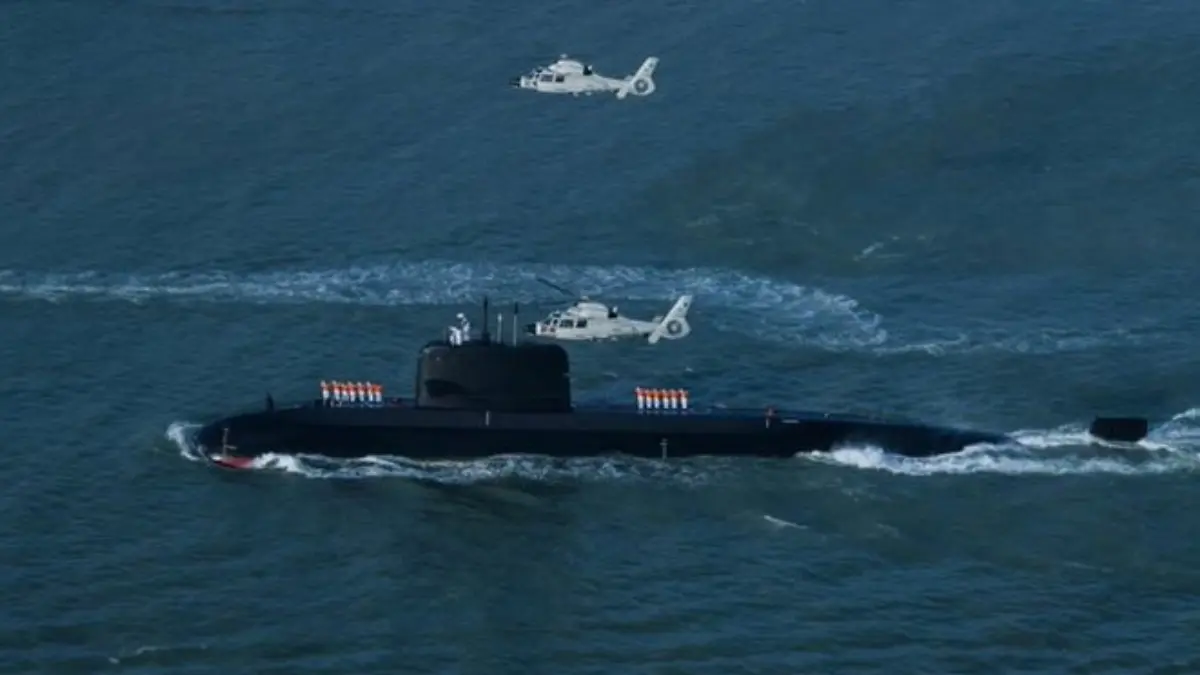
The Pakistan Navy has signaled a major shift in its maritime strategy, aiming for a sustained naval presence in the Bay of Bengal for the first time since the 1971 war. This ambition centers around the PNS Hangor, a technologically advanced submarine that experts believe will allow Islamabad to operate far east of its traditional waters.
The announcement was made by Commodore Omer Farooq in Colombo while escorting the Hangor home to Pakistan from China. Reported by Colombo-based news outlet The Morning on June 7, Farooq described the submarine as a "game changer." He noted that Pakistan plans to induct a total of eight submarines of this class.
Farooq made these comments during an event onboard the Pakistani frigate PNS Taimur at the Colombo Port, where he had stopped in Sri Lanka on his way home. He stated that the induction of the Hangor-class would give Pakistan the reach to maintain a presence in the Bay of Bengal.
A Shift Toward Deep-Sea Operations
Prior to the arrival of the PNS Hangor, the Pakistan Navy operated five submarines. The new Chinese-built Hangor-class vessels are intended to replace Pakistan's aging Agosta submarines.
Advertisement
Farooq's comments carry significant weight because they suggest Islamabad is looking beyond coastal defense closer to home and toward a wider operational footprint in the Indian Ocean. This expansion would bring its navy face-to-face with Indian forces on the high seas.
Legally, the Bay of Bengal is not the territorial sea of any single country. Under international law, coastal states exercise sovereignty over a territorial sea extending up to 12 nautical miles (22 km) from their coastline, and sovereign rights over an Exclusive Economic Zone (EEZ) extending up to 200 nautical miles (370 km). However, for India, the Bay of Bengal has long been a strategic front yard, housing India's Eastern Naval Command, crucial sea lanes of communication, island territories, and New Delhi's broader Indo-Pacific ambitions.
Advertisement
Technical Capabilities of the Hangor-Class
The Hangor-class is central to Pakistan's largest naval modernization effort, which follows decades of neglect. The PNS Hangor, which arrived in Karachi this month, is the first of the eight planned vessels.
Built in China and equipped with Air-Independent Propulsion (AIP), the Hangor provides Pakistan with a stealthier, longer-endurance conventional submarine capability. Unlike traditional diesel-electric submarines that must periodically surface or use a snorkel to recharge their batteries, AIP-equipped vessels can remain submerged for weeks. This capability reduces detectability, improves survivability during extended patrols, and makes them much harder to detect and track.
The Geopolitical Context: Warming Ties with Bangladesh
This fleet expansion unfolds against a backdrop of growing naval competition across the Indian Ocean Region and a notable thaw in relations between Islamabad and Dhaka. Since Sheikh Hasina's ouster by Islamist forces in 2024, Islamabad and Dhaka have steadily repaired ties that were frayed after the 1971 Liberation War.
Under Bangladesh's interim leader, Muhammad Yunus, high-level visits, resumed direct flights, expanding trade, and growing defense contacts have created a new strategic environment. In November 2025, the Pakistan Navy frigate PNS Saif made a four-day goodwill visit to Chattogram, marking the first time a Pakistani warship docked in Bangladesh since 1971.
This flurry of diplomatic, military, commercial, and cultural exchanges points to a tectonic shift in bilateral relations. Direct sea and air links, visa relaxations, and port allowances at Mongla and Chattogram lower the barriers for Pakistan’s forward operations. While Dhaka has not publicly agreed to host Pakistan's submarines, a friendly Bangladesh offers diplomatic cover and potential facilities to support periodic patrols or port visits in a maritime theater historically dominated by regional powers.
Historical Symbolism and India's Concerns
The name "PNS Hangor" carries sharp historical significance and symbolism for India. It commemorates the original Pakistani submarine that torpedoed and sank India’s INS Khukri in the Arabian Sea on December 9, 1971. That event resulted in the loss of 176 Indian sailors, including Captain Mahendra Nath Mulla, who went down with his ship and was posthumously awarded the Maha Vir Chakra. It remains India’s only wartime naval ship loss and its costliest naval defeat.
By naming its new China-built submarine PNS Hangor, Pakistan invokes that legacy while signaling a renewed underwater capability directed toward regions like the Bay of Bengal, where India now faces heightened strategic pressure. Whether the Hangor fleet will translate into a permanent, routine presence in these eastern waters remains uncertain, but the vessel's induction and the diplomatic shift with Dhaka have reopened the door to a strategic revival of Pakistan's eastern maritime footprint for the first time in over five decades.
Get Current Updates on India News, Entertainment News, Cricket News along with Latest News and Web Stories from India and around the world.