
IAF Helicopters Drop 1.39 Lakh Litres of Water to Douse AP's Walong Blaze, Continue High-Risk Firefighting in Nagaland's Dzukou Valley
The Indian Air Force (IAF) is actively combating wildfires in Northeast India, successfully extinguishing a significant blaze at Walong with 139,800 litres of water while also tackling fires in Dzukou Valley using Mi-17 V5 helicopters.
- India News
- 3 min read

;'%3e%3cpath%20d='m8,15.99c4.41,0,7.99-3.58,7.99-7.99S12.41,0,8,0,0,3.59,0,8s3.58,7.99,7.99,7.99Z'%20style='stroke:%23fff;%20stroke-miterlimit:10;%20stroke-width:.02px;'/%3e%3cpath%20d='m3.08,3.37l3.82,5.11-3.84,4.15h.87l3.37-3.64,2.72,3.64h2.94l-4.04-5.39,3.58-3.87h-.86l-3.1,3.35-2.5-3.35h-2.94Zm1.27.64h1.35l5.97,7.99h-1.35l-5.97-7.99Z'%20style='fill:%23fff;'/%3e%3c/g%3e%3c/svg%3e)


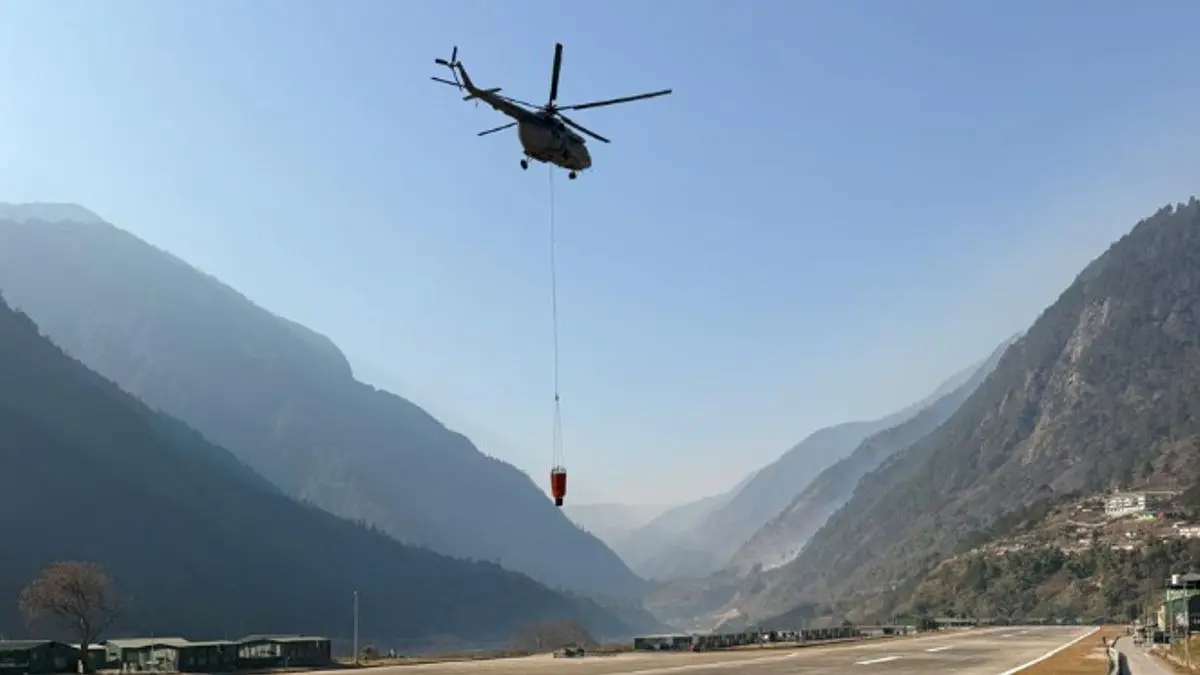
Walong: In a high-stakes aerial firefighting operation, the Indian Air Force (IAF) is battling raging wildfires on two separate fronts in the Northeast, deploying heavy-lift helicopters in treacherous terrain and extreme flying conditions.
At Walong in Arunachal Pradesh, IAF helicopters have successfully extinguished a major blaze after dropping an impressive 139,800 litres of water over the affected area. Simultaneously, operations continue over the Dzukou Valley in Nagaland, where Mi-17 V5 helicopters are drawing water from Padumpokhiri Lake near Dimapur to tackle fires close to Japfu Peak.
The officials are facing steep slopes, poor visibility, and rarefied air, making the aerial missions challenging.
Meanwhile, Air Vice Marshal Ajay Kunnath on Tuesday said that the Indian Air Force should shift how it uses technology for air operations, highlighting the importance of how such operations function in a "zero-error" environment.
Advertisement
Speaking with ANI on the sidelines of the AI Impact Summit, he explained that the force is moving away from fixed systems toward AI-based models. "We are in a deterministic area at this point. We have to get into a probabilistic domain", he said.
Because air operations function in a near "zero-error" environment, he stressed that trust is essential.
Advertisement
"The type of domain that we talk about, like air operations specifically, actually mandates trust. And that is implicit. We are in a domain which is sort of zero error. So we need to now have probabilistic solutions which take us to that trust and failsafe operations".
Summing up the goal, he said, "If you really want me to sum it up, it is trust, failsafe, moving from automation to autonomy".
He also described how human involvement changes as AI systems advance. "We gravitate from human in the loop, where he becomes a decision maker, to human on the loop, where he uses it to his advantage, and finally autonomy, where it goes human out of the loop. You have to decide which area you are into and which facet of the human you want to use in, on or out".
He warned that AI solutions cannot simply be copied from one field to another. "You can't take one particular scenario and think that it can replicate or manifest itself in the other domain," he said.
Finally, he pointed out a key challenge with AI accuracy. "Your probabilistic takes you to 95 per cent. But the fact remains that it is the last five percentile that actually determines a leaker who can come in," he said, adding that better models and higher-quality data will be needed to close that gap.
Get Current Updates on India News, Entertainment News, Cricket News along with Latest News and Web Stories from India and around the world.