
Nepal Foreign Minister Shisir Khanal to Visit India From June 5 to 7, Amid Fresh Border Dialogue Calls
Nepal's Foreign Minister Shisir Khanal will visit India to meet S Jaishankar, as Prime Minister Balendra Shah calls for bilateral dialogue on border disputes.
- India News
- 3 min read

;'%3e%3cpath%20d='m8,15.99c4.41,0,7.99-3.58,7.99-7.99S12.41,0,8,0,0,3.59,0,8s3.58,7.99,7.99,7.99Z'%20style='stroke:%23fff;%20stroke-miterlimit:10;%20stroke-width:.02px;'/%3e%3cpath%20d='m3.08,3.37l3.82,5.11-3.84,4.15h.87l3.37-3.64,2.72,3.64h2.94l-4.04-5.39,3.58-3.87h-.86l-3.1,3.35-2.5-3.35h-2.94Zm1.27.64h1.35l5.97,7.99h-1.35l-5.97-7.99Z'%20style='fill:%23fff;'/%3e%3c/g%3e%3c/svg%3e)


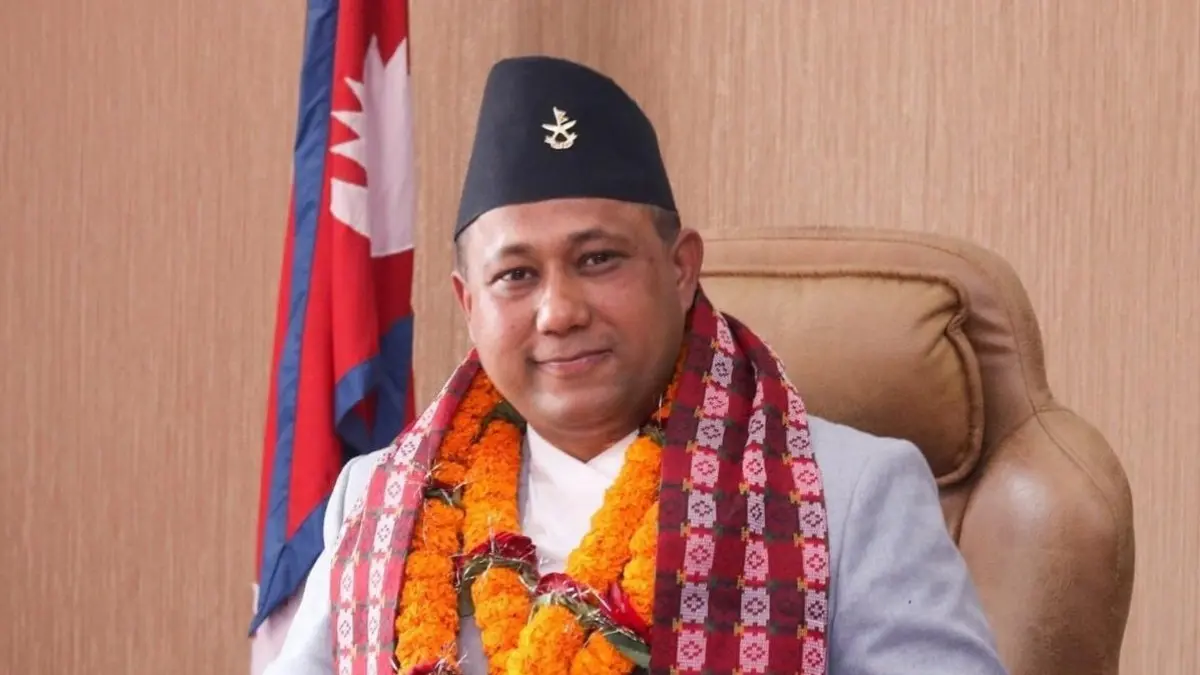
Nepal’s Minister for Foreign Affairs, Shisir Khanal, is set to travel to India for an official visit from June 5 to 7. The announcement, made by the government on Thursday, comes following an invitation from his Indian counterpart, S Jaishankar.
During his time in New Delhi, Khanal will hold a formal meeting with Jaishankar to evaluate and strengthen the bilateral relationship.
"The two sides will discuss matters of mutual interest, with a view to enhancing cooperation across key areas including trade, investment, connectivity, energy and people to people ties," the Nepal government’s statement read.
According to the foreign ministry, this trip is part of a regular exchange of high-level visits aimed at further consolidating the enduring and multifaceted bilateral relations between Nepal and India. Notably, this marks the first official visit by a minister from Prime Minister Balendra Shah's government to India since it assumed office in March. Nepali leaders have traditionally prioritized early engagement with New Delhi, a reflection of the deep-rooted political, economic, and people-to-people ties connecting the two neighbors.
Advertisement
New Dynamics in the Border Dispute
The upcoming high-level visit coincides with renewed attention on historical border issues. Nepal's Prime Minister, Balendra Shah, recently reignited the border dispute with India by claiming in parliament that territory has been encroached upon by both sides.
“You will be surprised to know a fact that I have learned recently, only after becoming prime minister: Not only has India encroached Nepali territory, but Nepal has also encroached Indian territory in many places,” Shah stated during his address to parliament.
Advertisement
While the Nepali leader did not elaborate on which specific parts of India he believed Nepal had encroached on, he advocated for a broader diplomatic approach to settle the boundaries. “Now, both countries should study the facts and sit together as friends and resolve the issue,” the Nepali leader added, while highlighting that China and the United Kingdom should be involved in mediating the dispute.
India Rejects Third-Party Mediation
New Delhi quickly clarified its stance on how territorial discussions should be handled. On June 2, India rejected any third-country involvement in its border dispute with Nepal, highlighting that there exists bilateral mechanisms to discuss all issues between New Delhi and Kathmandu.
The new Prime Minister of Nepal has similarly indicated that the only way to solve these disputes is through direct dialogue between New Delhi and Kathmandu.
A Complex History of Mapping and Geography
The long-running dispute between Nepal and India over border territories, including Limpiyadhura, Lipulekh, and Kalapani, has periodically bubbled up over the years. The conflict remains a complex mix of contested history, geography, politics, and mapping.
India has consistently maintained that these territories are part of the state of Uttarakhand, denying any claim by Kathmandu on these three specific regions.
Tensions over the three territories intensified in 2019 after Nepal objected to a new map published by New Delhi highlighting Kalapani as part of Indian territory. The friction grew in 2020 when India inaugurated a new road linking Lipulekh to the Kailash Mansarovar pilgrimage route. In response, Nepal amended its constitution in June 2020 to incorporate a new map including the three areas within its borders.
Get Current Updates on India News, Entertainment News, Cricket News along with Latest News and Web Stories from India and around the world.