
'No Charges Will Be Levied on Customers or Common Man, It Amounts to Criminal Offence': Scindia on UPI Transaction Costs
As per the National Payments Corporation of India (NPCI), UPI transactions above ₹2,000 will attract an MDR of 0.4 per cent under the revised framework, which comes into effect from October 15, 2026, and applies only to select merchant transactions. Consumers will continue to use UPI free of cost.
- India News
- 3 min read

;'%3e%3cpath%20d='m8,15.99c4.41,0,7.99-3.58,7.99-7.99S12.41,0,8,0,0,3.59,0,8s3.58,7.99,7.99,7.99Z'%20style='stroke:%23fff;%20stroke-miterlimit:10;%20stroke-width:.02px;'/%3e%3cpath%20d='m3.08,3.37l3.82,5.11-3.84,4.15h.87l3.37-3.64,2.72,3.64h2.94l-4.04-5.39,3.58-3.87h-.86l-3.1,3.35-2.5-3.35h-2.94Zm1.27.64h1.35l5.97,7.99h-1.35l-5.97-7.99Z'%20style='fill:%23fff;'/%3e%3c/g%3e%3c/svg%3e)


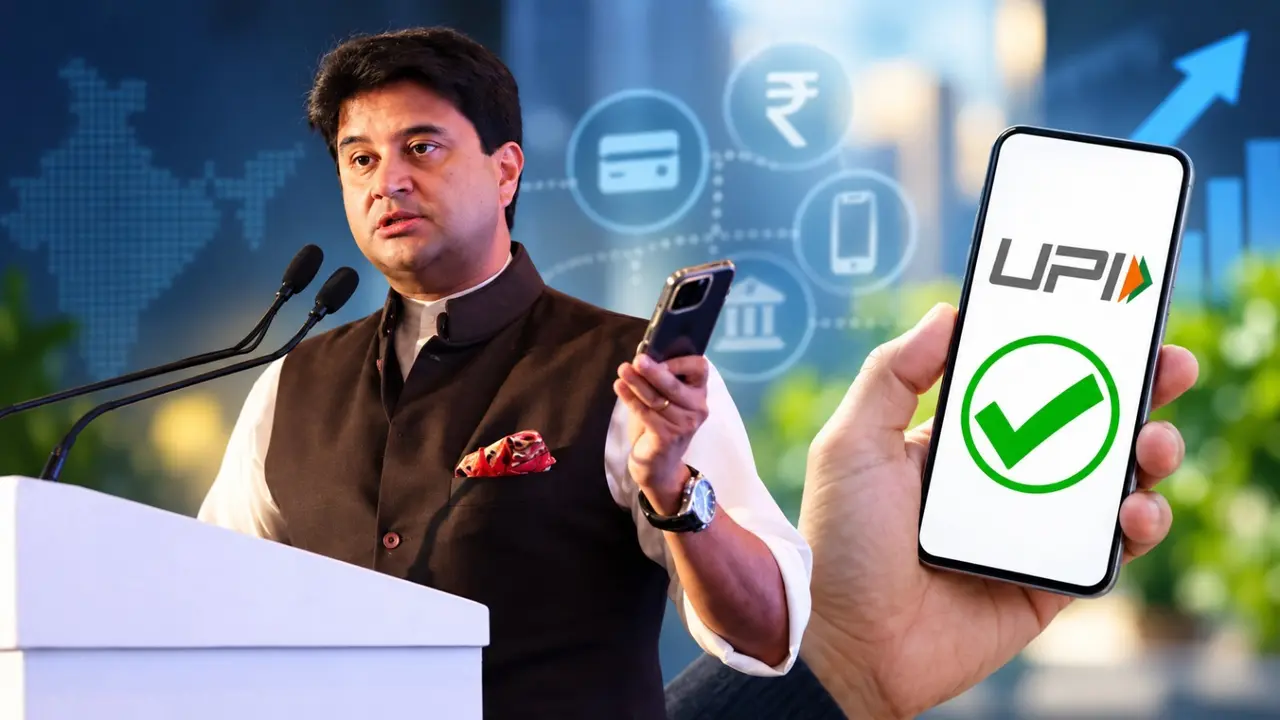
New Delhi: Union Minister for Communications Jyotiraditya M. Scindia on Wednesday firmly ruled out any burden on ordinary citizens from the revised UPI Merchant Discount Rate (MDR) framework, warning that merchants who attempt to pass on the 0.4 per cent charge to customers would be violating the law and committing a criminal offence.
“There is no recommendation to levy this on the customer. Doing so would violate the law and amount to a criminal offence. This will never be imposed on the customer or the common man. You cannot impose this on our consumer,” Scindia said when asked about the possibility of merchants shifting the cost.
As per the National Payments Corporation of India (NPCI), UPI transactions above ₹2,000 will attract an MDR of 0.4 per cent under the revised framework, which comes into effect from October 15, 2026, and applies only to select merchant transactions. Consumers will continue to use UPI free of cost.
The minister clarified that the charge falls exclusively on merchants whose monthly UPI-based payments exceed ₹1 lakh -- covering just 4 per cent of merchants. Merchants below this threshold face zero MDR. Peer-to-peer transfers to family and friends also attract no charge.
Advertisement
Scindia detailed the slab structure: zero MDR on transactions below ₹2,000 (which account for 96 per cent of all UPI transactions); 0.4 per cent on amounts between ₹2,000 and ₹75,000; and a flat fee of ₹300 for transactions above ₹75,000, regardless of whether the amount is ₹2 lakh or ₹5 lakh. Essential payments such as railway tickets, electricity and mobile bills, insurance, and fuel will see a maximum merchant charge of only ₹5, which cannot be passed to consumers.
Responding to Leader of Opposition Rahul Gandhi’s allegation that the MDR was introduced under American pressure, Scindia said, “Rahul ji sees the ‘bhoot’ (ghost) of America everywhere. There is no talk of nation-building… I have clearly explained… There will be no burden on the customer. This charge falls on the merchant… As I mentioned, this applies to only 4% of merchants.”
Advertisement
The minister explained that the proceeds would fund infrastructure upgrades and a dedicated subsidy mechanism to onboard merchants from Tier-3 to Tier-6 towns, expanding digital payments.
“Even today, it remains a free public good… once a system is established, there comes a time when it must become self-sustaining,” he noted, adding that India’s 0.4 per cent rate is significantly lower than international norms for credit cards (1.5–2.5 per cent) and debit cards (around 0.9 per cent), while uniquely exempting the vast majority of users and smaller merchants.
Scindia emphasised that the move would not push people back to cash, given that 96 per cent of transactions remain unaffected. UPI currently processes payments worth ₹30 lakh crore every month, and the government has invested heavily in both capital and operational expenditure to build the system.
Get Current Updates on India News, Entertainment News, Cricket News along with Latest News and Web Stories from India and around the world.