
'We Accurately Struck Them': IAF Chief Credits Political Will, Joint Planning For Op Sindoor Success
He said the leadership gave clear directions, no restrictions were imposed and full freedom was given to them to plan the strikes.
- India News
- 3 min read

;'%3e%3cpath%20d='m8,15.99c4.41,0,7.99-3.58,7.99-7.99S12.41,0,8,0,0,3.59,0,8s3.58,7.99,7.99,7.99Z'%20style='stroke:%23fff;%20stroke-miterlimit:10;%20stroke-width:.02px;'/%3e%3cpath%20d='m3.08,3.37l3.82,5.11-3.84,4.15h.87l3.37-3.64,2.72,3.64h2.94l-4.04-5.39,3.58-3.87h-.86l-3.1,3.35-2.5-3.35h-2.94Zm1.27.64h1.35l5.97,7.99h-1.35l-5.97-7.99Z'%20style='fill:%23fff;'/%3e%3c/g%3e%3c/svg%3e)


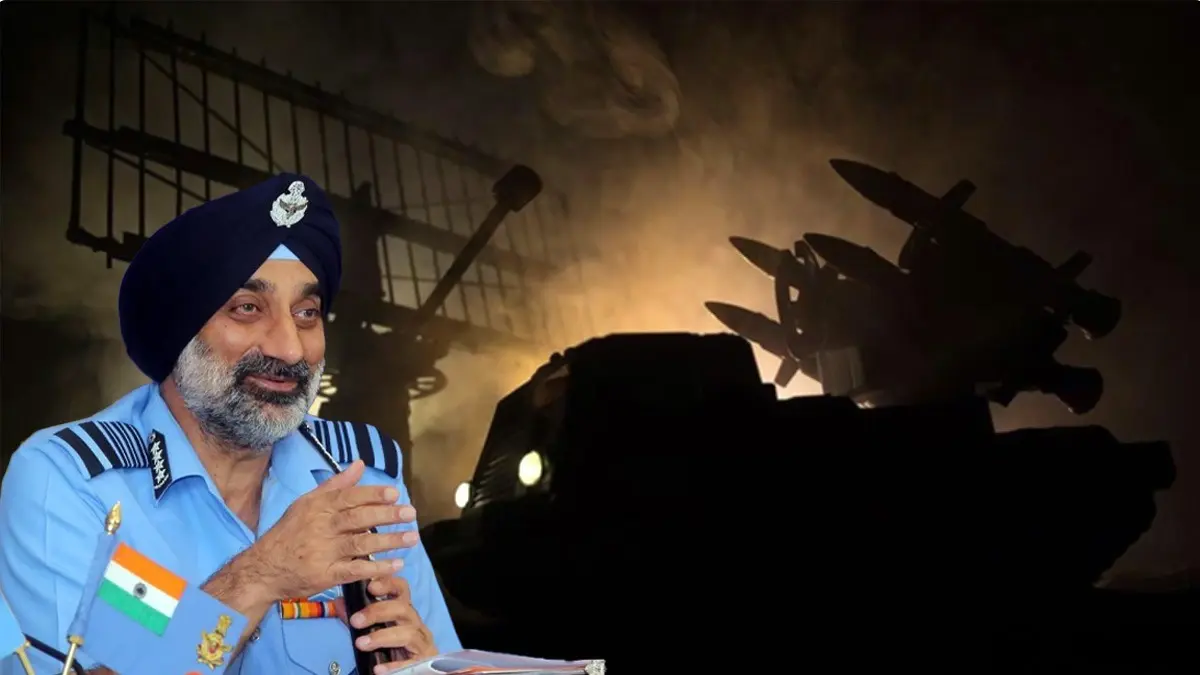
New Delhi: Indian Air Force Chief Air Chief Marshal AP Singh on Friday gave a detailed account of Operation Sindoor, saying the campaign precisely hit terrorist targets, inflicted heavy damage on enemy military infrastructure and was made possible by clear political direction and close joint planning between the services.
“We were given terrorist targets. We accurately struck them. When our enemies refused to stop the war and tried to attack us, then we struck them nice and hard. Many of their bases were damaged. A lot of their infrastructure, radars, control and coordination centres, their hangars, aircraft, suffered a lot of damage,” the Air Chief Marshal said, describing the scale and accuracy of the IAF’s strikes.
Singh singled out political will as the campaign’s decisive enabler. “One of the best things that happened was political will. Our leadership gave us clear directions, no restrictions were imposed, and full freedom was given to us to plan,” he said, adding that “all three services, CDS, NSA and agencies worked together as one team.” The IAF chief contrasted the freedom in planning during Operation Sindoor with the scrutiny the force faced after earlier strikes, including Balakot.
Restraint amid civilian air traffic
The IAF chief highlighted a major operational constraint: the continued movement of civil aircraft over parts of the adversary’s territory. “Pakistan had not closed some of its airfields, had not closed the airspace. Their civil aircraft were landing and taking off over Lahore… if we had not thought about it at that time, then maybe many people could have lost their lives,” Singh said, noting that under the “cover of those aircraft blips” enemy forces also launched attack drones. He stressed the IAF’s decision to avoid any action that could risk civilian lives or non-military aircraft.
Advertisement
On unmanned systems, Singh acknowledged drones’ tactical value: “Many drones were used in this war of ours as well… drones are very good. They are good to saturate a system.” Yet he warned that drones alone cannot secure victory. “If we have to win the war, it cannot be won with drones alone. It is very important for us to have some long-range, some heavy-calibre weapons, some such aircraft which can deliver long-range missiles. So basically, we will need a happy mix of manned-unmanned systems,” he said.
The IAF Chief described long-range air-defence and radar systems such as LR-SAM and the S-400 as “game changers”, saying their reach allowed India to neutralise enemy aircraft before they could approach weapon release range: “They could never even come up to the weapon release range without being threatened and those who came had to face damage.”
Advertisement
'Conflicts must end when objectives met'
Reflecting on broader strategic lessons, Singh argued for clear objectives and early conflict termination. Citing conflicts such as Russia–Ukraine and the Israel war, he said prolonged fighting often results from shifting objectives and ego, adding: “Our objective was anti-terrorism. We had to strike them. We had done that. So if our objectives have been met, then why should we not terminate a conflict? … Any conflict has a lot of price which has to be paid. It will affect our preparedness for the next one. It will affect our economy. It will affect the progress of the country.”
Get Current Updates on India News, Entertainment News, Cricket News along with Latest News and Web Stories from India and around the world.