
Supreme Court Questions CBSE’s Class 9 Three-Language Rule, Says ‘Don’t Start a New Language in 9th’; Centre Asked to Reply
The Supreme Court has raised concerns over CBSE’s decision to make the three-language formula compulsory for Class 9 students from 2026-27, warning it could add stress before board exams. The Court also heard Tamil Nadu’s objections to Jawahar Navodaya Vidyalayas, clarifying the policy does not mandate Hindi.
- India News
- 4 min read

;'%3e%3cpath%20d='m8,15.99c4.41,0,7.99-3.58,7.99-7.99S12.41,0,8,0,0,3.59,0,8s3.58,7.99,7.99,7.99Z'%20style='stroke:%23fff;%20stroke-miterlimit:10;%20stroke-width:.02px;'/%3e%3cpath%20d='m3.08,3.37l3.82,5.11-3.84,4.15h.87l3.37-3.64,2.72,3.64h2.94l-4.04-5.39,3.58-3.87h-.86l-3.1,3.35-2.5-3.35h-2.94Zm1.27.64h1.35l5.97,7.99h-1.35l-5.97-7.99Z'%20style='fill:%23fff;'/%3e%3c/g%3e%3c/svg%3e)


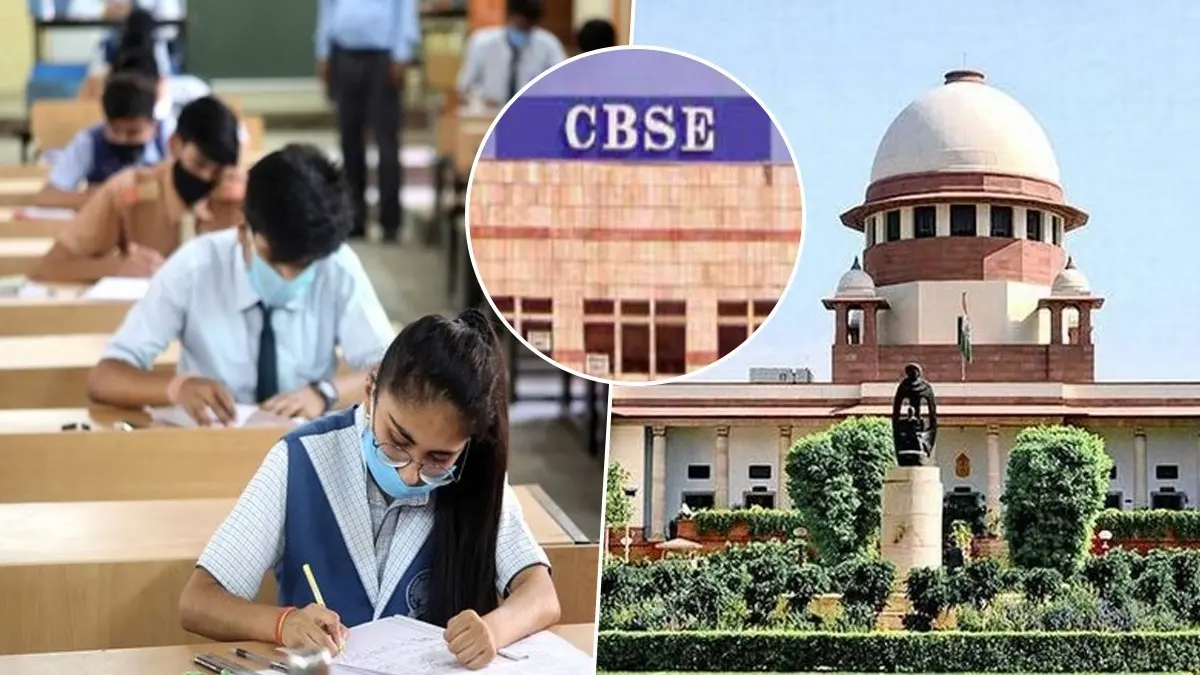
New Delhi: The Supreme Court on Thursday raised concerns over the CBSE’s decision to make the three-language formula compulsory for Class 9 students from the 2026-27 academic session, observing that introducing a new language just before board examinations could place unnecessary pressure on students.
A Bench led by the Chief Justice of India also issued notices to the Centre, the Central Board of Secondary Education (CBSE) and the National Council of Educational Research and Training (NCERT) on fresh petitions challenging the policy. The respondents have been given 10 days to file their replies, and the matter will now be heard on July 22, 2026.
While refusing to stay the implementation of the policy for now, the Court remarked that learning a language never goes to waste, even as it agreed to examine concerns over the timing and implementation of the new rule.
Petitioners Question Timing of Policy
The petitions challenge the CBSE notification that makes the three-language formula mandatory for students entering Class 9 from the 2026-27 academic year.
Advertisement
The petitioners argued that the move is premature because the National Education Policy (NEP) 2020 envisages a phased rollout. They also claimed that many schools are not prepared to implement the policy due to a shortage of trained language teachers and the non-availability of NCERT textbooks in several languages.
Another concern raised before the Court was the impact on students who are currently studying foreign languages, saying the sudden shift could disrupt their academic plans.
Advertisement
CBSE, however, defended the policy, stating that its objective is to promote multilingualism and encourage students to learn Indian languages.
‘Class 9 Is Already Stressful’: Justice BV Nagarathna
In a separate but related hearing concerning the establishment of Jawahar Navodaya Vidyalayas (JNVs) in Tamil Nadu, Justice B V Nagarathna strongly questioned the decision to introduce a third language at the Class 9 level.
Hearing Tamil Nadu’s appeal against a Madras High Court order directing the setting up of JNVs in every district, Justice Nagarathna said students in Class 9 are already under immense pressure as they begin preparing for board examinations.
“No, that is very bad. Ninth standard is stressful. Why do you introduce a new language in 9th? You introduce it in 6th,” the judge orally observed.
Addressing the Union government, she added that a third language should ideally be introduced in middle school rather than just before the board examination years.
“Please don’t have the third language in 9th standard. CBSE, ICSE or State Board, the pressure for Class 10 starts from the end of Class 8 itself,” she said.
Drawing from her own school experience, Justice Nagarathna said students in her generation began learning a third language much earlier, making it easier to adapt.
Court Clarifies Third Language Does Not Mean Hindi
During the hearing, Tamil Nadu reiterated its long-standing objection to the three-language policy, which has also been one of the reasons it has resisted the establishment of Jawahar Navodaya Vidyalayas in the State.
Justice Nagarathna, however, clarified that the policy does not mandate Hindi.
“The State language has to be taught, English has to be taught and any third language. It doesn’t say Hindi,” she observed.
When counsel pointed out that the National Education Policy itself says no language should be imposed on any State, the judge asked whether there would still be an objection if the third language was Sanskrit instead of Hindi.
Judge Advises Tamil Nadu Against Rejecting Central Schemes
The Bench also advised the Tamil Nadu government not to reject Central education schemes solely because they originate from the Union government.
“You may have your education system, but don’t prevent the Central government schools,” Justice Nagarathna observed.
The Court noted that discussions between the Centre and the Tamil Nadu government regarding the establishment of Jawahar Navodaya Vidyalayas are still underway. Since consultations have not concluded, the Bench said it would consider the legal issues only if those talks fail.
The matter relating to JNVs has been posted for further hearing on August 11, 2026.
Background of the Dispute
Tamil Nadu has consistently opposed the establishment of Jawahar Navodaya Vidyalayas, arguing that the schools follow the three-language formula, which conflicts with the State’s long-standing two-language policy based on Tamil and English.
The Centre, on the other hand, has maintained that JNVs are meant to provide quality residential education to talented rural students and has informed the Supreme Court that while 689 Jawahar Navodaya Vidyalayas have been sanctioned across 666 districts in India, none has been established in Tamil Nadu because the State has not accepted the scheme.
The Union government has also told the Court that it remains willing to establish JNVs in Tamil Nadu if the State agrees to the proposal and provides the required land and infrastructure. Meanwhile, Tamil Nadu has argued that its own model residential schools already achieve the objectives of the JNV scheme and has urged the Centre to support those institutions instead.
Get Current Updates on India News, Entertainment News, Cricket News along with Latest News and Web Stories from India and around the world.