
The Tale of Malini River: Why Lord Jagannath’s Rath Yatra Once Needed Six Chariots to Complete
The fascinating legend and history behind the six chariots trace back to an ancient river, a queen's dream, and a landscape long changed by time.
- India News
- 4 min read

;'%3e%3cpath%20d='m8,15.99c4.41,0,7.99-3.58,7.99-7.99S12.41,0,8,0,0,3.59,0,8s3.58,7.99,7.99,7.99Z'%20style='stroke:%23fff;%20stroke-miterlimit:10;%20stroke-width:.02px;'/%3e%3cpath%20d='m3.08,3.37l3.82,5.11-3.84,4.15h.87l3.37-3.64,2.72,3.64h2.94l-4.04-5.39,3.58-3.87h-.86l-3.1,3.35-2.5-3.35h-2.94Zm1.27.64h1.35l5.97,7.99h-1.35l-5.97-7.99Z'%20style='fill:%23fff;'/%3e%3c/g%3e%3c/svg%3e)


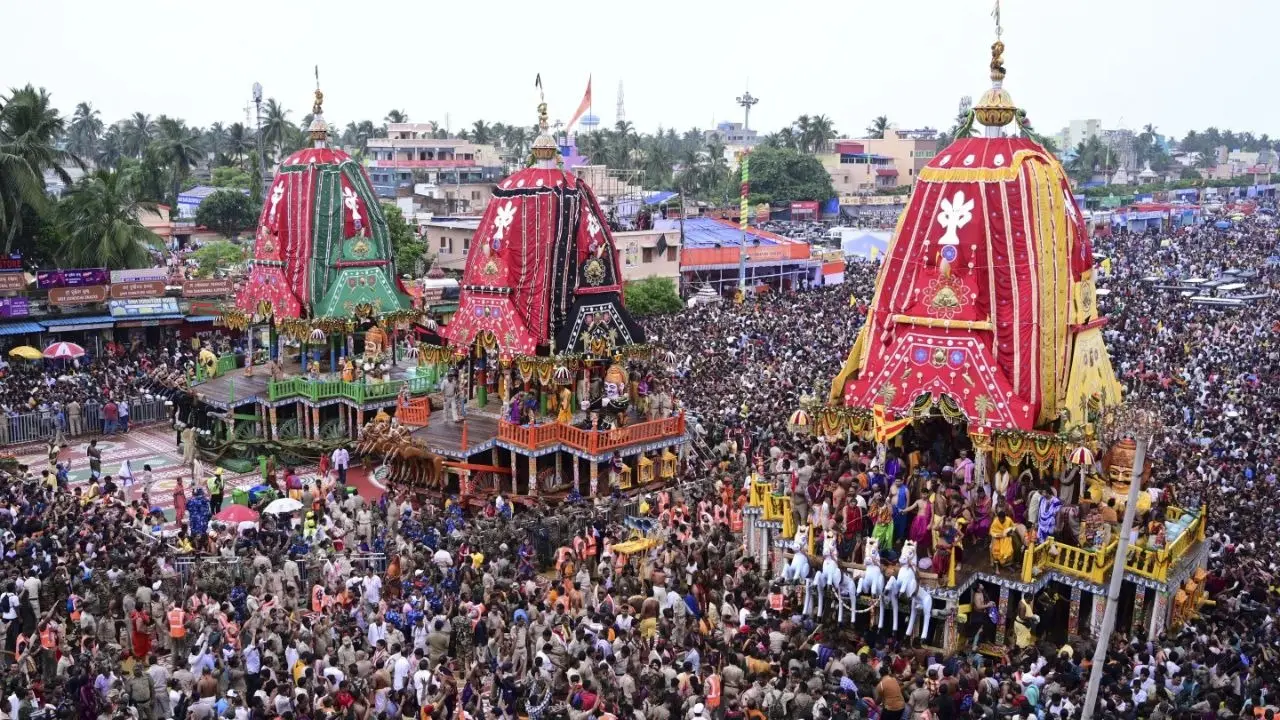
Every year, millions of devotees gather in the holy coastal city of Puri, Odisha, to witness the spectacular sights and sounds of the Jagannath Rath Yatra. The iconic image of three towering wooden chariots—Nandighosha, Taladhwaja, and Darpadalana—being pulled down the Grand Road (Bada Danda) is globally recognized.
However, many do not know that the festival did not always rely on three chariots. In ancient times, the grand procession actually required six massive chariots to complete the holy journey.
The fascinating legend and history behind the six chariots trace back to an ancient river, a queen's dream, and a landscape long changed by time.
The Divided Highway: The Role of the Malini River
Centuries ago, the 3-kilometer stretch of the Bada Danda was not a continuous, paved road. Historically, the Malini River (a tributary of the Bhargavi River) flowed right across the middle of the path, physically separating the Sri Mandir (main temple) from the Gundicha Temple (the deities' garden house/maternal home).
Advertisement
Because the river cut through the path of the procession, a single, direct chariot ride was impossible. To overcome this natural barrier, the temple administration had to build six chariots in total—two sets of three:
- The First Leg: Three chariots were stationed at the Sri Mandir. The deities of Lord Jagannath, Lord Balabhadra, and Goddess Subhadra boarded these raths and were pulled to the southern bank of the Malini River.
- The River Crossing: Upon reaching the riverbank, the deities were disembarked. They were carefully carried across the water on large, flat-bottomed boats (similar to the Chappa boats used in Chandan Yatra today) or via a temporary makeshift bridge.
- The Second Leg: Waiting on the northern bank of the river were three identical, empty chariots. Once the deities reached the other side, they were boarded onto these waiting vessels to complete the final leg of their journey to the Gundicha Temple.
This complex, two-stage operation was described in historical texts, including the medieval Bengali hagiography Chaitanya Charitamrita.
Advertisement
A Divine Request: The Legend of Saradha Devi
The shift from six chariots to three is attributed to a mixture of engineering and divine intervention.
According to regional folklore, Queen Saradha Devi, the chief consort of the then-ruling Puri King Gajapati Narasingh Dev, was deeply troubled by the arduous process. The act of moving the heavy wooden idols off the chariots, onto boats, and back onto a second set of chariots was physically taxing for the servitors and disrupted the seamless flow of devotion.
Legend has it that Lord Jagannath appeared in Queen Saradha's dream, expressing a desire for a single, uninterrupted journey (Yatra) to his aunt's house without any intermediate transfers.
Birth of the 'Saradha Baali'
Determined to fulfill the Lord’s wish, the Queen ordered a massive public works project. The mouth of the Malini River was systematically closed off, and the entire riverbed intersecting the Bada Danda was filled with tons of sand, leveling the road completely.
The closed mouth of the river became known as Banki Muhana, and the sandy stretch where the river once ran was named Saradha Baali (Saradha's Sand) in honor of the Queen.
From that point onward, the need for six chariots was eliminated. Craftsmen began building only three chariots, allowing Lord Jagannath and his siblings to travel seamlessly from start to finish.
Today, the "Saradha Baali" remains one of the holiest patches of land in Puri. Devotees still roll on this sacred sand and smear it on their bodies as a mark of deep devotion, keeping alive the memory of an ancient river and the six chariots that once traversed it.
Get Current Updates on India News, Entertainment News, Cricket News along with Latest News and Web Stories from India and around the world.