
TMC-DMK Factor: How the Shifting Power Dynamics in Lok Sabha Can Finally Lead to Clearing the Roadblock for Women Reservation and De-Limitation Bill
By clearing the roadblock for the Delimitation Bill using the 2011 Census, the government can now immediately implement the reservation policy, permanently altering the gender dynamics of Indian politics ahead of the 2029 general elections.
- India News
- 3 min read

;'%3e%3cpath%20d='m8,15.99c4.41,0,7.99-3.58,7.99-7.99S12.41,0,8,0,0,3.59,0,8s3.58,7.99,7.99,7.99Z'%20style='stroke:%23fff;%20stroke-miterlimit:10;%20stroke-width:.02px;'/%3e%3cpath%20d='m3.08,3.37l3.82,5.11-3.84,4.15h.87l3.37-3.64,2.72,3.64h2.94l-4.04-5.39,3.58-3.87h-.86l-3.1,3.35-2.5-3.35h-2.94Zm1.27.64h1.35l5.97,7.99h-1.35l-5.97-7.99Z'%20style='fill:%23fff;'/%3e%3c/g%3e%3c/svg%3e)


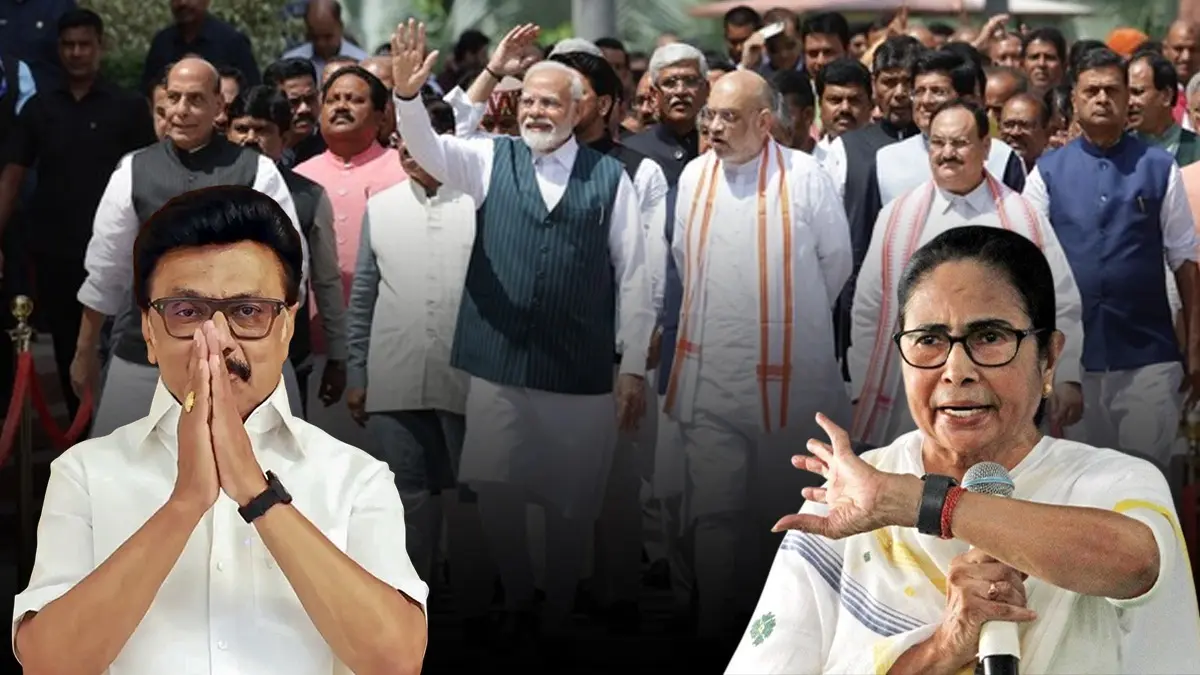
Just months after the opposition blocked the historic Constitution Bill in April, a combination of regional rebellions and back-channel negotiations has dramatically tilted the parliamentary balance of power in favor of the ruling National Democratic Alliance (NDA).
At the center of this shift are two powerful regional forces: the Trinamool Congress (TMC) and the Dravida Munnetra Kazhagam (DMK). Their shifting trajectories are paving a clear path for the government to revive and pass the crucial Delimitation Bill and the fast-tracked framework for the Women’s Reservation Act during the upcoming Monsoon Session in July.
The TMC Fractures
The most immediate breakthrough for the government came from West Bengal, following the political fallout of the recent state assembly elections. In a stunning move, senior parliamentarian Dr. Kakoli Ghosh Dastidar led a rebellion within the Trinamool Congress ranks, claiming the support of 20 out of the party's 29 Lok Sabha MPs. By commanding more than two-thirds of the parliamentary party, the rebel bloc safely meets the threshold required under the Tenth Schedule to merge or form a separate group without facing disqualification.
The faction has already submitted a formal letter to Lok Sabha Speaker Om Birla seeking recognition and has met with senior Union Minister Bhupender Yadav to align their legislative strategy with the NDA. This structural implosion strips West Bengal Chief Minister Mamata Banerjee of her leverage in New Delhi and hands the ruling coalition a crucial bloc of 20 reliable votes to push past the elusive two-thirds majority mark required for constitutional amendments.
Advertisement
The DMK Pivot
Simultaneously, the political arithmetic is shifting in southern India. Senior political observers point to a growing chill between the Congress and the DMK, aggravated by national alignments that have left the Tamil Nadu ruling party reassessing its absolute opposition to central policies.
Top political functionaries indicate that the NDA has received positive feelers from the DMK’s 22-member Lok Sabha contingent regarding issue-based support.
Advertisement
While the DMK had previously strongly resisted the Delimitation Bill, arguing that redrawing constituencies based on population metrics would unfairly penalize southern states that successfully implemented family planning, the government’s revised approach has opened new doors. The NDA's legislative strategy for July involves unbundling the Delimitation Bill from the Women's Reservation amendments and offering structural reassurances.
By increasing the total Lok Sabha seats by 50 percent, the absolute number of representatives from southern states will actually grow, ensuring that no state loses its current voice in Parliament even as growing northern states expand.
The Path to 360 Votes
With three current vacancies reducing the effective strength of the 543-member Lok Sabha, the magic number for a two-thirds constitutional amendment stands at 360 votes. The NDA core strength currently rests at 293 seats. When the breakaway TMC faction adds its 20 votes and the potential DMK support brings another 22 votes, the projected vote base rises significantly. Combined with anticipated splits in other regional opposition factions like the Shiv Sena (UBT) and supportive independent lawmakers, the NDA finds itself within striking distance of the final required mark.
This newly stabilized arithmetic completely changes the fate of the Women’s Reservation framework. When the bill failed in April, opposition parties argued that linking 33 percent reservation to a future, unscheduled delimitation process was an empty promise.
By clearing the roadblock for the Delimitation Bill using the 2011 Census, the government can now immediately implement the reservation policy, permanently altering the gender dynamics of Indian politics ahead of the 2029 general elections.
Get Current Updates on India News, Entertainment News, Cricket News along with Latest News and Web Stories from India and around the world.