
The Odyssey And Ramayana Have Several Thematic Commonalities, But Which Epic Originated First
The Odyssey and Ramayana are epics from polar opposite parts of the world. However, the two stories have more in common than one would think.
- Lifestyle News
- 4 min read

;'%3e%3cpath%20d='m8,15.99c4.41,0,7.99-3.58,7.99-7.99S12.41,0,8,0,0,3.59,0,8s3.58,7.99,7.99,7.99Z'%20style='stroke:%23fff;%20stroke-miterlimit:10;%20stroke-width:.02px;'/%3e%3cpath%20d='m3.08,3.37l3.82,5.11-3.84,4.15h.87l3.37-3.64,2.72,3.64h2.94l-4.04-5.39,3.58-3.87h-.86l-3.1,3.35-2.5-3.35h-2.94Zm1.27.64h1.35l5.97,7.99h-1.35l-5.97-7.99Z'%20style='fill:%23fff;'/%3e%3c/g%3e%3c/svg%3e)


Christopher Nolan's The Odyssey hit the big screens on July 17 amid massive pre-release hype. The Matt Damon-led movie is based on the ancient Greek poem by Homer. Social media interest in the 3000-year-old poem is heightened as Nolan's movie hits the big screen today.
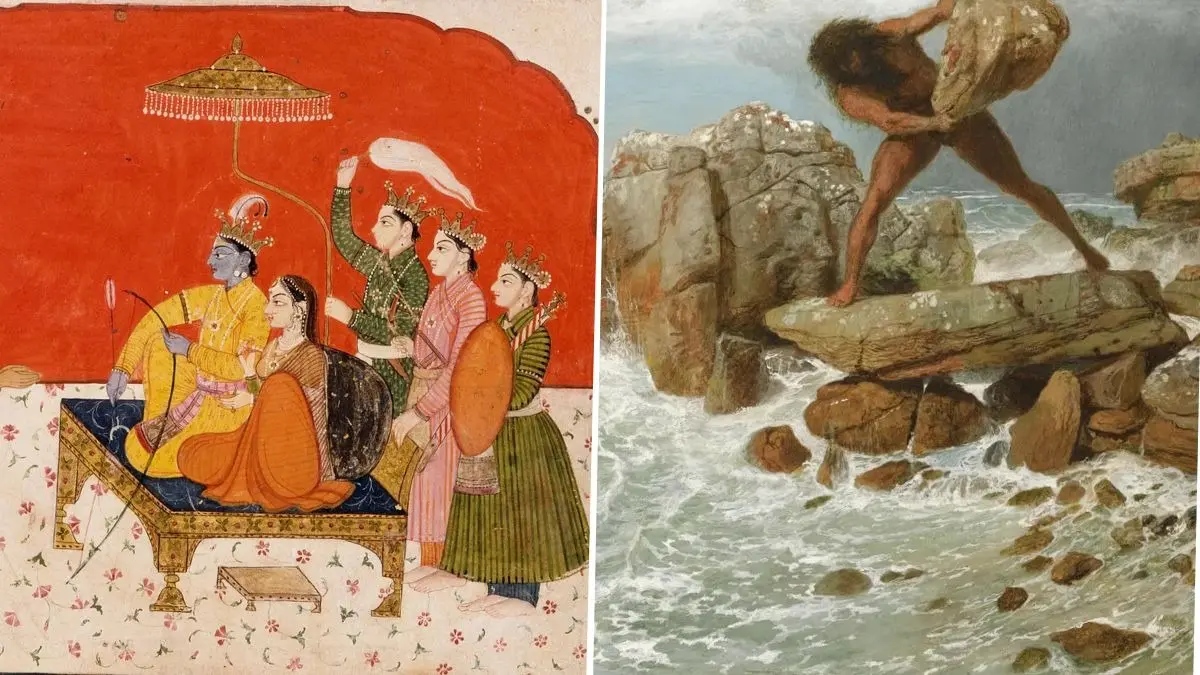
The story of The Odyssey might be set in ancient Greece, but it bears uncanny similarities with the Indian epic Ramayana. While some sequences of the poem are more evidently similar to the Hindu epic, in others, the thematic similarities are too hard to miss. Both works revolve around heroic journeys, loyalty, divine intervention, and the triumph of good over evil.
What are the commonalities between Ramayana and The Odyssey?
The main theme of both Ramayana and The Odyssey revolves around the protagonist's journey home. In the Hindu epic, while Lord Ram spends years in exile with Goddess Sita and Laxman, The Odyssey also chronicles the 25-year journey of King Odysseus back to his kingdom, Ithaca. While spending their years in exile, Lord Rama battles several evil and harsh consequences, including the abduction of Sita. Similarly, in The Odyssey, the king's journey back home is marked with numerous trials that test not only his physical strength but also their character and resilience.

Another striking similarity between the two texts is the wife's longing. Sita remains steadfast during her captivity in Lanka, while Penelope resists numerous suitors during Odysseus' two-decade absence, symbolising loyalty and patience. Both women wait for years in hope of their husbands freeing them from their captivity. And in the end, both women are united with their husbands, who fight evil for their wives.
Advertisement
A particular scene in The Odyssey will definietly remind the Indian audience of the Ramayana. The Hindu epic starts with Lord Ram lifting Lord Shiva's bow and breaking it into two halves during Sita’s swayamvar, winning her hand in marriage. A similar scene takes place in the climax of The Odyssey, however, a little differently. Forced to conduct her own swayamvar of sorts, Penelope hosts a competition for all her suitors, where she challenges them to string the bow. When everyone else fails, only her husband Odysseus, disguised as a beggar, can string the bow. This also serves as a statement of his return.
Another obvious commonality between The Odyssey and Ramayana comes in the form of a deer. In the Hindu epic, the animal becomes a symbol of temptation. The abduction of Sita takes place after she forces Lord Ram to go after a golden deer, which is just an illusion used to lure him away from her. Similarly, in Homer's poem, a deer is chased down by the king and shot with an arrow. However, he later realises that the deer is actually a man in disguise.
Also Read: Nolan's Highest Grossing Movies In India Ahead Of The Odyssey
Advertisement
Another obvious connection between Ramayana and The Odyssey is the divine intervention. Divine beings also play central roles in both narratives. Rama receives guidance and support from gods and devoted allies such as Hanuman, while Odysseus is aided by Athena and repeatedly challenged by Poseidon, underscoring how destiny and divine will influence human lives.
So, which happened first- Ramayana or The Odyssey?
The Odyssey is traditionally attributed to the ancient Greek poet Homer. Along with The Iliad, it forms the foundation of classical Greek literature. Most scholars date the composition of The Odyssey to around the late 8th century BCE, approximately between 725 and 675 BCE.
Based on current academic estimates, the earliest layers of the Ramayana and The Odyssey were composed within a broadly similar historical period. However, many scholars place Homer's The Odyssey in the late 8th century BCE, while the composition of Valmiki's Ramayana is generally dated between the 7th and 4th centuries BCE, making precise chronological comparisons difficult. In Hindu tradition, however, the events of the Ramayana are believed to have occurred much earlier in the Treta Yuga. While the documentation and the written version of Ramayana might have emerged later, the oral telling of Valmiki's tale is known to have happened long before The Odyssey.