
Rocket Lab announces new launch site for NASA’s TROPICS mission
Aerospace manufacturer Rocket Lab has confirmed a new launch location for NASA's constellation of four CubeSats meant to track storms and cyclones.
- Science News
- 2 min read

;'%3e%3cpath%20d='m8,15.99c4.41,0,7.99-3.58,7.99-7.99S12.41,0,8,0,0,3.59,0,8s3.58,7.99,7.99,7.99Z'%20style='stroke:%23fff;%20stroke-miterlimit:10;%20stroke-width:.02px;'/%3e%3cpath%20d='m3.08,3.37l3.82,5.11-3.84,4.15h.87l3.37-3.64,2.72,3.64h2.94l-4.04-5.39,3.58-3.87h-.86l-3.1,3.35-2.5-3.35h-2.94Zm1.27.64h1.35l5.97,7.99h-1.35l-5.97-7.99Z'%20style='fill:%23fff;'/%3e%3c/g%3e%3c/svg%3e)


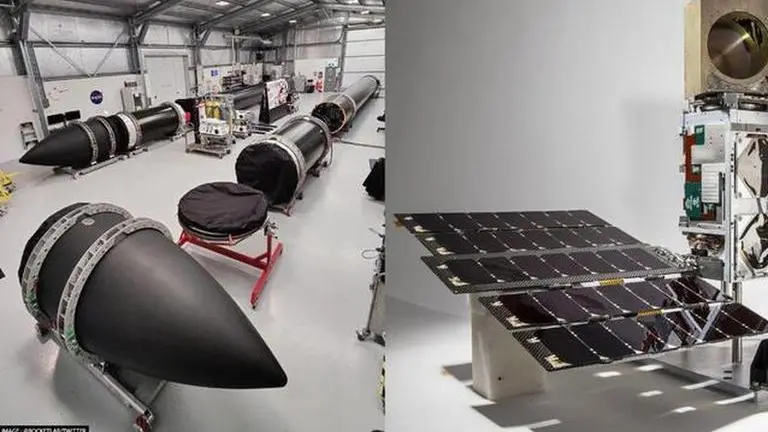
Aerospace manufacturer Rocket Lab has confirmed a new launch location for NASA's constellation of four CubeSats that are meant to track storms and cyclones ahead of this year's Atlantic hurricane season. According to NASA's official blog, the space agency's Time-Resolved Observations of Precipitation Structure and Storm Intensity with a Constellation of SmallSats (TROPICS) is set to study the atmosphere to deeply understand the nature of hurricanes, typhoons, and other strong weather events.
Rocket Lab recently announced that the mission will be sent into orbit with the help of two Electron rockets that will each carry two TROPICS CubeSats. The launch will take place at Launch Complex 1 in Mahia, New Zealand in May, just in time for the hurricane season.
With each launch, a pair of small satellites will improve the frequency at which tropical cyclones are measured from space. NASA's TROPICS constellation allows scientists to keep a check on how tropical cyclones evolve at a frequency of about once per hour, a significant improvement from the once every 6 hours frequency used at the moment.
Launching this May: A hurricane-hunting double header for @NASA!
— Rocket Lab (@RocketLab) April 10, 2023
We’re launching the TROPICS constellation across 2 Electron missions, now lifting-off from LC-1.
More about this storm-studying constellation and how Electron is enabling it. https://t.co/YoqRFe07IE pic.twitter.com/jgD8areeNA
TROPICS mission
Each satellite is an identical 3U (1U, or unit = 10cm x 10cm x 10cm) CubeSat that is equivalent to the size of a bread loaf, and weighs some 12 pounds. NASA's TROPICS team is spearheaded by Dr. William Blackwell at Massachusetts Institute of Technology’s Lincoln Laboratory in Lexington, Massachusetts.
Advertisement
Many researchers are a part of it, including those from NASA, the National Oceanic and Atmospheric Administration (NOAA), and some universities. The mission's launch services were offered to Rocket Lab last November under NASA's Venture-class Acquisition of Dedicated and Rideshare (VADR) launch services contract.