No Ceasefire? Iranian Cyber-Attacks on Israel Increase 3-Fold Amid Ongoing Conflict
Israeli authorities say they have so far managed to prevent successful attacks against critical infrastructure, although some private companies with weaker cybersecurity reportedly had their computer systems completely wiped following successful breaches.

;'%3e%3cpath%20d='m8,15.99c4.41,0,7.99-3.58,7.99-7.99S12.41,0,8,0,0,3.59,0,8s3.58,7.99,7.99,7.99Z'%20style='stroke:%23fff;%20stroke-miterlimit:10;%20stroke-width:.02px;'/%3e%3cpath%20d='m3.08,3.37l3.82,5.11-3.84,4.15h.87l3.37-3.64,2.72,3.64h2.94l-4.04-5.39,3.58-3.87h-.86l-3.1,3.35-2.5-3.35h-2.94Zm1.27.64h1.35l5.97,7.99h-1.35l-5.97-7.99Z'%20style='fill:%23fff;'/%3e%3c/g%3e%3c/svg%3e)


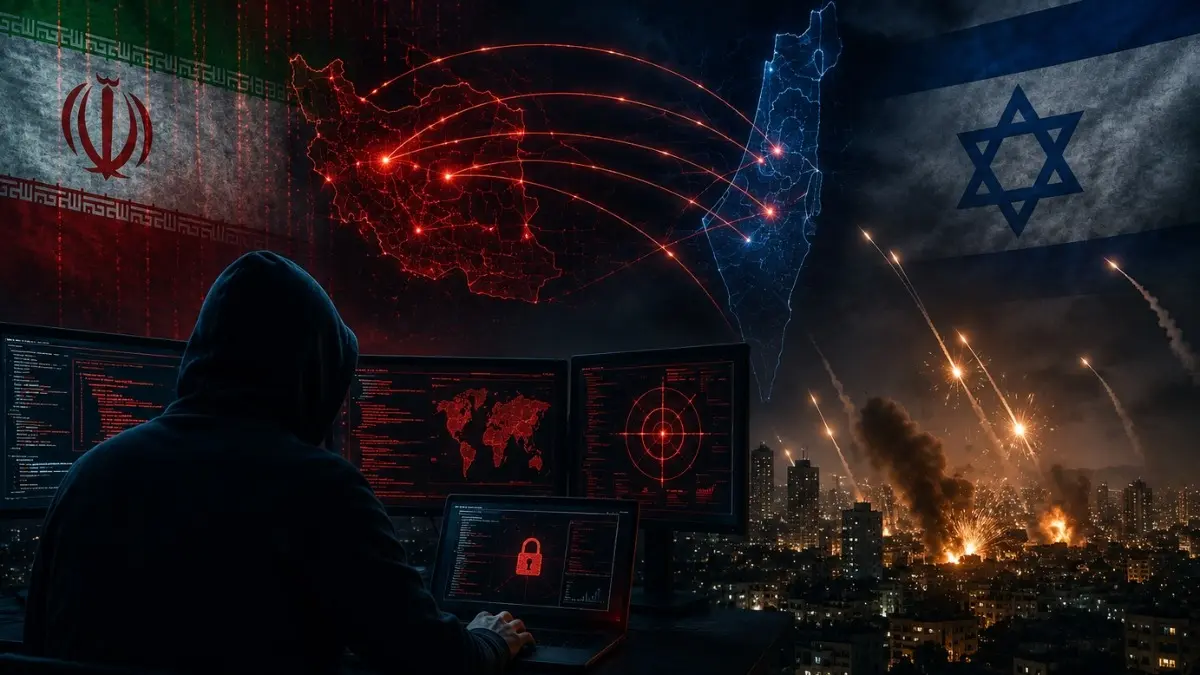
The cyber war between Iran and Israel is escalating even as military tensions show signs of easing.
Israel's National Cyber Directorate says the number of cyber-attacks linked to Iran has tripled over the past year, with nearly 4,800 hostile cyber incidents recorded in June 2026, compared to around 1,600 attacks during the same month last year. The figures suggest that while missile strikes may slow, the digital battlefield remains as active as ever.
'There's No Ceasefire in Cyberspace'
The figures were disclosed by Yossi Karadi, Director General of Israel's National Cyber Directorate, in an interview with German newspaper Die Welt. According to Karadi, some Iranian-linked hacking groups have become increasingly sophisticated, forcing Israel to strengthen its cyber defences across both public and private sectors.
"Some groups are very skilled," Karadi said. "Unlike in the kinetic realm, there's no ceasefire in cyberspace."
Advertisement
His remarks underscore a growing reality in modern conflicts, where cyber-attacks continue regardless of developments on the physical battlefield.
Critical Infrastructure Remains a Prime Target
The attacks have reportedly targeted a wide range of organisations. According to Karadi, hackers have attempted to breach systems belonging to critical infrastructure operators, government and central institutions, small and medium-sized businesses, law firms, and accounting firms.
Advertisement
Israeli authorities say they have so far managed to prevent successful attacks against critical infrastructure, although some private companies with weaker cybersecurity reportedly had their computer systems completely wiped following successful breaches.
Cyber Warfare Has Become Part of the Conflict
The surge comes amid continuing tensions between Israel and Iran, where cyber operations have increasingly accompanied military action.
Cybersecurity experts have long warned that state-backed hacking campaigns are becoming a standard part of geopolitical conflicts. Instead of relying solely on missiles or drones, countries are also attempting to disrupt communications, financial systems, utilities, and government networks through digital attacks.
Recent incidents have highlighted that the cyber conflict is not one-sided. Last week, Iran reported that cyberattacks disrupted card-based banking services at several of its largest banks, temporarily affecting ATMs, payment terminals, and mobile banking platforms. Iranian authorities have not publicly identified the attackers but have previously accused hostile foreign actors, including Israel, of similar operations.
Why Cyberattacks Matter
Unlike conventional military strikes, cyberattacks can be launched remotely, are relatively inexpensive, and are often difficult to attribute with certainty. Targets range from hospitals and transport systems to banks and power grids, making cybersecurity an increasingly important component of national defence.
For governments, the challenge is no longer just protecting military assets. Increasingly, it is safeguarding digital infrastructure that underpins everyday life, including financial services, communications, healthcare, and energy networks.