
Lab-Grown Meat to make its debut after Singapore Food Agency approves its sale
The company, Eat Just, Inc, revealed its plans last month to jointly open their largest plant protein isolate production facility in Singapore.
- World News
- 3 min read

;'%3e%3cpath%20d='m8,15.99c4.41,0,7.99-3.58,7.99-7.99S12.41,0,8,0,0,3.59,0,8s3.58,7.99,7.99,7.99Z'%20style='stroke:%23fff;%20stroke-miterlimit:10;%20stroke-width:.02px;'/%3e%3cpath%20d='m3.08,3.37l3.82,5.11-3.84,4.15h.87l3.37-3.64,2.72,3.64h2.94l-4.04-5.39,3.58-3.87h-.86l-3.1,3.35-2.5-3.35h-2.94Zm1.27.64h1.35l5.97,7.99h-1.35l-5.97-7.99Z'%20style='fill:%23fff;'/%3e%3c/g%3e%3c/svg%3e)


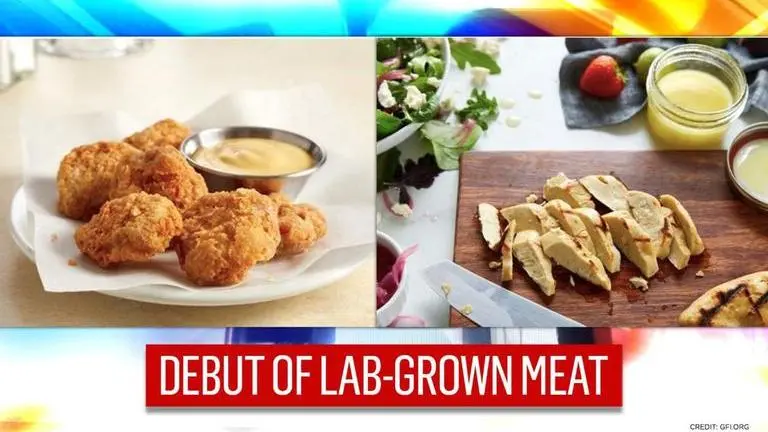
Lab-grown meat will be making a debut at a Singapore restaurant in a culinary first this weekend after the Singapore Food Agency (SFA), the lead agency for food-related matters in Singapore, approved its sale. The company, Eat Just, Inc, revealed its plans last month to jointly open their largest plant protein isolate production facility in Singapore. According to a blog by GFI, this company appears to be the first company to have secured such cultivated meat approval.
Lab-grown meat to soon make debut
An Associate Professor at Nanjing Agricultural University and one of the core members of the team that produced China’s first cultivated pork meat in 2019, Dr. Ding Shijie, told The Good Food Institute Asia Pacific (GFI APAC) that he is hoping that the approval will accelerate funding and development of cultivated meat. He said, “This could be a new milestone in cultured meat history”. Director of Policy and Government Relations for Food Frontier, a GFI APAC strategic partner, Sam Lawrence, is also optimistic about Singapore's influence on the broader Asia Pacific region. He said, “Regulators in Australia take cues from similar markets around the world, so any framework released by the SFA is likely to be closely examined”.
BREAKING: @eatjust has made the world's first commercial sale of #cultivatedmeat! Its cultivated chicken bites will launch in Singapore's 1880 restaurant this Saturday, Dec. 19. Read our full #mediastatement 👉 https://t.co/izc8UqF1Br 1/5 pic.twitter.com/lE7lfjBbyM
— The Good Food Institute (@GoodFoodInst) December 15, 2020
“The world-first sale and serving of #cultivatedmeat demonstrates the feasibility of this technology, and the Singapore government is doing all it can to advance this better way of making meat," says GFI executive director @BruceGFriedrich 2/5
— The Good Food Institute (@GoodFoodInst) December 15, 2020
This is a huge step forward, but bringing cultivated meat to the masses will require significantly more government investment. Just like governments support renewable energy and vaccine development, they should be funding open-access cultivated meat science and innovation." 3/5
— The Good Food Institute (@GoodFoodInst) December 15, 2020
“Now that Singapore has proven it can be done, it’s time for other countries to invest the significant scientific resources needed to bring this safe and sustainable dining experience to every restaurant in the world," says GFI APAC director @_elainesiu 4/5
— The Good Food Institute (@GoodFoodInst) December 15, 2020
This news comes just 2 weeks after @SGFoodAgency granted @eatjust regulatory approval to sell its cultivated chicken in the country. ICYMI, catch up on our blog: https://t.co/Nm3rOe7vRf 5/5
— The Good Food Institute (@GoodFoodInst) December 15, 2020
According to the blog, Singapore imports over 90 per cent of its food. However, with investment in local production and innovation, the country aims at meeting its 30 by 30 goal. The aim involves producing 30 per cent of its nutritional needs locally by 2030. The government is working hard to meet its objective. Talking about the initiative, which also marks a major milestone, GFI’s Managing Director of Asia Pacific, Elaine Siu said, “The race to divorce meat production from industrial animal agriculture is underway and nations that follow Singapore’s lead will be able to reap the benefits as the entire world shifts to this new and better way of making meat”.
Advertisement

(GFI Managing Director of Asia Pacific, Elaine Siu, at Shiok Meats’ 2019 press conference debuting cultivated shrimp dumplings in Singapore, alongside Shiok co-founders Ka Yi Ling and Sandhya Sriram, John Cheng, Director of Innovate 360, and Henry Soesanto, CEO of Monde Nissin. Image Credits: gfi.org)
According to reports, the new chicken product will be priced similar to premium chicken for the first six months. The cost will, however, come down over time as the company builds a global scale. Moreover, Eat Just is also planning to submit its application for lab-created beef in Singapore. However, the approval process for cultured meat products is moving slower in Europe and the United States.