
Schedule FA Explained: Where Resident Indian Taxpayers Must Report Foreign Shares, Bank Accounts and Overseas Income
A practical guide to matching overseas assets, foreign-source income and tax credits with the correct income-tax schedules.
- Opinion News
- 5 min read

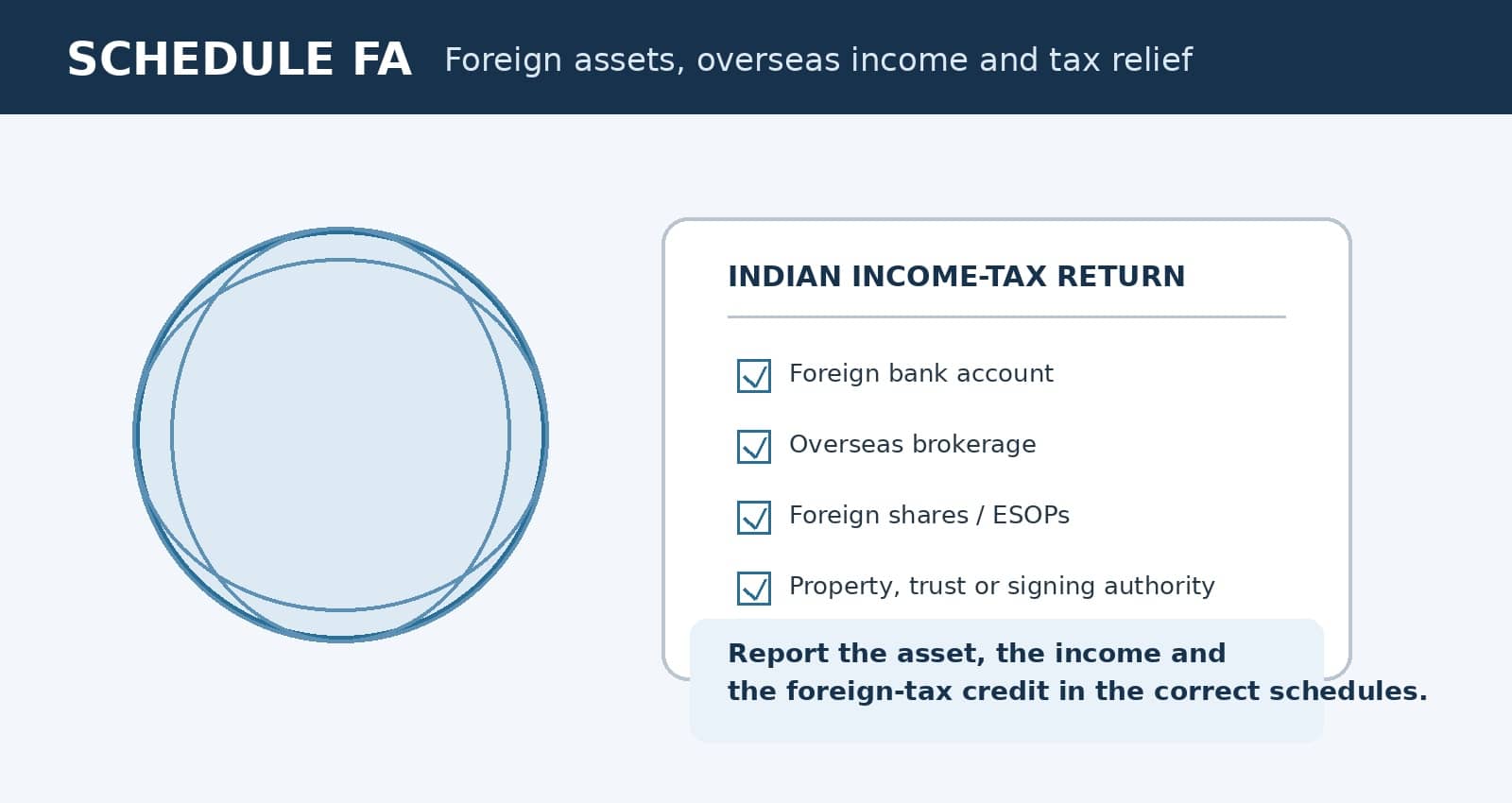
Foreign assets may require coordinated reporting in Schedule FA, Schedule FSI, Schedule TR and Form 67.
Indian residents investing in overseas shares, receiving stock-based compensation from foreign companies or maintaining bank and brokerage accounts abroad must pay close attention to Schedule FA while filing their income-tax returns. The challenge is not merely deciding whether an overseas holding must be disclosed; it is identifying every table and related schedule affected by the same asset or transaction.
The Income Tax Department’s step-by-step guide states that taxpayers with foreign assets or foreign-source income should use an ITR form containing Schedule FA. ITR-1 and ITR-4 do not contain the necessary foreign-disclosure schedules. Depending on the taxpayer’s status and sources of income, ITR-2, ITR-3 or another applicable form may therefore be required.
Three schedules that must be read together
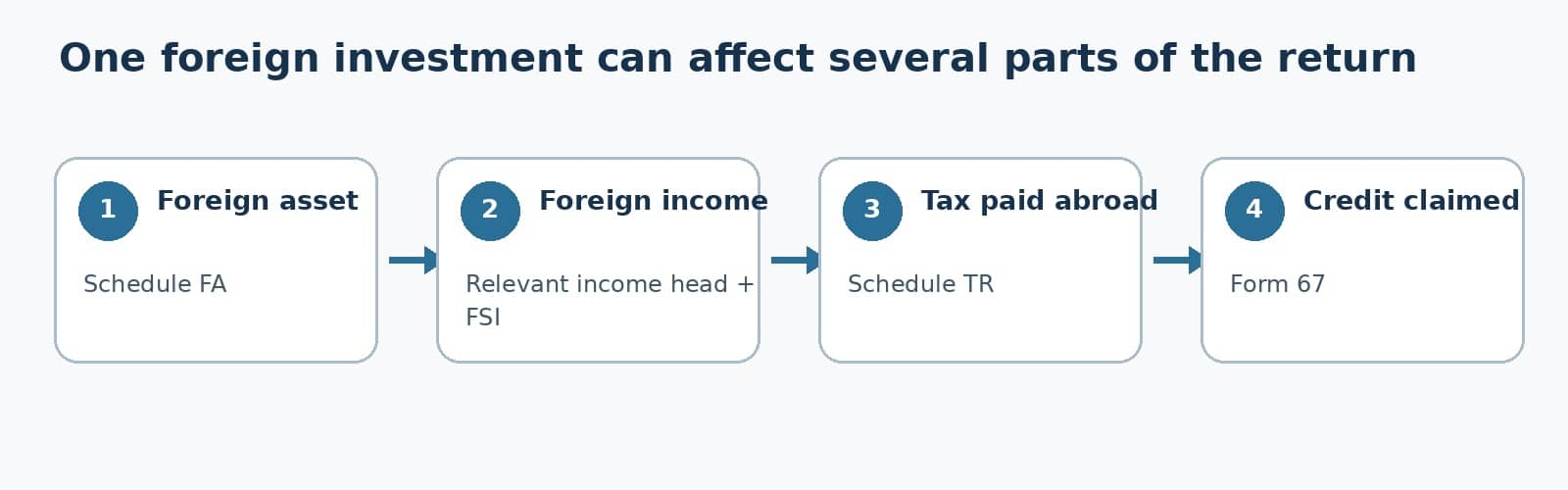
The asset disclosure, income reporting and foreign-tax-credit claim are connected but separate compliance steps.
Schedule FA records the foreign asset or account. Schedule FSI reports income that accrues or arises outside India, while Schedule TR provides a country-wise summary of foreign tax relief claimed. Where credit is claimed for tax paid overseas, Form 67 is also relevant. The same dividend, interest receipt or share sale may therefore appear in more than one part of the return, for different purposes.
Who must complete Schedule FA?
Schedule FA generally applies to a person who is resident and ordinarily resident in India and who, during the relevant reporting period, held a foreign asset or account as a legal owner, beneficial owner or beneficiary. It can also cover specified signing authority and trust relationships. The department’s guide states that the schedule need not be completed by a taxpayer classified as non-resident or not ordinarily resident.
Disclosure can remain relevant even where the foreign investment produced no income, no money was remitted to India, or the asset was sold before the reporting period ended. The compliance trigger is the foreign asset, account, interest, authority or income itself not merely whether Indian tax is ultimately payable.
The Schedule FA map
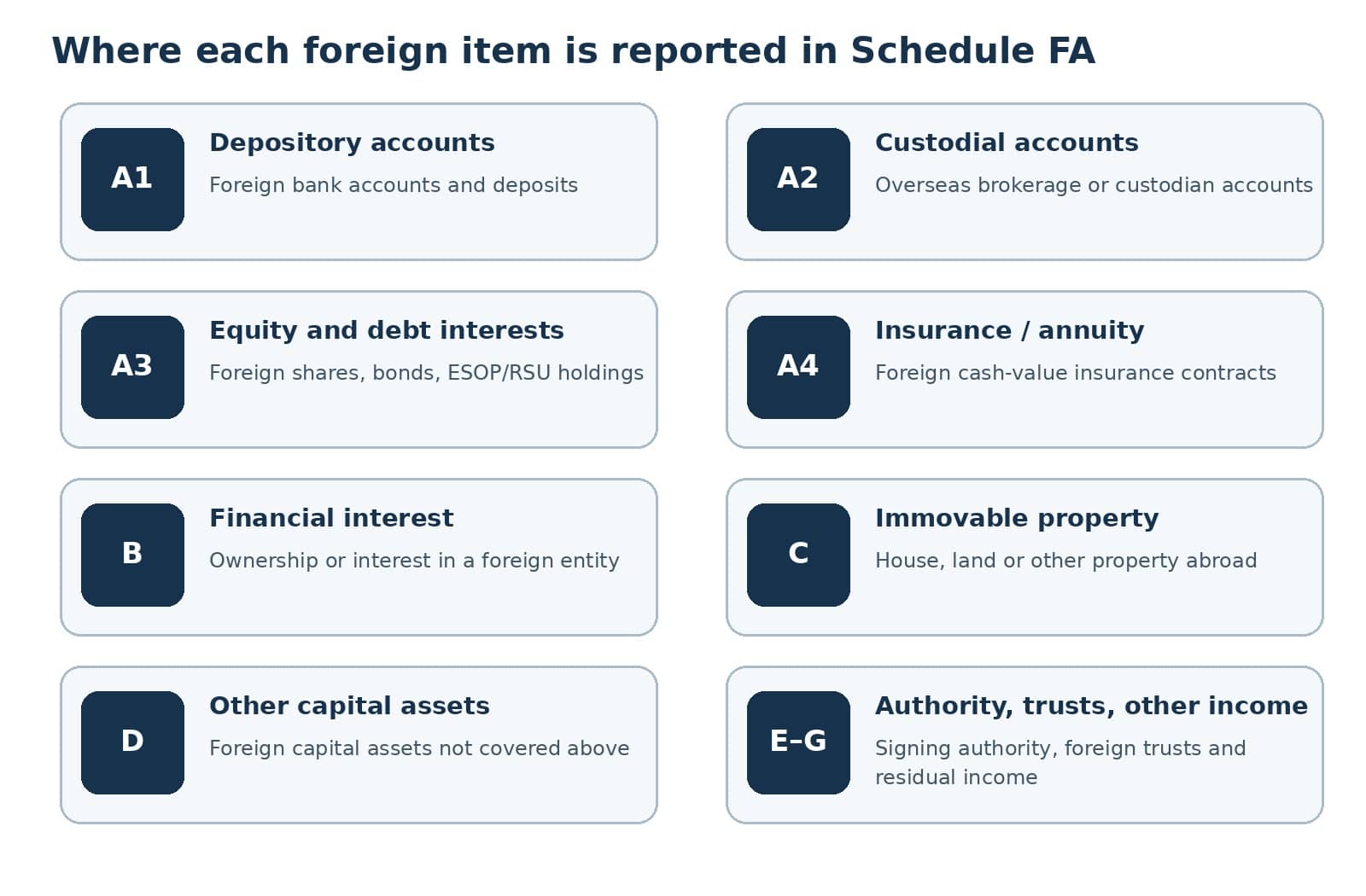
Schedule FA separates bank and custodial accounts, underlying investments, property, trusts and other foreign interests into different tables.
Foreign shares: Table A2, Table A3 or Table B?
Table A2 — foreign custodial accounts. Where securities are held through an overseas brokerage or custodian, the account itself may need disclosure in Table A2. The table seeks details such as peak balance, closing balance and gross amounts credited, including interest, dividends, sale proceeds or other income.
Table A3 — foreign equity and debt interests. The underlying shares, bonds, employee stock plan holdings or other foreign equity and debt investments are reported here. Relevant particulars can include the acquisition date, initial value, peak value, closing value, income received and gross sale or redemption proceeds.
Table B — financial interest in an entity outside India. This table has a broader ownership and interest test and can cover direct or indirect shareholding, voting power, partnership interest, trust interest or another qualifying financial interest in a foreign entity. Reporting the brokerage account in Table A2 does not automatically replace the need to report the underlying investment in Table A3 or another applicable table.
SOPs and restricted stock units also require attention
Foreign shares received through employee stock option plans, restricted stock units or employee stock purchase plans are frequently overlooked. A taxpayer may need the grant and vesting documents, the acquisition or vesting date, the fair market value used for salary taxation, the number of shares held and sold, dividends credited, the foreign brokerage or stock-plan account details, tax withheld abroad and the sale proceeds used for the capital-gain computation.
Calendar-year reporting and currency conversion
The official guide requires foreign assets or accounts held at any time during the relevant calendar year ending on December 31 to be examined for Schedule FA. Taxpayers should therefore not rely only on a March 31 portfolio statement. Monthly bank, brokerage and stock-plan statements may be needed to establish the peak balance and the correct closing value for the Schedule FA reporting period.
Peak balances, investment values and foreign-source income must be converted into Indian rupees using the prescribed telegraphic-transfer buying rate for the relevant date. The guide refers to the State Bank of India telegraphic-transfer buying rate. A single year-end exchange rate should not automatically be applied to every acquisition, peak balance, income receipt and sale transaction.
A practical compliance checklist
- Foreign bank and brokerage statements, including monthly records needed to identify peak balances
- Contract notes and sale confirmations for overseas securities
- Dividend, interest and foreign tax withholding statements
- ESOP, RSU and employee stock-plan documents
- Foreign property, insurance, annuity, trust and signing-authority records
- Exchange-rate workings and reconciliation with capital gains, Schedule FSI, Schedule TR and Form 67
Disclosure first, classification carefully
The central task in foreign-asset reporting is to ensure that the account, underlying investment, resulting income and foreign-tax credit are each reported in the correct place. Schedule FA should not be treated as an isolated form: its figures must be consistent with the capital gains schedules, the relevant income heads, Schedule FSI, Schedule TR and Form 67.
With tax authorities increasingly receiving financial-account information through international exchange arrangements, incomplete or inconsistent reporting can generate questions even when an omission was unintentional. A safer approach is to create a complete inventory of overseas accounts, investments, stock-plan holdings, property, trusts and authority relationships before beginning the return.
Published By : Deepti Verma
Published On: 24 July 2026 at 14:14 IST