Ancient Life on Mars? NASA Detects Complex Carbon in Billion-Year-Old Rocks
While the discovery does not prove ancient life existed, scientists say it strengthens the case that Mars was once capable of supporting it.
- Science News
- 3 min read

;'%3e%3cpath%20d='m8,15.99c4.41,0,7.99-3.58,7.99-7.99S12.41,0,8,0,0,3.59,0,8s3.58,7.99,7.99,7.99Z'%20style='stroke:%23fff;%20stroke-miterlimit:10;%20stroke-width:.02px;'/%3e%3cpath%20d='m3.08,3.37l3.82,5.11-3.84,4.15h.87l3.37-3.64,2.72,3.64h2.94l-4.04-5.39,3.58-3.87h-.86l-3.1,3.35-2.5-3.35h-2.94Zm1.27.64h1.35l5.97,7.99h-1.35l-5.97-7.99Z'%20style='fill:%23fff;'/%3e%3c/g%3e%3c/svg%3e)


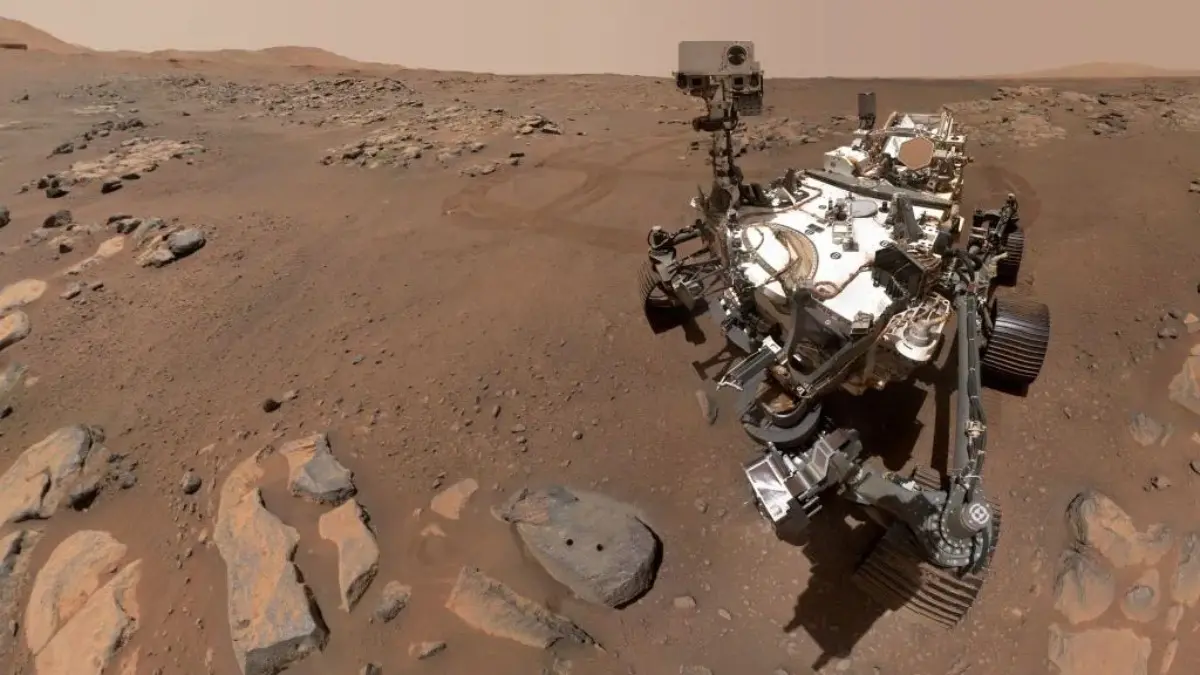
NASA's Perseverance rover has made another intriguing discovery on Mars, detecting complex carbon molecules in rocks that scientists believe could hold clues about whether the Red Planet once hosted life.
The findings come from mudstone rocks in Jezero Crater, an area believed to have once contained a lake and river delta billions of years ago. Researchers identified a form of organic material known as macromolecular carbon (MMC), one of the most complex carbon compounds ever detected on Mars. While the discovery does not prove ancient life existed, scientists say it strengthens the case that Mars was once capable of supporting it.
What Exactly Did NASA Find?
Using the SHERLOC instrument aboard Perseverance, scientists detected macromolecular carbon within rocks at the Bright Angel outcrop in Jezero Crater. Macromolecular carbon is significant because it can form from biological processes, such as the breakdown of ancient microbes. However, it can also be produced through non-biological mechanisms, including chemical reactions between rocks and water or material delivered by meteorites.
Why Scientists Are Excited
The rocks themselves have already attracted attention before. In 2024, Perseverance discovered unusual spots and mineral formations inside a rock nicknamed Cheyava Falls. Some researchers suggested the textures resembled structures associated with fossilised microbes on Earth, prompting NASA to describe it as one of the most promising locations yet in the search for ancient Martian life.
Advertisement
The latest detection of complex carbon adds another layer to that puzzle by showing that organic material is also present in the same geological environment.
Does This Mean There Was Life on Mars?
Not yet.
Advertisement
Scientists are being careful not to overstate the findings because current rover instruments cannot determine whether the detected carbon originated from biological or geological processes. "This does not amount to proof of past Martian life," researchers emphasised, noting that similar carbon compounds can be produced without living organisms.
Instead, the discovery highlights another promising sample that scientists would like to analyse in laboratories on Earth, where far more sophisticated instruments are available.
The Biggest Problem
Ironically, Perseverance has already collected many of the samples researchers want to study. The challenge is bringing them home.
NASA's original Mars Sample Return mission was cancelled earlier this year after costs spiralled. The agency is now working on a revised plan that could return the samples sometime in the 2030s. Until then, scientists can only analyse the rocks using the instruments carried by the rover itself.
Why This Matters
The discovery also suggests that organic materials may have been widespread across ancient Mars.
Researchers note that similar organic-bearing mudstones have now been identified thousands of kilometres apart by both Perseverance and Curiosity, strengthening the idea that habitable environments may once have existed across large parts of the planet.
For now, the latest findings move Mars one step higher on the list of places that might once have supported life. They do not answer the biggest question, but they do make it harder to dismiss.