
Artemis II’s Final Test: What Today’s Splashdown Means For Future Moon Missions
NASA’s next step is Artemis III, which aims to land humans on the Moon for the first time since Apollo. But that mission depends heavily on what happens during Artemis II.
- Science News
- 3 min read

;'%3e%3cpath%20d='m8,15.99c4.41,0,7.99-3.58,7.99-7.99S12.41,0,8,0,0,3.59,0,8s3.58,7.99,7.99,7.99Z'%20style='stroke:%23fff;%20stroke-miterlimit:10;%20stroke-width:.02px;'/%3e%3cpath%20d='m3.08,3.37l3.82,5.11-3.84,4.15h.87l3.37-3.64,2.72,3.64h2.94l-4.04-5.39,3.58-3.87h-.86l-3.1,3.35-2.5-3.35h-2.94Zm1.27.64h1.35l5.97,7.99h-1.35l-5.97-7.99Z'%20style='fill:%23fff;'/%3e%3c/g%3e%3c/svg%3e)


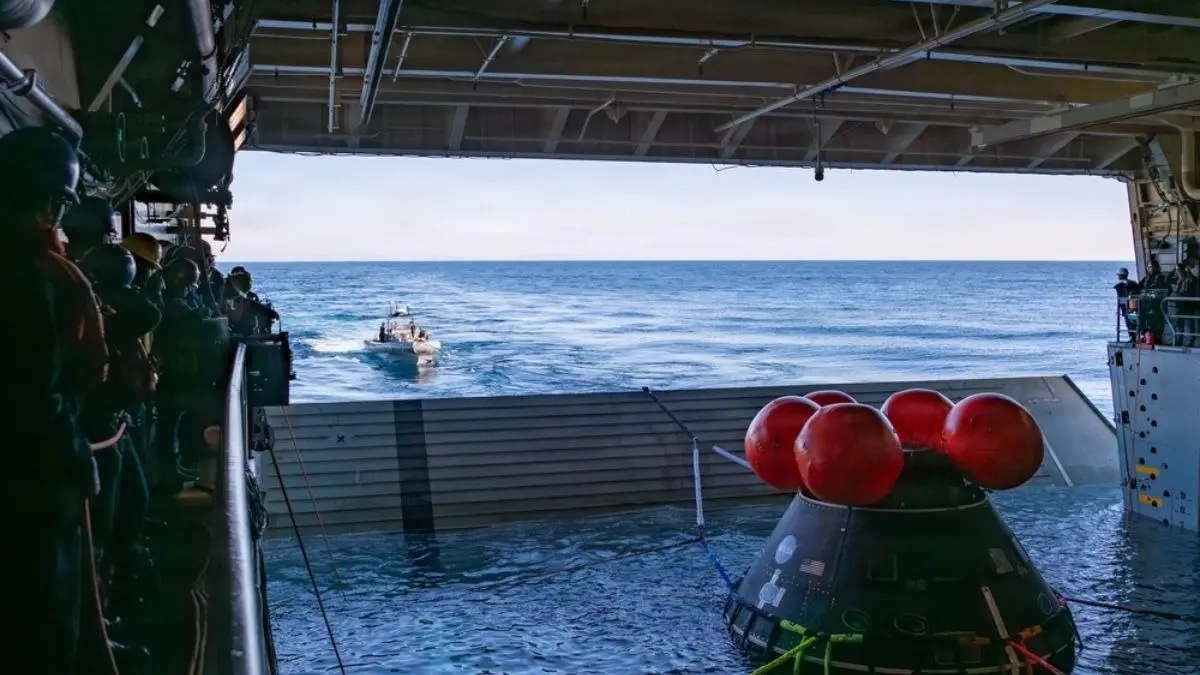
NASA’s Artemis II mission is about to reach its most critical moment. Not launch, not lunar flyby, but the return. The crewed mission, which sent four astronauts around the Moon for the first time in over 50 years, is now preparing for splashdown in the Pacific Ocean after making history for mankind.
And this final phase, the splashdown, may decide more than just a safe landing. It could determine how quickly humans return to the Moon.
A Mission Designed as a Test, Not a Destination
Artemis II is not a Moon landing mission. It never was. Instead, it is a full-system test of NASA’s Space Launch System (SLS) rocket and the Orion spacecraft with humans onboard. The goal is simple: prove that everything works in deep space conditions before attempting a landing mission.
The mission lasts about 10 days, sending astronauts on a loop around the Moon and back using a free-return trajectory. That means if something goes wrong, gravity brings them back to Earth. It’s elegant, but also unforgiving.
Advertisement
Why Splashdown Matters More Than the Journey
The spacecraft has already done the hard part. It reached lunar distance, orbited the Moon, and began its return. Now comes re-entry.
The Orion capsule will hit Earth’s atmosphere at speeds of around 25,000 mph, facing extreme heat and pressure before deploying parachutes for a controlled ocean landing.
Advertisement
This is where things can fail. Heat shields, navigation accuracy, parachute deployment, crew safety systems. Everything is tested in minutes.
If this phase works flawlessly, it validates the spacecraft for future missions. If not, it delays everything.
Setting the Stage for Artemis III
NASA’s next step is Artemis III, which aims to land humans on the Moon for the first time since Apollo. But that mission depends heavily on what happens during Artemis II.
The data collected during re-entry and splashdown will inform changes to spacecraft design, safety protocols, and mission planning. Even minor anomalies could lead to redesigns or delays.
In other words, Artemis II is the gatekeeper.
More Than Just a Safe Landing
Beyond engineering, Artemis II is also testing the human side of deep space travel. The crew has spent days in microgravity, travelled farther than most humans in history, and operated systems in isolation.
How they respond during re-entry, both physically and mentally, will shape how future missions are planned. Because getting to the Moon is one problem. Bringing people back safely, repeatedly, is another.
A Defining Moment for NASA’s Moon Plans
NASA’s Artemis programme is designed to establish a long-term human presence on the Moon and eventually prepare for missions to Mars. But all of that depends on reliability.
Tomorrow’s splashdown is not just the end of Artemis II. It is a validation test for everything that comes next. If it goes as planned, it clears a major hurdle toward putting humans back on the lunar surface.
If it doesn’t, the timeline shifts.
Either way, the answer arrives when Orion hits the Pacific Ocean off the coast of San Diego, California, on Friday, April 10, 2026, at approximately 8:07 pm ET (5:37 am IST).
