
Galileo Galilei observed ‘Neptune’ on this day in 1612, had mistaken it for a 'star'
Italian astronomer Galileo Galilei drew Neptune twice in his notebook as he discovered the planet through the telescope when it was in conjunction with Jupiter.
- Science News
- 3 min read

;'%3e%3cpath%20d='m8,15.99c4.41,0,7.99-3.58,7.99-7.99S12.41,0,8,0,0,3.59,0,8s3.58,7.99,7.99,7.99Z'%20style='stroke:%23fff;%20stroke-miterlimit:10;%20stroke-width:.02px;'/%3e%3cpath%20d='m3.08,3.37l3.82,5.11-3.84,4.15h.87l3.37-3.64,2.72,3.64h2.94l-4.04-5.39,3.58-3.87h-.86l-3.1,3.35-2.5-3.35h-2.94Zm1.27.64h1.35l5.97,7.99h-1.35l-5.97-7.99Z'%20style='fill:%23fff;'/%3e%3c/g%3e%3c/svg%3e)


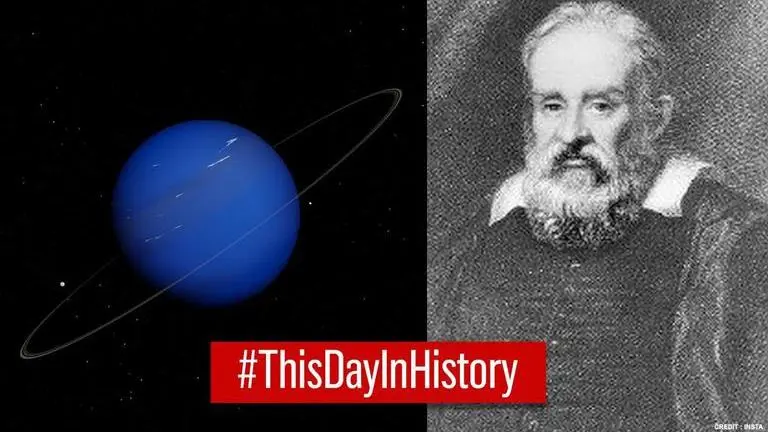
On this day in 1612, more than two centuries before planet Neptune had been officially declared a planet, Italian astronomer Galileo Galilei discovered the blue planet but mistook it as a 'star', according to the University of Melbourne physicist David Jamieson. According to the scientific evidence cited in the historical archives, the Italian astronomer Galileo drew the planet Neptune twice in his notebook as he discovered the planet through the telescope when it was in conjunction with Jupiter in early 1612. However, the planet was later 'officially' discovered in 1846 by Johann Gottfried Galle who carried out extensive observation using the mathematical calculations of researchers Urbain Le Verrier and John Couch Adams and declared Galileo’s ‘star’ as a planet in a new British-French-German discovery.
#onthisday 1612 Galileo Galilei observed Neptune but catalogued it as a fixed star rather than a planet 🔵 This 19th century orrery showing Neptune is on show in our exhibition, The Sun 🌕 Find out about these amazing models in @Circa1350BC's blog: https://t.co/HOeARN9LfT 🌕🌕 pic.twitter.com/nFHKYVPBh7
— Science and Industry Museum (@sim_manchester) December 28, 2019
Galileo had mistaken the planet for the star due to its ‘slow movement’, notwithstanding that it was because of the planet’s farther distance from the earth, revolving in the 9th orbit of the solar system. Scientists recreated historic observations like Galileo using Starry Night software and later found that the astronomer had indeed discovered the Neptune in the 1600s, according to a report published by SPACE journal. Furthermore, a sketch in Galileo’s notebook from Dec. 27 or 28, 1612 indicated that he saw Jupiter with its moons Ganymede and Callisto on the right and Neptune on the left of the largest planet of the solar system. However, he labelled the blue planet as a background “star”.
#Onthisday in 1612, Galileo Galilei observed the planet Neptune, though he originally thought it was a fixed star. Later in January 1613, he observed that this ‘star’ had moved, proving it was the planet which we now know as Neptune.
— Science Museum (@sciencemuseum) December 28, 2017
Image taken by @NASA's Voyager 2 in 1989 pic.twitter.com/SYlXGyQzqK
In a separate sketch that Galileo drew while observing the two planet’s conjunction on January 3 or 4, 1613, the Neptune had moved to the south of Jupiter while the planet’s 4 moons had fixated to the left. Once again as Galileo drew the sketch of the two planets, he had detected the motion of Neptune but called it a star as his early, primitive telescope provided the planet’s view extremely small in size which provided only 30 times magnification. Later that September, the ‘Father of Modern Astronomy’ discovered the phases of the planet, Venus.
Advertisement

[Galileo's sketch after observing Neptune as a 'star' in the sky. Credit: Twitter/@Libroantiguo]
Advertisement
#OnThisDay 28 Dec 1612: Galileo is 1st astronomer to observe Neptune. "Conserving Galileo":https://t.co/otCHNfj6K2 pic.twitter.com/XKhDxfkDGc
— Royal Observatory Greenwich (@ROGAstronomers) December 28, 2015
Officially discovered in 1846
Several astronomers in subsequent years checked on Galileo’s ‘fixed star’, and its “point” near conjunction with Jupiter, English astronomer and mathematician John Couch Adams found the orbit and the calculation of the orbit of the ‘said star’ problematic. With further assistance from the French astronomer Urbain Le Verrier and British Astronomer Royal George Airey, Adams searched for Galileo’s star across the sky to no avail. But the German astronomer Johann Galle who later launched a hunt via Berlin Observatory’s telescope ultimately discovered the planet and documented the planet as the 'Neptune'.
On this day in 1611 - Polish astronomer Johannes Hevelius is born however also died on his birthday 76 yrs later. Also otd in 1613 Galileo Galilei observes Neptune 233 years before its discovery after incorrectly mistaking it as a fixed star. #otd #astronomy #OnThisDay #HamOnt
— HAA (@HAATweet) January 28, 2019
Today is DEC 27. On the night of DEC 27-28, 1612, #Galileo Galilei observed Jupiter's moons, and in the process discovered the planet #Neptune ! Only that he thought it to be a background star. The planet was officially discovered only in 1846. pic.twitter.com/55uKp6SqXD
— Mario Livio (@Mario_Livio) December 27, 2019