Your Next Job Interview Could Be With an AI Bot. Here's How to Prepare for It
Recruiters have been using AI-powered hiring tools for years to assess job applicants, and their use has been expanding in step with technology advances.
- Tech News
- 6 min read

;'%3e%3cpath%20d='m8,15.99c4.41,0,7.99-3.58,7.99-7.99S12.41,0,8,0,0,3.59,0,8s3.58,7.99,7.99,7.99Z'%20style='stroke:%23fff;%20stroke-miterlimit:10;%20stroke-width:.02px;'/%3e%3cpath%20d='m3.08,3.37l3.82,5.11-3.84,4.15h.87l3.37-3.64,2.72,3.64h2.94l-4.04-5.39,3.58-3.87h-.86l-3.1,3.35-2.5-3.35h-2.94Zm1.27.64h1.35l5.97,7.99h-1.35l-5.97-7.99Z'%20style='fill:%23fff;'/%3e%3c/g%3e%3c/svg%3e)


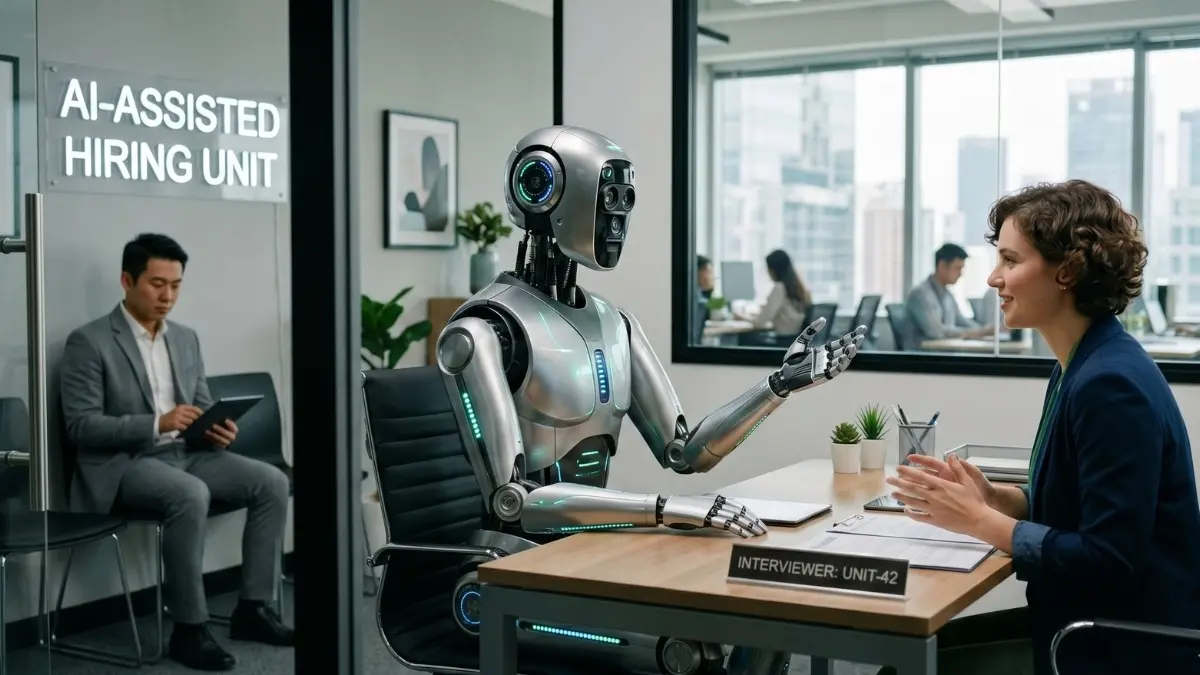
Have you applied for a new job? If you've been shortlisted, get ready to be interviewed by artificial intelligence.
Deluged by a flood of AI-generated job applications from easy-apply job boards, recruiters are turning to AI to cope. Companies are using chatbots to interview candidates, typically at the screening stage, through phone calls, text messaging or video chats with on-screen avatars.
Recruiters have been using AI-powered hiring tools for years to assess job applicants, and their use has been expanding in step with technology advances.
Many people find AI job interviews unsettling, though the trend seems here to stay. According to recent research by hiring platform Glasshouse, more jobseekers are reporting they’ve faced AI job interviews. But many applicants have walked away from the hiring process because of it, which could be a sign that they're either creeped out, or they could be fraudulent or “low-intent,” depending on who you ask.
Advertisement
Here's what to expect from an AI job interview and how to do your best:
Do your homework
Whatever the interview format, the fundamentals still apply, said Amanda Augustine, a career coach at Careerminds, which helps companies support laid-off workers with resume writing and job search services.
Advertisement
Ahead of the interview, review the job description, research the organization, and understand what it's looking for.
“The more prepared you are, the easier it will be to tailor your responses, even when you’re interacting with AI instead of a person,” she advised.
Get used to the format
If you've never done an AI job interview before, the first time could be unnerving or unsettling.
I did a demo AI interview set up by Netherlands-based TestGorilla, one of numerous platforms providing recruitment tools for companies. First came two sets of questions, one that tested problem-solving skills and another gauging work experience. Then I faced an AI-generated female face.
“My goal is to learn more about you and the experiences, skills and competencies that you might bring to this role," it said, adding that I should plan to spend about two minutes to answer each of three questions.
Unlike a human interview, there was no warm-up chit-chat, no chance to build a rapport. There was no point in smiling or trying to break the ice.
Experts say the best way to get over that is preparation.
“You need to practice out loud,” said Priya Rathod, workplace trends editor at online job board Indeed. “And when I say practice out loud, I mean, say the actual answers out loud,” because the chatbot needs to record what you're saying, she said.
Also keep in mind you're providing information about yourself to a machine, not having a conversation.
“You have to be particularly descriptive and a very clear communicator in your language so that they can pick up on things that a regular interviewer might pick up through your facial expressions and tone," Rathod said.
An AI interviewer “cares less about my tone and more about what it is that I’m saying," she added.
Use an online interview simulator to prep — there are many available. They can record your answers and provide instant feedback on your content, delivery or pacing. They'll also help you get used to speaking into a camera, manage time limits and give your answers in a structured way without the natural back-and-forth of a live conversation, Augustine said.
Get ready for behavioral questions
For my demo interview, the AI grilled me for a communications professional role.
One question it asked was how I use AI in my "workflow,” including examples of both success and failure. When I replied that I saved lots of time with an AI transcription tool for interviews and other recordings, it summarized my answer and then asked me if I wanted to add anything else. I wasn't sure whether I had answered satisfactorily.
I scored “below average” on this question, according to TestGorilla's assessment, which said I provided “no concrete metric” such as minutes saved. “The improvement claim is therefore vague,” it said.
AI interviewers are asking these “behavioral questions" because they want candidates to provide examples of how they handled specific work situations, complete with numbers and metrics, Rathod said.
“Those are the kinds of questions that AI relies heavily on. And the trap that we see a lot of people falling into is giving really vague answers,” she said.
Candidates should still rely on tried and tested tactics like the STAR method — short for situation, task, action, result.
So be prepared to talk about a specific work situation and the task assigned to you, the action that you took, and the result, Rathod said.
“You want to use numbers as much as possible. Even if you’re not in a revenue driving role, there are ways in which you can say (how) you influenced something or impacted something within a group,” she said.
Setup still matters
Don't neglect the physical setup of your desk and computer — it's still important even if the video-based interview is with AI, and not a person.
Test your audio and video in advance. Make sure the lighting is bright enough and is on your face. Raise your laptop to eye level so that you're not looking down at the camera.
“Small adjustments, such as using a stack of books or a ring light, can make a noticeable difference in how polished and professional you present,” Augustine said.
Don't be tempted to use AI shortcuts
Jobseekers might be tempted to use AI to help come up with answers. After all, they're so easy to use and if you're not talking to a human, no one will be able to tell, right?
"That’s a big no-no because it’s pretty obvious" to both the AI interviewing tool and anyone who might review the recording, said Rathod. Using AI for your answers “can sometimes immediately disqualify you.”
If you're having difficulty answering, you can always ask it to clarify or repeat the question.
The question might even be designed to figure out if you're using AI to cheat. TestGorilla's head of marketing, Mehak Chowdhary, said it sometimes poses simple questions worded in a very convoluted way.
“We do that intentionally to understand whether you are running an AI alongside, because the AI will then try and optimize for the length of the question,” she said. "But if you know your skill set, you will understand what’s being asked.
“And we strongly recommend candidates put the AI devices aside. This is a test of your capability.”