
Updated 21 December 2022 at 16:22 IST
Europe's second Vega C mission fails as rocket malfunctions after launch
The second mission of Europe’s Vega C space rocket came to an unexpected end due to a malfunction shortly after its launch from the Guiana Space Centre.
- World News
- 2 min read

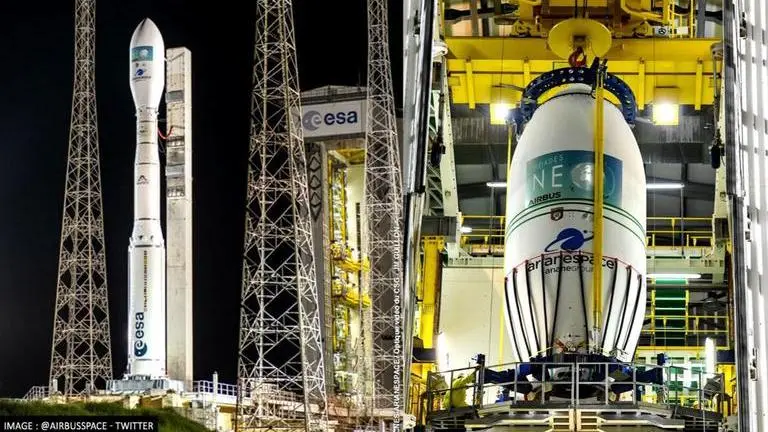
The second mission of Europe’s Vega C space rocket came to an unexpected end due to a malfunction shortly after its launch from the Guiana Space Centre in Europe on Tuesday evening, according to Space.com. While the rocket’s first stage, known as the P120C, was successfully conducted, the second stage of Zefiro 40 experienced what operators called an “anomaly.”
"Approximately 2 minutes and 27 seconds after liftoff an anomaly occurred on the Zefiro 40, thus ending the Vega C mission. Data analyses are in progress to determine the reasons of this failure," said representatives of Arianespace, a France-based launch provider that operates the Vega C.
The medium-lift Vega C was also carrying two Airbus satellites, which are now lost in space. The satellites were headed for the sun-synchronous orbit and were meant for the Pléiades Neo Earth-imaging constellation. They weighed 4,359 pounds collectively.
In a mission description of the constellation, Arianespace said that it was “made of four identical satellites, built using the latest Airbus innovations and technological developments, and allows to image any point of the globe, several times per day, at 30-centimeter [12 inches] resolution.”
Advertisement
All you need to know about Vega C and the lost satellites
Furthermore, they had the ability to send snapshots to Earth within an hour, and are "smaller, lighter, more agile, accurate and reactive” than their competitors. On the other hand, the Vega C rocket was constructed by the European Space Agency, with its operations being handled by Arianespace. Standing 115 feet tall, the four-stage rocket is a higher version of its original Vega, which launched off in 2012.
The Vega C, which possesses the capacity to haul about 2,300 kilograms of payload to a 700 km orbit, was initially scheduled for launch on November 24 this year but was delayed due to faulty equipment which was then replaced at a facility in Kourou, French Guiana.
Advertisement
Published By : Deeksha Sharma
Published On: 21 December 2022 at 16:22 IST