
Indian Army confirms 4th Corps-Commander talks in line with consensus; 'process intricate'
Issuing a statement two days after the 14.5 hours long Commander-Corps level talks, Indian Army said that India & China are committed to disengagement process
- India News
- 3 min read

;'%3e%3cpath%20d='m8,15.99c4.41,0,7.99-3.58,7.99-7.99S12.41,0,8,0,0,3.59,0,8s3.58,7.99,7.99,7.99Z'%20style='stroke:%23fff;%20stroke-miterlimit:10;%20stroke-width:.02px;'/%3e%3cpath%20d='m3.08,3.37l3.82,5.11-3.84,4.15h.87l3.37-3.64,2.72,3.64h2.94l-4.04-5.39,3.58-3.87h-.86l-3.1,3.35-2.5-3.35h-2.94Zm1.27.64h1.35l5.97,7.99h-1.35l-5.97-7.99Z'%20style='fill:%23fff;'/%3e%3c/g%3e%3c/svg%3e)


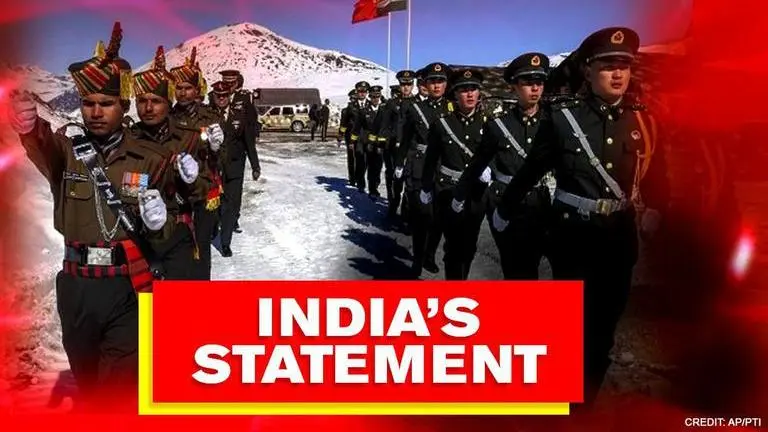
Issuing a statement two days after the 14.5-hours long Commander Corps level talks between India and China, the Indian Army on Thursday said that the two nations have been engaged in discussions through established military and diplomatic channels to address the prevailing situation along the LAC. Speaking on the situation in Ladakh along the LAC, the Indian Army stated that the engagement was consistent with the consensus reached between the Special Representatives of India and China earlier on July, 5 wherein complete disengagement was discussed.
Indian Army Statement on the Ladakh Situation:
"India and China have been engaged in discussions through established military and diplomatic channels to address the prevailing situation along the LAC.
Commanders from PLA & Indian Army held a meeting at Chushul, on Indian side, for the fourth round of talks, on 14 July 2020.
The engagement was consistent with the consensus reached between the Special Representatives of India and China earlier, on 05 July, to discuss complete disengagement.
Advertisement
The Senior Commanders reviewed the progress on implementation of the first phase of disengagement and discussed further steps to ensure complete disengagement.
The two sides remain committed to the objective of complete disengagement. This process is intricate and requires constant verification. They are taking it forward through regular meetings at diplomatic and military level."
Advertisement
The statement added that the senior Commanders reviewed the progress on implementation of the first phase of disengagement and discussed further steps to ensure complete disengagement. India and China are committed to the objective of complete disengagement and the process is intricate and requires constant verification, Indian Army's statement added.
China's statement
Earlier in the day, Chinese spokesperson Hua Chunying said that both countries have achieved progress in further disengagement between border troops. Speaking about the talks, she said that India and China are building on the common understanding reached at the previous three rounds of commander-level talks and corresponding implementation work accordingly. Chinese Foreign Ministry also said that it hopes that India will work with China to implement consensus with concrete actions and jointly safeguard peace and tranquility in border areas.
READ | Coronavirus Live Updates
Fourth military-level talks
The fourth military-level talks took place at Chushul in Eastern Ladakh. After the violent Galwan valley clash in which 20 Indian soldiers were martyred and the Chinese side also suffered casualties. As per sources, the talks on Wednesday included a discussion on Pangong lake. Meanwhile, Defence Minister Rajnath Singh will visit Leh, Ladakh, and forward locations of Line of Actual Control (LAC) as well as Line of Control (LoC) on July 17-18, sources confirmed on Wednesday.
India-China diplomatic talks reaffirm disengagement
Apart from military-level talks, India and China have issued statements reaffirming both countries' agreement to 'ensure complete disengagement of the troops along the Line of Actual Control (LAC)'. Both countries have agreed to the same as troops deployed along LAC were very close to each other. More talks between diplomatic and military officials under the existing framework were also agreed upon.
China pulls back
On July 6, the Chinese Army removed tents from Patrol point 14 -- the place where the Galwan Valley faceoff took place and moved back by 1 km. Moreover, sources said that the rearward movement of vehicles of Chinese troops was seen in the general area of Galwan and Gogra Hot Springs. India has demanded a return to the status quo in April, asking the Chinese to remove the additional buildup done in the Galwan and Pangong Tso areas.