Nothing CEO Carl Pei Warns: Don't Expect Heavy Smartphone Discounts This Sale Season. Here's Why
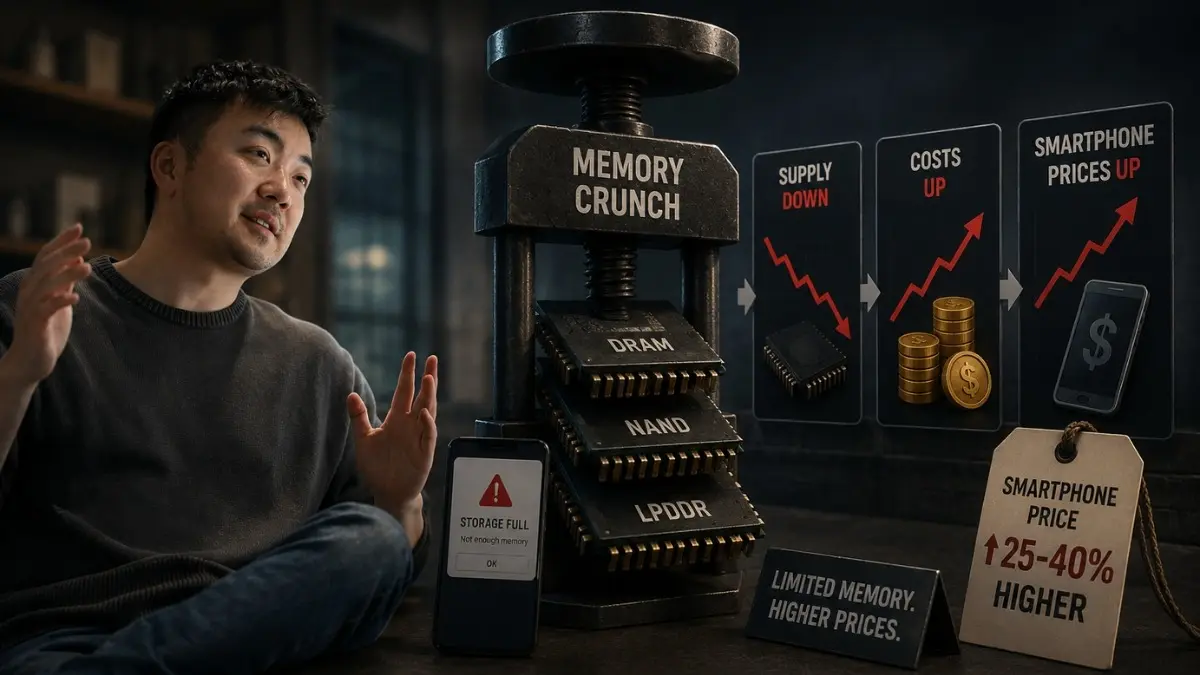
"Memory is now the most expensive component in a smartphone," Pei noted, adding that it costs more than both the processor and the display.
- Tech News
- 3 min read

;'%3e%3cpath%20d='m8,15.99c4.41,0,7.99-3.58,7.99-7.99S12.41,0,8,0,0,3.59,0,8s3.58,7.99,7.99,7.99Z'%20style='stroke:%23fff;%20stroke-miterlimit:10;%20stroke-width:.02px;'/%3e%3cpath%20d='m3.08,3.37l3.82,5.11-3.84,4.15h.87l3.37-3.64,2.72,3.64h2.94l-4.04-5.39,3.58-3.87h-.86l-3.1,3.35-2.5-3.35h-2.94Zm1.27.64h1.35l5.97,7.99h-1.35l-5.97-7.99Z'%20style='fill:%23fff;'/%3e%3c/g%3e%3c/svg%3e)


If you're planning to wait for the festive sale season in the hope of grabbing a smartphone at a massive discount, Nothing CEO Carl Pei has a message: don't count on it.
In a recent post, Pei said memory has now become the single most expensive component inside a smartphone, overtaking both the processor and the display. The shift, he argues, is changing the economics of smartphone manufacturing and making deep discounts increasingly difficult to offer.
For years, flash sales and festive events have conditioned buyers to expect aggressive price cuts across price segments. But rising component costs, particularly for memory, could force brands to rethink that strategy.
"Memory is now the most expensive component in a smartphone," Pei noted, adding that it costs more than both the processor and the display.
Advertisement
Why Memory Costs Matter
RAM and storage account for a significant portion of a smartphone's bill of materials, particularly as manufacturers continue to push higher capacities to support AI features, larger apps, and increasingly demanding workloads.
Unlike software costs, hardware component prices have a direct impact on manufacturing costs, leaving brands with less room to slash prices without affecting margins.
Advertisement
The situation is particularly relevant for phones in the mid-range and premium segments, where 12GB or 16GB of RAM and 256GB or 512GB of storage are becoming increasingly common. Citing the increase in the bill of materials for its last flagship phone, Nothing Phone (4a), Pei said memory costs “doubled” since the phone's inception through its commercial launch.
Discounts May Not Disappear, But They Could Shrink
Pei's comments do not necessarily mean smartphones will stop receiving discounts altogether. E-commerce sales, bank offers, exchange bonuses, and retailer promotions are likely to continue. However, the era of dramatic price cuts on newly launched devices could become harder to sustain if component costs remain elevated.
The trend may also encourage manufacturers to focus more on bundled offers, financing schemes, and exchange programmes instead of straightforward reductions in retail prices.
For consumers, that means waiting for a sale may not always deliver the bargains they have come to expect. And if component prices continue to climb, brands across the industry, not just Nothing, may have little choice but to pass at least some of those costs on to buyers.