Why the UK Is Regulating Microsoft, Google, AWS and Oracle for Finance, and Why India Could Be Watching Closely
Britain's decision to place the world's biggest cloud providers under direct financial regulation highlights a growing concern that could eventually shape India's own digital finance rules.

;'%3e%3cpath%20d='m8,15.99c4.41,0,7.99-3.58,7.99-7.99S12.41,0,8,0,0,3.59,0,8s3.58,7.99,7.99,7.99Z'%20style='stroke:%23fff;%20stroke-miterlimit:10;%20stroke-width:.02px;'/%3e%3cpath%20d='m3.08,3.37l3.82,5.11-3.84,4.15h.87l3.37-3.64,2.72,3.64h2.94l-4.04-5.39,3.58-3.87h-.86l-3.1,3.35-2.5-3.35h-2.94Zm1.27.64h1.35l5.97,7.99h-1.35l-5.97-7.99Z'%20style='fill:%23fff;'/%3e%3c/g%3e%3c/svg%3e)


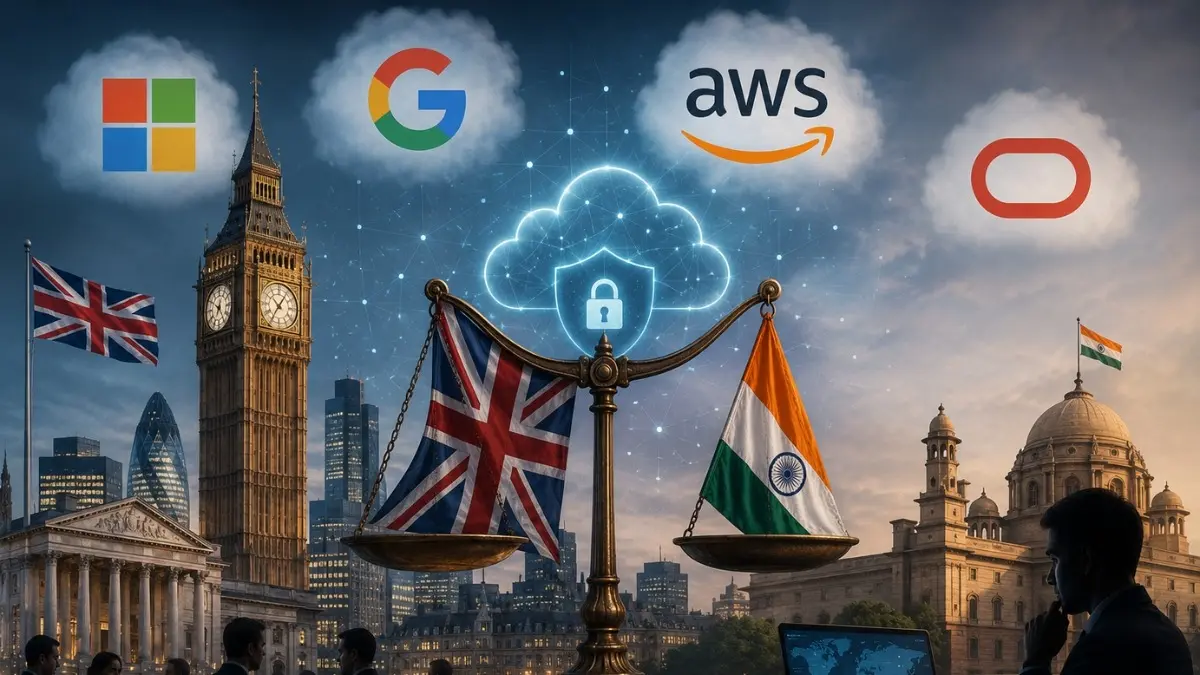
The UK government has designated Microsoft, Google Cloud, Amazon Web Services (AWS) and Oracle as "critical third-party" providers to the country's financial sector, bringing them under direct regulatory oversight for the first time.
The move reflects a growing global concern that banks, insurers and payment systems have become so dependent on a handful of cloud companies that a major cyberattack or technical outage could disrupt essential financial services for millions of customers.
Under the new framework, the cloud providers will be jointly supervised by the Bank of England, the Prudential Regulation Authority and the Financial Conduct Authority. They will be required to undergo resilience testing, regularly assess operational risks and report major incidents.
Why Cloud Companies Are Being Regulated
Banks today no longer run most of their critical systems entirely from their own data centres. Instead, they increasingly rely on cloud platforms operated by companies such as Microsoft Azure, Google Cloud and AWS for everything from customer databases and payment processing to fraud detection and AI workloads.
Advertisement
If one of these platforms experiences a prolonged outage or suffers a successful cyberattack, multiple banks could be affected simultaneously. Rather than regulating only banks, the UK has now decided that the cloud providers themselves should be held accountable for maintaining the resilience of the financial system.
Why This Matters for India
The UK's decision could have implications well beyond Europe, particularly for countries such as India where digital financial infrastructure has expanded rapidly over the past decade.
Advertisement
Major Indian banks, fintech firms, stock exchanges, insurance companies and payment platforms increasingly depend on the same global cloud providers. Services including UPI, digital banking, mobile wallets and AI-powered financial tools all rely, directly or indirectly, on cloud infrastructure.
Although institutions typically use multiple cloud providers and maintain backup systems, industry experts have repeatedly warned about concentration risk, where a disruption at one major cloud platform could affect several organisations at once.
India Has Already Started Looking at Operational Risks
Indian regulators have also been paying closer attention to technology resilience. The Reserve Bank of India has strengthened its cybersecurity and IT governance requirements for regulated entities in recent years, while financial institutions are increasingly expected to maintain disaster recovery plans, conduct cyber resilience testing and reduce operational risks.
However, unlike the UK, India currently regulates financial institutions using cloud services rather than placing direct regulatory obligations on the cloud providers themselves.
Could India Follow the UK's Approach?
It is too early to say whether India will introduce a similar framework, but the UK decision is likely to be closely watched by regulators around the world.
As artificial intelligence, digital payments and cloud computing become even more deeply integrated into banking, governments are beginning to view large cloud providers as critical infrastructure rather than ordinary technology vendors.
The European Union has already adopted a similar approach under its Digital Operational Resilience Act (DORA), while the UK has now formally brought the biggest cloud companies under financial supervision.
For India, where digital payments have become central to everyday life and financial services are rapidly moving to the cloud, the question may no longer be whether cloud providers deserve greater regulatory scrutiny, but when and how such oversight should be introduced.