India's Smartphone Launch Prices Jump 69% as Brands Go Premium, Make-in-India Coverage Hits 99%
An analysis of consumer electronics launches in Q2 2026 shows smartphones and smart TVs dominating new launches, while premiumisation, AI features and multiple product variants reshape the market.
- Tech News
- 4 min read

;'%3e%3cpath%20d='m8,15.99c4.41,0,7.99-3.58,7.99-7.99S12.41,0,8,0,0,3.59,0,8s3.58,7.99,7.99,7.99Z'%20style='stroke:%23fff;%20stroke-miterlimit:10;%20stroke-width:.02px;'/%3e%3cpath%20d='m3.08,3.37l3.82,5.11-3.84,4.15h.87l3.37-3.64,2.72,3.64h2.94l-4.04-5.39,3.58-3.87h-.86l-3.1,3.35-2.5-3.35h-2.94Zm1.27.64h1.35l5.97,7.99h-1.35l-5.97-7.99Z'%20style='fill:%23fff;'/%3e%3c/g%3e%3c/svg%3e)


India's consumer electronics market saw 257 smart device launch entries during the second quarter of 2026, but the bigger story was not simply the number of products entering the market. Smartphone launch prices rose sharply, premium laptops accounted for a significant portion of new models and brands increasingly relied on multiple configurations of the same product to expand their portfolios.
According to Techarc's India Consumer Electronics Launch Analysis for Q2 2026, smart TVs led the market with 113 launch entries between April and June, followed by smartphones with 99, laptops with 38 and tablets with just seven. The report counts individual models as well as their variants, providing a broader picture of how brands are expanding their portfolios across different price and specification combinations.
Smartphone Launch Prices Jump 69%
One of the clearest trends during the quarter was the sharp increase in the average price of newly launched smartphones. The average operating price of smartphone launches reached ₹35,990 during Q2 2026, representing an increase of roughly 69% compared with the same quarter last year.
The increase marks a significant shift after two years in which smartphone launches were more heavily tilted towards the budget segment.
Advertisement
However, the higher average launch price does not necessarily mean brands have abandoned the mass market. Instead, the data indicates that more expensive devices are entering the launch mix alongside continued activity in affordable segments.
5G and High Refresh Rate Displays Become Standard
Features that were once marketed as major smartphone differentiators are now becoming nearly ubiquitous among newly launched devices. Around 87.9% of smartphones launched during Q2 2026 supported 5G connectivity, while 96% featured displays with refresh rates of 120Hz or higher.
Advertisement
More Variants, Not Necessarily More New Phones
Smartphone launch volume nearly doubled from 38 entries in Q2 2025 to 99 in Q2 2026. But the number of unique smartphone models increased at a much slower pace, from 38 to 53. The difference highlights what Techarc describes as variant fan-out, where manufacturers introduce the same smartphone in multiple RAM and storage configurations to cover more price points.
Realme demonstrated this strategy particularly clearly during the quarter. The company recorded 12 smartphone launch entries from just four unique models.
A similar trend was visible in the smart TV market, where manufacturers offered individual television series across several screen sizes, with some spanning as many as five different sizes.
Laptops and tablets, in comparison, continued to be launched predominantly as individual SKUs.
Premium Laptops Dominate New Launches
The premiumisation trend was even more pronounced in the laptop market. Nearly 44.7% of all laptops launched during the quarter were priced above ₹1.5 lakh.
The category was also highly concentrated around one manufacturer. ASUS accounted for 52.6% of all laptop launches tracked during Q2, giving it the highest level of single-brand concentration among the four consumer electronics categories covered in the report.
AI capabilities have also rapidly become mainstream in new laptops. According to the analysis, 78.9% of laptop launches during the quarter were Copilot+ certified.
Smart TVs Get Bigger
India's smart TV launch market showed another form of premiumisation, with manufacturers increasingly introducing larger displays. Televisions measuring more than 65 inches emerged as the single largest segment by launch count, accounting for 34.5% of smart TV launches during the quarter.
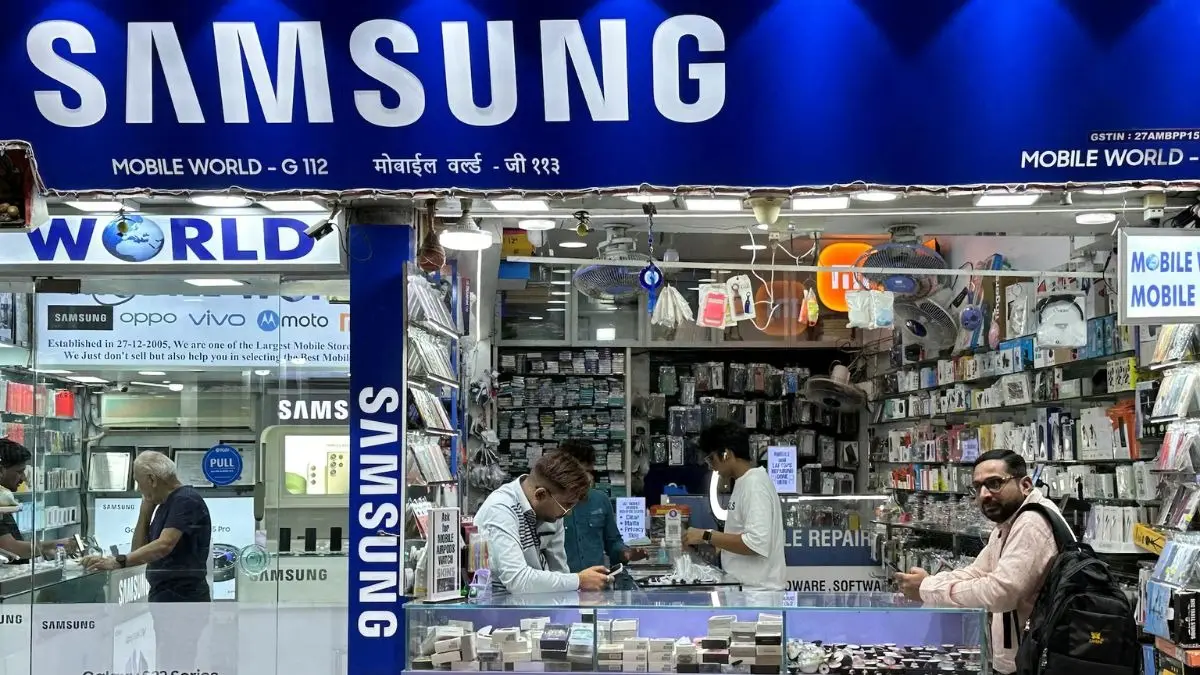
Samsung dominated the category with a 29.2% share of smart TV launches, nearly three times the share of its closest competitors.
Make-in-India Coverage Reaches 99% for Smartphones
The report also highlights the extent to which smartphone and television manufacturing has shifted towards domestic production. Make-in-India coverage stood at 99% for smartphones and 95.6% for smart TVs launched during the quarter.
Laptops remained the notable exception, with domestic manufacturing coverage of 63.2%, indicating that the category continues to depend more heavily on imported products compared with smartphones and televisions.
Tablets See a Quiet Quarter
The tablet market recorded only seven launch entries during Q2 2026, making it by far the quietest of the four categories tracked. However, Techarc cautioned against interpreting the decline as evidence of weakening consumer demand.
The research firm attributed the low launch activity primarily to seasonality, pointing out that its tracker recorded 18 tablet launches in March 2026 alone.
The seven Q2 tablet launches were distributed evenly across five brands, with OnePlus and Motorola each expanding a single product line into two configurations.
India's Electronics Market Is Changing Shape
The Q2 numbers point towards an Indian consumer electronics market increasingly defined by premium products, AI capabilities and portfolio expansion through multiple configurations rather than an explosion of entirely new devices.
Smartphones and smart TVs continue to account for the bulk of product activity, while domestic manufacturing has become nearly universal across both categories. At the same time, laptops remain comparatively dependent on imports and are seeing a strong shift towards premium, AI-capable machines.